Showing posts with label Revival. Show all posts

Tuesday, February 3, 2015

Revival #25

written by Tim Seeley
art by Mike Norton

Part of what makes Revival so credible as a social satire, a sometimes devastating critique of American dysfunction, is the plethora of motivations always in play:  petty, predictable ones, like money, that leave unprincipled mercenaries like Reviver facility guard Kyle open to bribery; bitter, vindictive ones that spur Ed Holt into revolutionary action; desperation; avoidance of public humiliation; faith; compassion; love; grief; a desire for death; shame; obligation; betrayal.  It's not particularly surprising, then, to discover that Jess Blackdeer isn't the prime force behind the Revival conspiracy.  He was instead its first victim.

Warned by his bought guard at the holding facility that his strong-arm Reviver hadn't yet returned and rounds were about to be conducted, a black-clad, gloved, reflective spectacled conspirator hunts him down at his daughter's funeral.  And he (probably he, though it's not definitive) has no difficulty in wrestling Blackdeer to the ground.  His promise: lasting death.

Meanwhile, protesters arrive at the facility, followed shortly after by the sheriff.  Aided by Jordan Borchardt's father, Ed Holt enlists the help of Jeannie Gorski and the Revival Support Group to stage a demonstration for the release of the Revivers being held there.  The sight is a grotesque with the wide- and vacant-eyed Revivers singing spirituals and crucifying Gorski just outside the gates.  And like it or not, deprived of the threat of death, the protesters don't have all that much to fear from the armed guards.  It also brings the unknown facility and quarantine practices into the view of Sheriff and Dana Cypress.  And he more than holds his own.

Unfortunately, the same discovery alienates Dana from Ramin, who as an agent of the CDC was fully aware of the facility's existence and practices, though he didn't exactly approve.  She rightfully feels betrayed, especially given her confidence in him regarding her sister.  After growing closer in the last few issues, sharing phone calls interrupted by dead toads in the washing machine and staying the night with pillowtalk and take-out, Dana pulls back.

But the most tantalizing promise Revival #25 makes is the hunt for Aaron Weimar, father to Reviver Em's baby and known (by readers) to have been killed by Blackdeer a while back.  With his involvement not yet resolved and the reemergence of Blaine Abel, it promises to be quite the search.

[November 2014]

Thursday, January 22, 2015

Revival #24

written by Tim Seeley
art by Mike Norton

While not the most graphic or the most horrific, Revival #24 may be the most quietly devastating issue of the series.  As the quarantine drags on, more and more cracks in the barricade show themselves, attracting not only the loud apocalyptic nutjobs that protested early after the dead first began to rise, but also those desperate for a miracle.  A young boy and his faithful but easily fear-struck mother, for example, who traveled to Wisconsin to bathe in one of the unexplained heavy water of a newly thawed river in the Revival quarantine.  But they're interrupted by the panicked and decaying (but revived) corpse of a stag caught in the frozen river.  The desperate mother interprets it as the twisted answer to her hubristic prayer, an emissary of Satan instead of Jesus.  Faith cannot make things different.

Animals are reviving, or they always were.  The Sheriff's Office is besieged by a steady stream of such refugees smuggled in by Holt and his anti-government disciples, their investigations thwarted by the mayor's insistence that they keep it all quiet and ship them out quickly, and the continued stress of having fewer and fewer answers to the science of the phenomenon.  Other than being unexplained, there was nothing particularly out of the ordinary about the water's deuterium oxide content, nothing toxic or unprecedented, but the rivers seem increasingly to be at the locus of the Revival event.

Meanwhile, the Revivers themselves are becoming stranger.  She may make her decision for what she perceives to be his benefit, but Rhodey's mother—frightened by his masochistic and self-abusive behavior on his website, especially as it increases when Em leaves him—turns him over to the federal detainment facility for Revivers, many of which share a proclivity toward self-mutilation:  Jordan Borchardt, whose fascination with her own eyelids led her to cut them off, and Arlene Dittman who continues to pull out her regrowing teeth.  It's a questionable practice, dictating to others what they may or may not do with their own bodies, especially those for whom mutilation presents no permanent or mortal threat, and especially because the psychological motivation is so poorly understood and their detainment does little to alleviate that stress.  After all, we know it is not the doctors or the medication that has improved Borchardt's perspective, but her murderous non-comatose neighbor John Doe, now known to be the incinerated remains of Jesse Blackdeer.

But this issue is stolen by the mirror relationships of Em's affair with her professor Aaron Weimar and Dana's casual but increasingly intimate fling with co-worker Ibrahaim Ramin, the quiet conversations between lovers.  Whatever Weimar and Em had—and it's really difficult to find common ground with them as a reader or to see both of them as anything but selfishly naive—it's disfunctional and mostly pathetic.  They're whiny, convinced of the great romantic value of their love affair even as they see it for the extra-marital mid-life crisis that it is.  Ramin is having a crisis of faith, both in science and in God, and unlike Weimar's sneaking around on his wife, Ramin seeks the consolation and reassurance of his ex Ami, who in one two-page conversation proves herself a fine friend and former love interest.  Unlike Em and Weimar, Dana and Ramin may not know exactly what their relationship is, but it's certainly much more interesting and fun.

[October 2014]

Friday, January 16, 2015

Revival #23

written by Tim Seeley
art by Mike Norton

Is Em remembering her murder?  Bleeding in the shower of her dorms, Em seems to be recalling an episode before she was covered in the scars of a reviver.  She finds a black deer carcass by the river with a white rose near wrapping its decaying antlers, before she is then bashed from behind by a showy figure with a crowbar.

And so Anders Hine makes his final exit.  After his terrible, self-mutilating assault on the rich diners of ΩΣΟ, those willing to consume a living body for the promise of immortality and youth.  But he's a poisoned meal, having laced his flesh and blood with mercury.  It's a grotesque spectacle, one of the darkest Revival Day has inspired.  Dana and Puig certainly play their part in tracking down Hine, but his death finally comes from his own "glowing man" shadow, the "air of loneliness [and] betrayal" (Revival #23: 16) or the abandonment of a jilted lover.  These ghosts, these "passengers" belong to people.

They are, despite their frightening appearance and occasional destruction, not quite the monsters Lester Majak once thought them to be.  He is moved and horrified when his spirit hunting ritual with Don catches a frightened and wailing baby, lost and abandoned.  [It's also, perhaps, noteworthy that in the waiting Majak wields a tire iron, a close silhouette of a crowbar.]  The next morning he returns to the smoldering dreamcatcher:  "So...soo sorry.  You just wanted to live.  We all just wanted to live" (24).  But, if Em's newly glowing belly is anything to judge by, the glowing baby may not be as dead as Majak imagines.

But the most satisfying vignette of the closing arc is runaway son Cooper's conversation with way-too-drunk-to-be-driving May Tao.  Chronically overlooked by their family and peers in the Revival crisis, Cooper and Tao are able to speak frankly and openly to one another, and their understanding of one another is refreshing.  When each takes that conversation with them—Cooper embracing his mother warmly upon returning from New York, May making some kind of amends with Abel in his hospital room—it brings much needed hope to Revival Wisconsin.

[August 2014]

Monday, September 15, 2014

Revival #22

written by Tim Seeley
art by Mike Norton

Revival's "passengers" are more and more an enigma.  The baby Majak and Don snared in their dreamcatchers is a pitiful sight, but a dangerous one, one that Don insists must be "sent back".  In trying to find a host, it killed Majak's beloved dog Chuck and attempted to possess Majak himself, to force his own spirit out of his body to make room.  But the "ghost man" in New York City is, if anything, working to restore the balance of the living and the dead, killing once and for all the risen and cannibalistic dead, those who prolong their own lives by eating the flesh of the Wisconsin Revivers.

And so re-enter Anders Hine, the buffet dinner for New York's elitist dining club ΩΣΟ, the rich and self-entitled and entirely convinced of their own deserving of immortality.  Hine is clearing up loose ends:  the butcher and smuggler Koziol and reporter Fields.  But the ghost is cleaning up his loose ends, incinerating the corpses of the would-be Revivers.

Meanwhile, Em Cypress falls into a potentially sweet, definitely masochistic and destructive, and probably (if unknowingly) exploitative affair with Reviver internet sensation Road Rash.  He knows her, at least part of her, better than anyone.  He sees her scars for what they are, her demonstrations of defiance as tacit pleas to be known, and he knows how to please her and he knows how to offer.  But where Em is private, intimate, Rhodey Rasch is an exhibitionist, both by trade and temperament.  His subscription channel is the darkest of Reviver masochism, just short of self-snuff.  Though it's difficult not to respond in kind with Em, his devastation at her revulsion is heartfelt.  His bafflement at her entirely justifiable horror at his taping their sex is foolish (and criminal) but sincere.  His plea as she storms away—"I-- I'm good for you." (Revival #22: 19)—is stunned and pathetic.

But the most significant strides in the development of the central mystery actually come from Ramin and his ill-advised appointment with Rose Black Deer, a local fortune teller and palm reader who drugs him with peyote, hypnotizes him into revealing details about the Reviver facility, and turns him loose as she must.  As Ramin reports his indiscretion, an anonymous voice on the other end of the phone ominously assures, "There will be repercussions" (18).  Black Deer may not have long, but her knowledge of John Doe the first Reviver is tantalizing.

[July 2014]

Thursday, August 14, 2014

Revival #21

written by Tim Seeley
art by Mike Norton

There's a dark—but somehow satisfying—irony in Jenny Frison' reliably gorgeous cover art for Revival #21: Dana Cypress becomes the first quarantine resident to travel to New York City only to find the bustling metropolis preoccupied with nothing more than the strange events of rural Wisconsin.  Newscasts, billboards, newspapers teem with stories and images of Revivers.  Cypress has come to the cultural hub of the country to discover she'd left behind its biggest story.

The Checks' black market "meat" trade goes all the way to New York.  And for the first time, Dana and New York detective Puig see just what that means.  Eryk Koziol, owner of a meat distribution company and purveyor of Reviver flesh, is found gutted and beheaded in his own meat freezer only to sputter back to temporary life before catching fire.  It's a gruesome scene, but one that gives reluctant credence to this new brand of cannibal.

Meanwhile, the rest of the issue meanders among several plot threads, variously intriguing and disappointing.  Ramin's investigation into the mysterious John Doe, the first recorded Reviver who awoke during his own cremation, seems to be traveling in an unknown direction but vaguely toward a psychic (/hypnotist?) Rose Black Deer even as Em is having dreams of a black stag with wreathes of white roses woven into his antlers.  Lester Majak and his American Indian friend Don seeking vengeance on the "spirit" that killed Majak's loyal dog Chuck are sweetly moving, though Don's tale of Nanabozho and Kitchi-Manitou is still enigmatic.  Em and her internet sensation of an acquaintance "Road Rash" move toward becoming lovers.  Less interestingly, Edmund Holt elevates his twisted power game with Sheriff Cypress by befriending Cooper, who looks poised to run away in rebellion.  But most intriguingly, Dana finally sees Cooper's "glowing man" crawling over New York rooftops.

There's a mythology here, one that supercedes human facility, whatever Don may insist about Revival Day being an "act of man".  And that mythology may be beginning to take shape.  Revival #21, for the first time I can recall, truly commits to its dreamlike tone and potential.  No longer a supernaturally driven murder mystery or clinical investigation, this is a story about man's place in his world and among his gods.  The pacing is hitched and the plot a little cluttered, but Revival #21 elevates the scope and ambition of the series yet again in very tangible and sometimes unexpected ways.

[June 2014]

Saturday, June 14, 2014

Revival #20

written by Tim Seeley
art by Mike Norton

Dana Cypress is getting lost in the momentum and responsibility of Revival's murder mystery.  Her father Sheriff Wayne Cypress is getting mired in the scandals of his past and threatened by the anarchic bullies of the present.  And Em Cypress is being seduced by the promise of guiltless pain and resurrection.

Mayor Ken Dillisch is a coward, an increasingly despicable coward.  He's a racist politician willing to use (and perhaps sacrifice) other people as distractions for personal gain and protection.  His guilt-inspired custody of his suicidal "reviver" wife is a mere microcosm of his limitless selfishness.  Sheriff Cypress may not be the stalwart citizen he pretends to be, but Dillisch's scheme to blackmail him about the apparent DUI homicide of his wife twenty ago threatens to derail his subsequent attempts to be a good man and a responsible officer.  His imminent decision whether or not to cowtow to Dillisch's demands will undoubtedly be a revealing one.

The Sheriff might be plagued by blackmail of his spotted past and the growing insurgency led by anti-government revolutionary (and monster-movie filmmaker) Ed Holt, but it's his daughter Dana's life that's under siege.  Living in constant fear that her part in the death of the devilish Check brothers will be discovered, Dana must still perform her job as a deputy in the Revival quarantine and quietly investigate the murder of her secretly revived sister.  But it is the growing alienation of her son Cooper that is so devastating here.  Stung by his own gratuitous jealousy, Dana's deadbeat—if sometimes charming—ex deflects his own insecurities to their son, who already feels a growing distance between himself and his put-upon mother.  Much of it is Cooper's reluctant but inevitable ingress into adulthood, no doubt punctuated by the new threats of Revival Day, but Derrick's childish inveigling doesn't help.  Dana's hot-headed but reasonable response and Derek's startled reaction is a pleasure.

But Revival #20's best developments:  (1) the possibility of a reviver in New York, the unanticipated impetus for the FBI making their way to the Wisconsin quarantine and an excuse to move the series (at least temporarily) to a new setting, and (2) Lester Majak's strange and complicating description of being possessed by a "passenger".  Following Revival #14, when Em apparently kills Jordan's ghost, the nature of the white, wailing strangers was seemingly clarified.  While Majak's experience is not necessarily at odds with those revelations—since someone else's ghost would presumably not "fit" either himself or his dog Chuck—it does perhaps shift the aggressiveness of the "passengers," who may be getting more anxious about not finding their own bodies.

[May 2014]

Wednesday, May 14, 2014

Revival #19

written by Tim Seeley
art by Mike Norton

Chuck seems to have been hijacked by a "passenger".  Maybe it's just the plaintive fear in Chuck's posture and face or maybe it's the creepy thought of an inhuman voice coming from a dog, but Chuck's death—vomiting blood, not unlike Em Cypress—is heartbreaking, especially for Lester.  Then the "passenger" comes after Lester, and in the brief moments before he spews it back out, the man catches glimpses of a small nest of baby squirrels in the woods where he and Chuck were running.  The "passengers," it seems, are not exclusively human, if they ever really were.

Meanwhile, Dana Cypress's life is about to get significantly more complicated, and there was already plenty of complication to begin with.  Dana first attempts to enlist Ibrahaim in her search for Em's killer.  It doesn't start well.  Ramin is galled by her refusal to register Em as a Reviver and report her murder to the police.  Whatever frustration Ramin may feel toward the situation, he defends his loyalty to the C.D.C.  At first.  When he discovers her shredded back, helps her remove the remaining glass shards, and patches her up, he finally agrees to help her.  When her ex Derrick sees her hugging Ibrahaim on her doorstep when he and their son Cooper drop by to pick up a video game, his unwarranted—and not a little bitter—jealousy kicks in.  And May Tao, drunk and mildly threatening, knows about the Cypress sisters' involvement in the death of the Check brothers, and now the FBI has shown up in Wausau to question Dana about them.

While Dana's personal investigation and private life keep her occupied, her father Sheriff Cypress has his hands full with Ed Holt and his militia of blue-collar discontents with a plan to escape the quarantine by burying underneath it.  And Martha meets the likely incarnation of the Jackass crew should they be fortunate enough to be undead and possibly undying.

Revival #19 builds logically on the steps before, but after the previous issue's quiet release, it seems more designed to reposition the immediate conflicts than anything else.

Tuesday, March 11, 2014

Revival #18

written by Tim Seeley
art by Mike Norton

And then comes the dulling emotional letdown.  Disillusionment, I suppose.  Disillusionment and anger.  Em Cypress finds herself increasingly a pariah.  A chance encounter with Derrick on campus provides her nothing but a brush-off and a cold shoulder, perhaps—but not necessarily—more a consequence of her loneliness than his indifference.

But it is her confrontation with Aaron Weimar's wife Nithiya in the charred remnants of his office that really cuts.  Em's affair with her professor was inexcusably ill-advised, and her concern for him is rooted in her romantic affection, but it makes her worry no less legitimate and justifiable.  Nithiya's hatred for Em at knowingly sleeping with a married man is not so much unmerited as it is implicitly dismissive of Aaron's responsibility in the affair.  To blame the other woman for "[seducing] my husband with your little love poems and false innocence" (Revival #18: 14) is all too common misdirected invective that offers convenient excuses for the unfaithful husband, especially in light of Nithiya's own suggestions that Em is hardly the first.  The wife and the mistress's shared psychic kiss is more complicated, but also for Em a glimpse at Aaron's love for his wife and a final chance to feel once again rejected by her former lover.  That Em is also increasingly physically ill, waking from her sleep bleeding from her eyes and nose to vomit blood, is yet another aspect of her deterioration.

But it's young Cooper's painful, truthful realization that his mother, once the hero of his own comic books, the ever-vigilant protector, is vulnerable in this new world of the undead, and perhaps she always was.  Dana's frustration at her son's nightmares—though they are real, and Em should probably have told her by now—and her own sleeplessness, especially when compounded with the stress of the Revival and the physical pain of her injuries, make her eruption at Cooper sympathetic and her sense of failure as a parent poignant. 

Meanwhile, Revival's intrigue continues to tighten.  Dana finally begins making headway on the scarred man—the victim of a partial cremation on Revival Day—but hits another wall when she discovers he was always a John Doe.  Lester Majak's adorable pit bull Chuck disappears on a run in the woods with the "glowing men".  And local anti-government and completely unsubtle hot-heat Ed Holt persists in stirring trouble for Sheriff Cypress.  He and his followers—increasing in number the longer the quarantine remains in effect and farmers continue to feel neglected by law enforcement and government agencies—seem to be digging something up, perhaps literally, while Cypress remains on a stakeout outside Holt's home.

[March 2014]

Saturday, February 1, 2014

Revival #17

written by Tim Seeley
art by Mike Norton

There's an echo here of Revival's opening issue:  Professor Aaron Weimar—frustrated writer convinced of his own voice but ignored by everyone else, aldulterous lover of his young student Martha Cypress, and cog in the mystery of the "revivers" who somehow finds himself at the epicenter—offers an explanation to his wife, a letter and his weak poetry written to Em, his vain attempt to recapture his youth.  And it's a pale answer to Em's ode to death.  But as a swan song it is suits the somewhat pitiful man.  Weimar is easy to dislike in his selfish disregard for other people, his callous abuse of his wife's trust and his manipulation of Martha to coddle his own sense of himself.  But he's a man with regret and in owning up to that regret, he finds himself somewhat redeemed.

There's also a message about Revival itself embedded in Dana Cypress' investigation.
"'Keep the grand design in mind as you work, but don't forget that each little stitch is important.  Know where your fingers are, or be content with unexpectedly red thread.  Always work from the center out.'" (Revival #17: 21)
Seeley's storytelling is a blend of mysteries layered on one another, bleeding into one another, and slowly, steadily illuminating the corners of the rural Wisconsin community at the heart of the "revival".  The last several issues have been humming with grand-design fervor, and Dana's discovery of the Grist Mill—final resting place of Weimar's undiscovered body, home of a macabre collection of human teeth, and very center of the Revival quarantine—propels that mystery even further.  The imposing burn-scarred man, the arsonist at Weimar's office and his murderer at the mill, is similarly thrust into the spotlight.  Once suspected, now all but assured, he is a "reviver," supposedly resting in a coma at the creepy medical quarantine facility in the room beside Jordan Borchardt.  He is also, it seems, a father, perhaps the father of the mysterious baby the "passengers" wail for, perhaps a surrogate for Jordan herself, but he is known by Weimar, who it now seems knew far more than he ever let on.

Revival's mysteries are gripping, but it's Seeley's character work that sells it as a noir.  May Tao is this issue's finest development.  For most of the series so far, Tao was little more than a caricature of the ambitious journalist, nosy, pushy, and concerned with little else than a story.  After being alerted to the scent of murder by Abel, she proves a more than competent investigator.  But her research and proclamation to hidden Em have a doubleness.
"It was a simple trail!  Anyone who had been paying attention could have followed it!!  ANYONE WHO CARED!"  (9)
Certainly, this is true of the Check brothers' murders by Martha Cypress.  But, even more, it's true of the Checks' murder of their own father, a transgendered woman who sought refuge from prejudice in Los Angeles and was brutally murdered when she attempted to re-establish contact with her sons.  May's enraged compassion for Alice Check comes as a welcome surprise.  It may not resolve the moral questions of their murder, or the revivers' increased proclivity to violence, but it tempers an otherwise flat character's ambition by her prickly humanity.

[January 2014]

Monday, January 20, 2014

Revival #2

written by Tim Seeley
art by Mike Norton

After a dense but straightforward opening issue, Revival fractures into a more mosaic depiction of the "revival" crisis.  Officer Dana Cypress and her family remain the engine of the series, but the mystery behind the supernatural events begins to radiate to the rest of the Wisconsin community.

1.  The second revival of Arlene Dittman.  Martha Cypress's removal of the top of Ms. Dittman's skull with a scythe is not enough to keep her dead.  Like Em, who revived not only after her murder but also after Dittman's assault with the same scythe, the old woman was also able to heal herself.  As soon as the skull cap is replaced, Ms. Dittman begins to heal and reawakens as mad and deranged as before, teeth still regrowing from pulling them out with pliers.

2.  Mr. Abel's exorcisism.  A young, beer-drinking, motorcycle-riding demonologist arrives to save a young woman in a trailer park.  Despite spewing some rather unappetizing vomit and a few vulgar phrases in patchy Latin, Kelly Merret is little other than a hare-brained teenager hoping to capitalize on town's burgeoning paranoia to get a little attention for herself.  He's more than crude about it, but Abel sees right through her ruse.

3.  The haunting of Lester Majak and his pit bull Chuck.  Aging fitness guru and hip-hop enthusiast Lester Majak begins hearing strange sounds in the woods outside his secluded cabin.  It's strange enough to frighten his dog and unsettling enough to sound like a crying baby, perhaps even the same one the ghostly figure in Revival #1 is wailing for.

4.  The strangeness of Em Cypress.  Following her father's understandable (but professionally unacceptable) overreaction to his daughters' confrontation with Arlene Dittman, Martha sneaks into her sister's old room and steal an angel-of-death hoodie from a box in her closet.  She stalks a couple at a diner—though he later recognizes her—and picks a fight with a seemingly random patron just to get beaten to a pulp.  When Dana comes to pick up her little sister, what she sees in the rearview mirror isn't exactly Em.
Dana Cypress, to son Cooper:  "Things are still the same.  We still have to appreciate all the good stuff we have.  Our friends.  Our families.  Life isn't a video game.  Death still has consequences.  It has to.  What kind of people would we be otherwise, right?"  (Revival #2: 3-4)
As a protagonist, Officer Dana Cypress continues to impress.  She endures too much fatherly interference in her job as a police officer under him, but she's confident and stubborn enough to keep herself on the R.C.A.T. even after the situation with Martha.  Her flirtation and near-fling with C.D.C. representative Ibrahaim Ramin—unknown to her at the time—unmasks her as saucy and clever and a bit rowdy, the kind of woman who once would have owned an angel-of-death hoodie as much as the kind of woman who would have packed it away.

[August 2012]

Wednesday, December 18, 2013

Revival #16

written by Tim Seeley
art by Mike Norton

I suppose the most suitable place to begin Seeley's latest taut issue of Revival is Jenny Frison's eerie cover portrait of Em Cypress, one of her most extraordinary in an already outstanding sequence for the title.  It's a sly echo of John Everett Millais' painting of drowned Ophelia (see below), a beautiful but haunting elegy to vulnerability and mental fragility through tragedy's most famous female victim.  Em's hands are delicate and slim, her eyes glassy and dead, and her mouth soft but slack, dead leaves scattered about her like so many of Ophelia's flowers.  And, perhaps a sinister side-effect of her undead (and undying) condition, Em's volatile and prone to semi-suicidal self-cruelty.  It's also an equally sly anticipation of the issue's final splash, an even more disturbing image of the issue's mute arsonist, a man masked and yet heavily scarred with burns, a likely Reviver himself.

So it turns out that the government seizure of the quarantine livestock is less for their observation than it is for their extermination and disposal like so much hazardous waste, a local mill transformed into a slaughterhouse.  Despite the unusual test results on local water supplies, Sheriff Cypress is less than convinced by the slick mayor's agenda.  Unfortunately for him and C.D.C. scientist Ibrahim Ramin, Edmond Holt and like-minded seditionists have beaten him to it.  Their terrorist-style bomb of cow blood and guts at the old mill is gloriously gory, easily Norton's most kinetic and memorable panel in the issue.  And a calling card, one rife with Holt's violent brand of revolutionary rhetoric, is found at the scene:  "THE TREE IS THIRSTY" (Revival #16: 8).
"The tree of liberty must be refreshed from time to time with the blood of patriots and tyrants."  —Thomas Jefferson in a letter to William Stephens Smith, Paris, 13 November 1787
Ophelia by John Everett Millais (1851-52)
But Revival's murder mysteries command the issue.  Reporter May Tao, now mostly friendly with her former kidnapper Blaine Abel, is investigating the disappearance of the notorious Check brothers.  Thanks to a snowmobile rescue by Em—pieces of Revival #5 recalled in flashback as though from her head (4)—May more or less knows Em's secret, though Dana doesn't know May knows.  It is, in fact, the incident that led to Abel's hospitalization.  But she's getting dangerously close.  Em, newly supplied with police uniforms and a car, must find out what exactly May knows.  Meanwhile, Dana and Derrick conspire to sneak into Professor Weimar's office after hours, only to find another intruder already poised to burn it down.  Though their caper was a disaster, they're a striking criminal duo.  Their high-school shenanigans, recalled with such relish by Derrick, are entirely credible, and their teenage romance even more so.

I wouldn't have thought it before, since his body was reduced to ashes on the hospital floor, an event itself attributed by the police to possible arson, but Revival seems to suggest the potential return (or, I suppose, "revival") of Joe Meyers.  Em responds so viscerally to seeing his obituary online early in the issue, and though Dana suspects that the arsonist in Weimar's office is covering up the professor's secrets, it may very well be that Meyers—who disclosed so much in his sessions with Weimar—may, in fact, be covering for himself.  Unlike Tommy the Torso's reunification with the mysterious ghost, Meyers was reunited with his soul by the magic of his housekeeper's ring.  The similarities, if suggestive, are far from conclusive, and the arsonist's spry athleticism and foot-speed would perhaps mitigate against it.  But either way, Weimar has found himself in the crosshairs of both Dana Cypress and very likely at least one of the Revivers he has interviewed.

[December 2013]

Thursday, December 12, 2013

Revival #15

written by Tim Seeley
art by Mike Norton

Martha Cypress' death has been a shadow over Revival since she took a scythe through the chest in the first issue.  It has almost entirely remained unspoken of in the aftermath.  She revisits the river where she awoke from death, staring at the water from the bridge or swimming in its icy waters, but little is spoken of what happened before and she herself cannot remember anything from the day or so prior to Revival Day.  In Revival #15, however, we discover that Dana has been diligently working to piece Em's life together, a murder-board in her basement that's overflowed onto the surrounding walls, cabinets, and floor.  But, it turns out Revival Day was a perfect day to commit a murder, which would inevitably get lost by law enforcement in the confusion and panic that accompanied the supernatural event.

But Dana has one lead: Professor Aaron Weimar, Em's academic advisor and lover, whom she called repeatedly in the weeks leading up to her death.  And, because he is the only other person who knows about Em's condition, Dana enlists the help of her ex, her son's father, Derrick to investigate Weimar.  Despite their tumultuous history, his bossy stripper girlfriend Nikki, the trauma of the recent Check brothers' deaths, and the general spit and gravel these two have accumulated over the years, it's perfectly apparent why they were once together.

The animosity and frustration that the Revival Day quarantine has elicited from the rural Wisconsin community looks finally to be coming to a head.  After having their livestock seized by government officials fearful of the contaminated water supply and its possible role in the Revival incident and feeling ignored and dismissed by local authorities including Mayor Dillisch, local farmers find themselves an audience to local racist, right-wing radical Edmond Holt with his hints of local militia and anti-government insurgency.  One need only investigate Norton's final illustration to find the unspoken reaction as mixed as eager to embarrassed.  It doesn't help that some of the more unstable Revivers—including young Jordan Borchardt, who cut off her own eyelids—are now being held by the C.D.C. in a remote facility.  Rural Wisconsin is quickly turning into a powder-keg.

[November 2013]

Tuesday, October 22, 2013

Revival #14

written by Tim Seeley
art by Mike Norton

Seeley and Norton rev up the action in Revival #14, and suddenly what was an eerie pseudo-zombie mystery just a short while ago becomes a ghostly thrill ride.  Driving fellow Reviver Jordan Borchardt home after her babysitting gig with Cooper, Em is attacked from the back seat by one of the ghosts in the woods, who in an action forebodingly reminiscent of the circumstances of Jordan's first death, wrecks the car trying to avoid a non-existent truck.  The confrontation that follows shifts Revival, and Martha in particular, into very grey moral territory.

Em confirms for us what readers have long begun to suspect:  the ghosts are pieces of the Revivers wrenched out of their bodies at their deaths for a thus-far unexplained reason.  Their absence allows those who should be dead to go on living, though it seems to change them in different and strange ways.  If rejoined with the right body—like unfortunate Tommy the Torso, whose reunification was tragic but merciful—the Reviver dies, a feat similarly achieved by Ms. Vang's spirit ring, which reunites Joe Meyers' spirit with his body and ignites his death, again.

Martha and young Jordan have radically divergent ideas about whether or not this should happen.  Em is fiercely protective of Jordan, thinking it her responsibility to keep Jordan's ghost from rejoining her body and killing her for good.  Jordan, who seems to hear the white ghosts more clearly than the adult Revivers, is more receptive to the possibility that she should have died, that they all should have died.  Martha may think that coming back from the dead righted some cosmic wrong, since in no right world would a young girl die, but her destruction of Jordan's ghost in the river against her will is enormously hubristic.  Who is she to kill someone else's ghost?

[September 2013]

Saturday, August 31, 2013

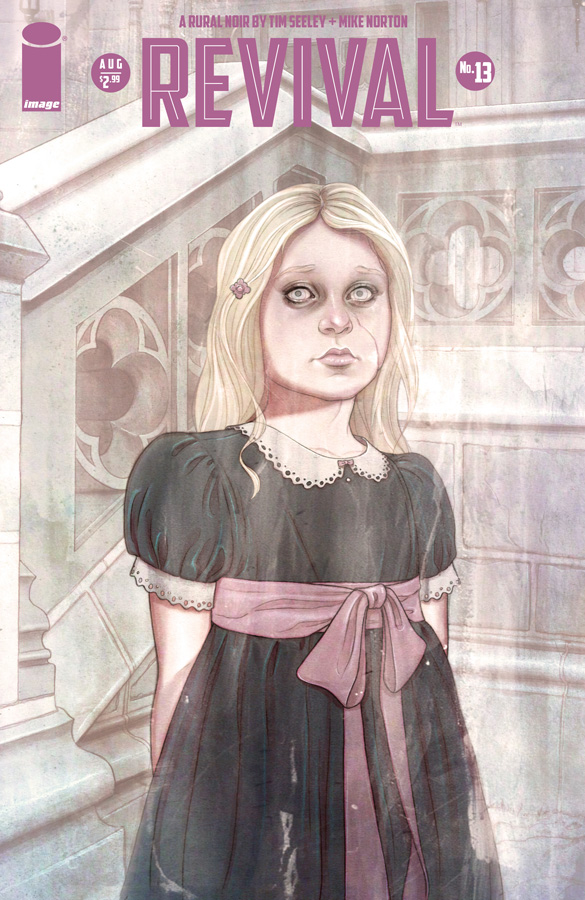
Revival #13

written by Tim Seeley
art by Mike Norton

It's Valentine's Day in the revival event quarantine, a week after Martha Cypress single-handedly killed the murderous and entrepreneurial Check brothers.  Em's babysitting Cooper and young fellow "reviver" Jordan Borchardt while Dana and Ibrahaim go on "the strangest triple date in the history of central Wisconsin" (Revival #13, p. 4) with newly "out" deputy Brent, his boyfriend Ian, colorful and elderly fitness guru Lester, and his date sheriff's dispatcher Bonnie.  Meanwhile, Aaron Weimar—formerly Martha's professor and lover—continues to interview Joe Myers, whose "revival" has unsettled him more overtly than most.

Recently, Seeley has accelerated Revival's central mysteries, even as he continues to introduce new ones.  What seems at first an exceptionally awkward and harassing kiss from interviewee Joe turns out to be a way of stealing glimpses into another's memories through contact or, more likely, ingestion of their blood, one of the first characteristics these "revivers" share with their other zombie kin.  Joe's disintegration/evaporation, after having received the soul ring from his Hmong housemaid as recompense for the long-ago stolen engagement ring, follows in the vein of fellow "reviver" Tommy the Torso.  Unlike Tommy, Joe's disappearance will be noticed.  And then there's young Jordan, who apparently hears the calls of the ghosts in the woods all the time, wherever she goes.

Revival's both an exciting and frustrating series to follow monthly, mostly because its immersive storytelling style is simultaneously dense and nuanced even as its plot is difficult to distill within the bounds of any given issue.  In fact, its central plot—that of the "revival" incident—is nearly swallowed by the bevy of layered subplots and intricate character development.  Generally, this makes Revival one of the finest series currently being published, but it also makes any individual issue seem a little plodding.  Revival #13 is an excellent example of how Seeley's narrative complexity integrates such disparate actions. 

[August 2013]

Tuesday, August 20, 2013

Revival #12

written by Tim Seeley
art by Mike Norton

Martha Cypress's body is turning into something unrecognizable and foreign to her.  Her wintertime swim in the river, which is overlaid with her and her father's conversation during a game of horseshoes, is an eerie marvel.  She is able to withstand the Wisconsin winter cold of the river an the air, her eyes bleed into the water, and her body is covered by the scars accumulated during her revived life.

Cooper's comics, while nothing really like what children draw or write, provide a delightful, clever perspective on both the "revival" events and the comic book medium.  "So, do you eat brains?" one reviver asks another.  "No.  Do you have any bacon?" (Revival #12, p. 5)  But it's Cooper's recollection of his trauma with the Check brothers, his kidnappers and black-market body parts dealers, that strikes the last, best, and most tantalizing chord.  He knows something's wrong, at least sometimes, with Martha. 

In recent issues, Revival's started dropping more concrete(-ish) details about the revivers themselves.  Joe, the older man seen earlier trying to dig himself a grave, begins talking about his memories:  an encounter during death with a black-winged young woman who tried to save him and the fresh lack of love-hurt for the woman who jilted him as a young man, the way he always knew he was alive.  But if Joe is hollow and depressed, Jeannie Gorski is unsettlingly perky even in her task of cataloging the body parts collected from the barricade accident.  The mysterious ghost in the woods too is coming to the fore.  Its disintegration of Tommy the Torso in the previous issue revealed it to Martha, but Cooper writes about it in his comics, which his mother has now seen, and young reviver Jordan Borchardt's father has captured footage on his trail cam.

As usual, Skottie Young does a stellar job filling in for the series' regular cover artist Jenny Frison.  His quietly creepy moment between Cooper and the forest ghost seamlessly incorporates Norton's style, rendering the ghost quite similarly to its interior representation, into his own quirky vision.  And it sets the tone perfectly for some of the issue's finest elements, including Cooper's own comic-book adaptation of events from his young perspective.

[July 2013]

Saturday, August 10, 2013

Revival #11

written by Tim Seeley
art by Mike Norton

While Revival's story arcs are heavily serial, stretching over multiple issues often with slow, deliberate development, issue #11 is a direct continuation of the very focused conflict begun in #10:  the kidnapping of Cooper by the Check brothers and their discovery by "Reviver" Martha Cypress.  After having upended her kidnapper and would-be murderer Adam Check at the end of the last issue, Martha is now faced with his brother Andrew.  Her violence, understandable in the context in which it erupts, is nevertheless increasingly disturbing, particularly in light of the viciousness that it seems to stimulate.  In the span of moments, Martha has killed two men quite literally with her hands, actions whose magnitude she realizes only after she finishes.

This encounter, so far the sharpest of Revival's plots, is a confluence of many of the series' best mysteries and characters.  Not only is the personality of Martha Cypress challenged by the increasing strangeness of her new condition, she and Cooper are saved from eldest brother Anthony by the enigmatic ghost in the woods, whom Cooper has somewhat befriended.  While this figure hasn't come even close to being identified, it seems to be fundamentally linked to the Revival phenomenon, if unknown to most of the series' characters.  And, it turns out, to the mercy of the scavenged and mutilated meth user Tommy the Torso, the only known thing that can kill the Revivers.

[June 2013]

Saturday, June 1, 2013

Revival #10

written by Tim Seeley
art by Mike Norton

After a few dizzyingly over-packed issues with correspondingly little substantive plot advancement, Revival #10 recovers its footing.  Here, Seeley exhibits the kind of storytelling that his series needs to sustain itself in a monthly format.  The wide, variable array of characters and multiple (sometimes interconnecting) plot lines have tended to spiral the series into stagnation, when Seeley attempts to address every one in the same issue, a strategy which effectively embodies the media, criminal, and religious onslaught that the "revival" event has imposed on the town, but one that feels like buckshot storytelling with a hitched pace and little focus.  Revival #10 easily identifies its main story interest and seamlessly incorporates several of the other plots and characters into its thread, and as such provides a promising model for future issues in the series.

Having stumbled into the Check brothers' black-market "reviver" organ harvesting in the final moments of Revival #9, Dana's son Cooper and her ex's new girlfriend Nikki are held hostage by the murderous and entrepreneurial Checks.  As the tension rises and more and more potential victims inadvertently discover their secret business, the brothers' willingness to dispatch intruders, however innocent, becomes increasingly apparent.  Though Dana and the rest of the Cypress family forms the structural core of the series, the Check brothers are undoubtedly the issue's main figures, and their calculated, inhuman response to the medical anomaly its thematic center.

One of Revival's interests has always been the definition and boundary of what is "human," and though this is most manifestly visible in the scientific/medical debate about the status of the Revivers and their relative resemblance to their pre-death selves, Seeley uses the Checks to elicit a profound sympathy for the sometimes unsettling Revivers from the reader.  However cold and disconnected Martha Cypress, however crazed-looking Jenny, however murderous or troubled, the plight of Tommy the Torso is truly pitiful and his treatment inhumanly cruel.  Harvested for his parts, but still alive and about to be buried until police scrutiny following the organ-truck crash dies down, Tommy, now nothing but a bloody torso with exposed ribs and a sewn mouth, embodies the imminent dangers and unacceptable consequences of treating the Revivers as anything but human.

[May 2013]

Sunday, April 28, 2013

Revival #9

written by Tim Seeley
art by Mike Norton

Nine issues into Revival's run and it's more evident than ever that Seeley has recreated a believably diverse Wisconsin town with very little fanfare.  The ethnic tensions and prejudices prompted the suspicion of the Hmong family in the slaughter of the zorse in Revival #1, and though their prominence in the series has waned in recent issues, it remains integral to the characterization of the town.  Rothschild is as likely to have an anti-semitic, anti-government nutjob—Edmund Holt—as it is to have a half-closeted, half-out gay policeman—Officer Gunderson.  It's often played for social critique, but just as often played for humor, such as Sheriff Cypress's misinterpretation of Ramin's search for a fallen sugar cube as Muslim prayer in the police conference room.

Unfortunately, this credible diversity is also symptomatic of one of Revival's structural weaknesses.  It's got too many plots and too many characters simultaneously in play.  Juggling these multiple threads has watered down its excellent story plotting.  It's a strategy that would hold up spectacularly in a television drama, which Revival often feels like anyway.  Revival has many narrative fronts, all suitable to the situation and part of the series' plausibility:  the combination of the increasingly bizarre behavior of the "revivers," each of whom seems to be unraveling in his or her own unique way, both physically and psychologically; the growth of criminal enterprises capitalizing on the event; cabin fever accumulating from the weeks of CDC quarantine; and rising tensions along the barricade with increasingly fanatical and belligerent religious zealots.  However, it's not a story particularly suited to the medium.  Much like The Walking Dead and other long-form serial comics, Revival may be better suited for trade publications, in which the complex narrative arcs spanning months in the comics are gathered in more logical and closely proximate units.  The lack of major resolutions to many of the arcs even within a generous publication period may make even these somewhat less satisfying than one would like.  Seeley and Norton are telling a very good story, but it's coming too slowly and in pieces that are too small.  I suspect that the ultimate payoff of this series will be well worth the wait, but I also expect to enjoy it much more re-reading up to its major moments than reading it monthly.

Note:  It's also about time to bring attention to the excellent cover art of Jenny Frison, whose rich and elegant coloring and fine lines consistently make the most of their macabre content.

[April 2013]

Sunday, March 3, 2013

Revival #1

written by Tim Seeley
art by Mike Norton

Revival begins shortly—though the exact duration is unspecified—after the eponymous event, a day on which the recently dead come back to life and (mostly) resume their old habits in full health.  Understandably, this has created a growing national concern and instigated media interest in the rural country around Rothschild and Wausau, Wisconsin, the epicenter of the reviving event.  And Seeley shows early interest in these disparate reactions to his fictional crisis.  Local law enforcement, under federal instruction and at the C.D.C.'s insistence, has established a quarantine and a highway barricade, already turning away religious zealots and other crazies using the incident as an excuse for whatever delusion.  Wisconsin radio features polemical talk shows with guests alternately demanding government withdrawal from Christian matters, greater restraint and temperance from media outlets, and scientific investigation into human biology.

No doubt, as the quarantine lingers and the event remains unexplained, these conflicting camps will come even further to the fore, but Revival's most immediate intrigue, and the features which fully belong to its self-proclaimed genre of rural noir, are its greatest strength.  Asked by her father and local police chief to investigate crimes related to or involving "revivers," Dana Cypress is sent to Wausau to investigate the death of a zorse—half-horse, half-zebra and the strange animal stumbling through the snow earlier in the issue—whose killer turns out to be one of the revivers, a particularly unstable one at that.  And it's through her first assignment as detective and C.D.C. liaison that some of the enduring questions about these revivers are raised, including, most importantly, whether or not—or perhaps to what degree—they are the people they used to be.

This question becomes personal when it is revealed, by her un-death at the hands of the berserking reviver, that her sister Martha is also among the revived, and therefore also likely the victim of an earlier murder, though she has no memory of how she died.  Combined with the strange ghostly creature her son Cooper meets in the woods, Dana Cypress finds herself in the very middle.  In its dense opening chapter, Revival seems to be both a meditation on death and the horror of a world without it, and layered thriller, one that hopes to piece together the lost memory of Martha, the lost identity of the ghost in the woods, and the reasons for the mysterious revival itself.

"We stood up on two legs
And raised our heads above golden grass
He was there.
We sharpened stone and steel
Used tools to harvest grass, beast and brother
He was there.
We clustered together
In brick and mud, swarming with rats and plaque
He was there.
We built nations and mistrust
Our fingers hovered over the red button
He smiled.
Still we build, to rise above the golden grass
Away from the reach of his scythe
For a day when he will harvest no more."
                            (Revival #1, pp. 1-2)

[July 2012]

Thursday, February 21, 2013

Revival #7

written by Tim Seeley
art by Mike Norton

Revival has opted for a more aggregate story-telling approach to its Wisconsin-bred alive-again-ers.  While its first few issues pointedly raised several questions about the nature and cause of the "revival" itself and the "revived," subsequent issues have gravitated more toward individual stories tangentially associated with the event.  And narrative arcs are simultaneous rather than sequential, as comics—particularly those prepping for TPB-dom—are wont to be arranged.  This is not a criticism.  In fact, it gives Revival the sense of a longer vision, but it consequently elevates the demands on its readers, who must recall details from events several issues prior in order to begin piecing together the larger story Seeley and Norton are telling.

Issue 7 is the inevitable consequence of this mode of storytelling, a somewhat piecemeal single issue that struggles with its own cohesion but fits very nicely into the series as a whole.  Most of the issue is spent resolving the murder of Justin Hine, but interspersed within this story are the continued and escalating trouble along the quarantine, a very brief—i.e., 2-page—introduction to the gruesome Check brothers, a briefer—i.e., 1-page—glimpse of reporter May Tao, a tantalizing scene between Martha Cypress and fellow reviver Jeannie Gorski, and the discovery of some unexpected cargo in a highway crash.  Thus far, Seeley has quite admirably, in my opinion, steered well clear of cheap, summarizing exposition, but Revival is approaching a dangerous horizon, at which it will have begun too many threads to adequately engage any of them, and it needs an issue once in a while that suspends the more immediate detective mysteries, which have recently occupied most of its page-count, in order to address its central questions.

Norton's art is certainly adequate to the task, though not much exceptional is asked of him here.  He does adeptly handle the unenviable burden of differentiating so many secondary characters with few textual cues.  And some of the crowd and highway scenes reward close scrutiny.

[February 2013]