Showing posts with label Nathan Edmondson. Show all posts

Thursday, January 22, 2015

The Dream Merchant #6

written by Nathan Edmondson
art by Anthony Hope-Smith

The Dream Merchant may not have much of a sense of humor about the near absurd narrative gyrations of this dream mythology, but Winslow certainly does:
"Stop the Gatekeeper.  Stop a being responsible for weaving worlds together with his waking dreams.  …Easy.  Stop the Gatekeeper.  Stop his nightmares from reaching my world.  I hardly know what that means."  (The Dream Merchant #6: 2)
An even more honest response might come from the mouth of now mutinous (and probably felonious) FBI Agent Coads:  "What just happened?" (13).  While only scattered sense can be reconstructed for the closing chapter of Edmondson's dream thriller, The Dream Merchant still manages some very fine and sincerely horrific moments.  Winslow is being burned away from the inside by his dream with the Gatekeeper, scorching his hair and steaming with pink dream energy.  It's a nightmare of its own that Anne must witness.  The destruction of the amulets, to send Winslow fully and waking into the Gatekeeper's imagination, isn't exactly a surprise, but Anne pulls it off with quiet resoluteness and just a few tears.  Winslow may be the hero, but Anne is the pulse of the story.

It's a pink saturated dream world, a contrast to the cool blues and greys of the waking world, but apparently it's not at all that simple.  The amulets shattered, Winslow's waking body sent hurtling into the Gatekeeper's world, one rock to the head of the villain, and all Winslow had to do was "wake up".  And so he does, bald and in a hospital bed.  At least I think that's Winslow, though the change of artist makes this less than definitive.  It may also be the Gatekeeper himself or perhaps even the Dream Merchant.  That the "voice" of the narrator is also less than clear makes his plea for "Ziggy" to wake up all the more confusing.  But Winslow and the Merchant also remain in that dream world, stranded after the loss of their anchors.  And so the cycle continues with only the most immediate crisis averted.  But The Dream Merchant was always a story of discovery, not conclusions, Winslow's story of how he became the apprentice of the Merchant, Anne's story of how she became the leader of a task force designed to fight nightmares.  And she never regretted not kissing him.  Bravo.

Tuesday, December 9, 2014

The Dream Merchant #5

written by Nathan Edmondson
art by Anthony Hope-Smith

Edmondson's mythology has by now become almost hopelessly convoluted.  The monsters of our nightmares, the ones we imagine in our closets and under our beds are creatures from another world—or perhaps worlds—once tame but now made wild and ravenous by a race of overlords, the Gatekeepers, who control the bridges between worlds, a manifestation of their own dreams.  Winslow too now has this power.  The Regulators were once people of this other world before the Gatekeepers stole their subconsciouses and emptied them into slaves, abruptly abandoning their civilization and leaving it barren to fall into ruin.  Only the Dream Merchant escaped this fate.  Though they do not fear the unknown worlds they help to conquer, the Regulators fear a race of "old ones," whoever they may be.  When the Merchant scoffs at Winslow for not yet having intuited the whole of this vast conspiracy of cross-dreaming and conquest, it's difficult not to be a little offended.

Winslow may be the series' protagonist and the Dream Merchant its mysterious titular character, but The Dream Merchant #5 finally gives some narrative reinforcement to the care and interest Edmondson has devoted to Anne from the beginning.  This was not only a course in training Winslow for his dream-battle with the Gatekeepers, but one in preparing Anne for her part in that battle.  After all, a bridge has two ends.  Her delightfully uncooperative attitude with both FBI Agent Coads and his even more bureaucratic DHS superiors is truly winning.
Coads (locked in a holding cell):   "They can't do this."
Anne:  "Give it a rest, dude.  They clearly can.  The government does whatever it wants.  Like some drunk uncle.  ...No offense.  ...  Besides, I'm tired.  So tired.  And you're annoying.  So we might as well sleep."  (The Dream Merchant #5: 17)
Her call to arms, whispered to her in her sleep by Winslow in his dream world, is a welcome (if not wholly unexpected) surprise.  That the government suits—both DHS and FBI—might actually prove allies rather than obstacles is an equally welcome (and almost entirely unexpected) surprise.

Friday, September 5, 2014

The Dream Merchant #4

written by Nathan Edmondson
art by Konstantin Novosadov

More than a year after its last issue, The Dream Merchant resumes its sleep-no-more thriller.  The invasion of regulators—the "migration" as the Dream Merchant describes it—has begun at the fringes.  And Winslow is a hero as weakened and deflated himself as his circumstances make him, but he's beginning not only to understand but feel some responsibility, some spark of motivation to save himself and the world.  By the end of the issue, as Winslow seeks sleep alone, downing a bottle of NyQuil in a tub, looking strung out, knowing he will be afraid but doing it anyway, the hero of Edmondson's supernatural fable finally takes his sword.

Nevertheless, Anne continues to be The Dream Merchant's brightest star.  Unflappable in the face of danger and unaccountable weirdness, she keeps her head and her humor, delighted that the trio will find something to eat and and curious to know the Merchant's affection for Earth.  But her rebuff of Winslow's attempt at a good-luck/goodbye kiss that steals the issue, a subversive slap-in-the-face to apocalyptic romances:
"The world is about to end, you're the only one who can stop it and you're thinking about making out?  Pathetic, dude!  Get over it and nut up and go do something!"  (The Dream Merchant #4: 17)
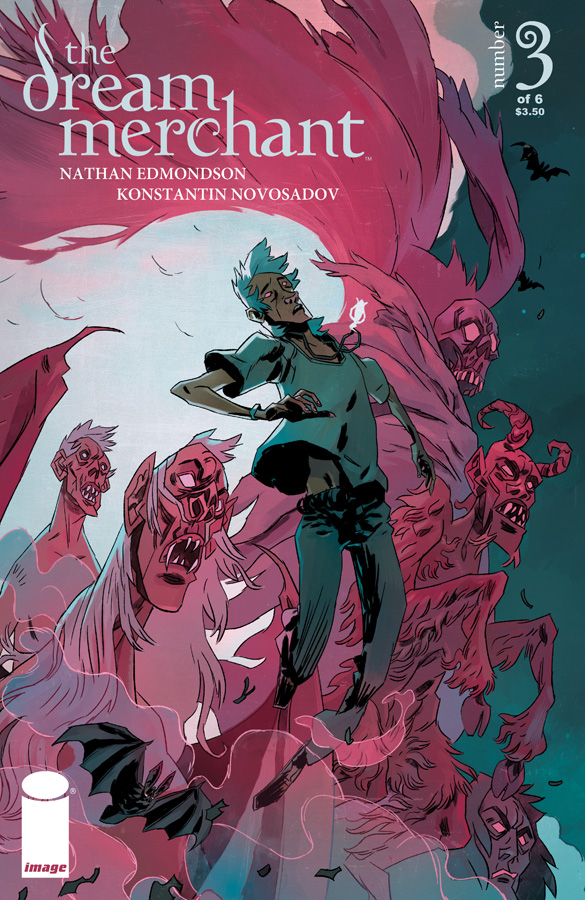
Novosadov's artwork, loopy and shaggy as it may sometimes seem, is unnervingly creepy.  Along with Stefano Simeone's haunting coloring, it gives The Dream Merchant the look of a truly horrific children's story.  Winslow's piercingly white eyes beam out of his hollow, shadowed face as he first wakes from his dream.  The horned monster is something out of a nightmare fantasy.  And the flush of eerie pink, the light that takes his eyes, and his stretched skin as Winslow moves into the dream world is a phantasm of possession and death.  The Dream Merchant may be a beautiful book, but it's one that lingers in the back of your eyes.

Saturday, August 10, 2013

The Dream Merchant #3

written by Nathan Edmondson
art by Konstantin Novosadov

After tagging along with Winslow and the Merchant of Dreams for two issues, making sensible if tentative suggestions, Anne begins to show her mettle here.  I can't say that I advocate stealing firearms from police cars—or policemen careless enough to allow her to do so, for that matter—but embracing her delinquent past and asserting her quick-witted opinions—such as sartorial suggestions for the Merchant so she and Winslow, fugitives from the FBI as well as their mental hospital, "don't stand out like a homeless Indian wizard is leading [them] around" (The Dream Merchant #3, p. 5)—have made Anne the member of their threesome-against-the-dream-apocalypse to watch.  Winslow is far too self-defeating and self-pitying, and the Merchant is far too pushy and narrow-minded in his humanitarian mission.

Edmondson drops a few surprises in this stronger episode of his series.  The first isn't all that unexpected for the audience even if unknown to the Merchant:  Winslow can move, like the Regulators pursuing him, through his own dreams, translating him from place to place in the physical world.  It gives him an impressive range of movement and one that makes him a formidable opponent if he learns how to control his new-found ability.  The second, if not quite a surprise since the Merchant has frequently alluded to it:  his world is the source of our nightmares, visions of which we remember in our dreams, the frightening forms of his threatening alien species locked in our subconscious.  And, apparently, they are preparing an invasion.  If the glimpses of this invasion, seen in the final few panels of the issue, are anything to judge by, Novosadov's vision of this invasion should be something to whet the visual appetite.  His imagination for Winslow's dream world has thus far been the stand-out element of the series, and any developments that promise more are welcome indeed.

However, like The Dream Merchant #2, the finest storytelling moments of this issue come unexpectedly from the few pages dedicated to the FBI investigation into Winslow's kidnapping/escape.  Apparently, the Merchant has been identified as a person of interest in a few cases, including one that even to the FBI agent is listed as confidential.  Perhaps, despite his insistence that the authorities would give Winslow no credence if he approached them, the Department of Homeland Security—who turn him away at the besieged police station—may, in fact, have some inkling about these events. 

Wednesday, July 31, 2013

The Dream Merchant #2

written by Nathan Edmondson
art by Konstantin Novosadov

The telling may be elegant and the ideas clever, but The Dream Merchant #2 is little more than exposition.  Having stolen a little distance from the alien Regulators pursuing Winslow, the Merchant of Dreams takes most of the issue to explain Winslow's dreams and begin his training.  On the other hand, the introduction of an FBI agent looking into events at the psychiatric hospital and the possible kidnapping of Winslow and Anne brings an unexpected and unexpectedly refreshing investigative angle to Edmondson's surreal dream tale. 

Some of The Dream Merchant's best storytelling is visual.  The disappearance of the Regulators with the coming dawn—a single-page, three-panel sequence on p. 10—is evocatively eerie.  The blossoming friendship between Winslow and fellow fugitive Anne is easily visible in their body language even as their social awkwardness makes it difficult for them to click in conversation.  Sleeping quietly on his shoulder in the truck speaks more for Anne than any of her gentle pleading for Winslow to embrace his unique situation.

Though its dream mythology is engaging and beautiful, its colonization metaphor is not.  A foreign race, who in Earth's earlier times traded peaceably with humans, now seeks to return only to take forcibly their resources and annihilate the species.  It's neither difficult to believe nor without numerous historical precedents in human history, but in the context of a dream saga, it comes across far heavier-handed than it should.

Friday, May 17, 2013

The Dream Merchant #1

written by Nathan Edmondson
art by Konstantin Novosadov

It takes nearly all of The Dream Merchant's double-sized inaugural issue for it to reveal its central, innovative concept, one that was unfortunately featured in its pre-release press, because this one's worth the wait.  Edmondson has been (with some justification) criticized for his meandering pace and extremely leisurely tempo, both a luxury and consequence of the capacious page-count.  But its pace and Edmondson's lyrical writing style both contribute to the series' dream-like tone, one that seduces the reader into the same manner of waking confusion that plagues its central character, the inability to perceive the differences between states, if not consciously discriminate between them.

Winslow—haunted by a recurring dream from his childhood and hospitalized because of the resulting insomnia—finds himself on the lam, escaped from the psychiatric institution and running from a mysterious band of cloaked figures he first sees in his dream.  For most of the issue, The Dream Merchant is a hybrid between chase thriller and supernatural mystery, both of which are governed by a kind of distant surrealism.  As a thriller, The Dream Merchant works quite well.  Winslow is a likable and vulnerable protagonist and his wraith-like pursuers are convincingly menacing.  But it's the titular Merchant of Dreams—wizened, tattooed, and peddling dream amulets out of a canvas-covered wagon—who gives the story its particular unearthly aura.

However solid Edmondson's opening chapter, it's newcomer Konstantin Novosadov's artwork that commands his debut.  His lines have a casual aspect—long, loose, and fluid—but they are deceptively sophisticated.  Protagonist Winslow, in his dream-avoiding insomnia, frequently looks weary and disheveled, the Merchant of Dreams aged and ragged, both suitable for Novosadov's style.  But it's his compositions and coloring that really dictate the visual tone of the issue.  In particular, the sometimes dramatic, sometimes quiet incorporation of pink—the color of Winslow's dreams—works both aesthetically and thematically.

All in all, Edmondson and especially Novosadov have put together a fine opening to what promises to be an intriguing story.  What it lacks in focus, it makes up for in momentum, bravura and eloquence.