Showing posts with label Mateus Santolouco. Show all posts

Monday, September 23, 2013

Dial H #5

"Disconnected"
written by China Miéville
art by Mateus Santolouco

"A few days ago I was just some guy.  I'm still just some guy.  Some guy working with his best friend's murderer to rescue an old lady superhero.  To fight a supervillain and an angry void."  (Dial H #5: 1)
"Disconnected" resumes the hunt for Abyss, a ravenous nothingness consuming all light, threatening to turn the world into a cold, dark, lifeless rock or perhaps to eat it into nothing.  Dr. Wald, a.k.a. Ex Nihilo and now superhero Hairbringer, was so hubristic that the assumed the creature would show some allegiance to her for bringing it back into the world, but the nullomancer soon discovers otherwise.  Forced into strangely amicable cooperation with Darren's murderer the Squid and now finding himself in equally strange collusion with a villainous mastermind, Nelson and Wald collaborate to turn the Abyss's small offspring voids against their parent/maker.

It is, perhaps, a convenient solution, but one with wonderfully unexpected execution and consequences.  Santolouco's Abyss has always been a gorgeously massive and star-filled monster, who glitters with the light it's already devoured.  In magic-logic and poetically symmetrical physics, nothing eating something begets nothing, but nothing eating nothing begets something.  As the befuddled little voidlets eat away at their progenitor, he turns into an awesome and grotesquely crumbling stone statue in the middle of Littleville.  In the words of the Squid, "They'll chew it into dense dead presence" (14).  The Squid, ironically in context, is also gives voice to Miéville's eloquent, beautiful, and a little painful tribute to human language and expression:
"Some people on my world...  ...think the whole of our universe is just the effluent of nihils' predation on each other...   ...that we live in the crumbling corpolite of nul-eat-nul.  That matter is the leftover of void rapacity, like that ugly statue, that abyssal aftermath.  It sounds better in your languages.  I learned 17 when I came.  I could never decide which was my favorite.  Or which voice to use."  (18)
While it grants a greater depth to the Squid, turns a character introduced as little more than a mindless goon in X.N.'s employ into a quietly philosophical and aesthetically minded solon, it's largely ancillary to the main story.  Instead, it's an example of precisely the deep appreciation of human creativity and experience that makes Miéville's thoughtful world so elegant and poignant.

Even as the Abyss and Wald are defeated, another shadowy figure with full command of its Dial emerges out of the Abyss in search of H-Dials, disarming and killing Wald in the process.  Nelson's still-glitchy Dial, which switched off just before the creature emerged onto scene may have saved him and Roxie (Manteau, now unmasked) from a similar fate for the moment, but it already poses a significant threat to any Dial user and stands poised as the next arc's likely antagonist.

Superheroes:  Rescue Jack (un-dialed), [unnamed Swiss Army knife hero], Hairbringer, Atavist, Timekiller, Girl Eclipse, Cock-a-Hoop

[December 2012]

Sunday, September 15, 2013

American Vampire #11

"The Way Out," Part Two
written by Scott Snyder
art by Mateus Santolouco

Despite Skinner Sweet's reputation and his seemingly never-ending feud with his inadvertent vampire makers, the existence of the American vampires Pearl and Sweet doesn't appear to have gained extensive currency among other vampire groups, who continue not to recognize Pearl and to be correspondingly arrogant prior to confrontations with her.  Pearl, almost single-handedly, destroys Little Feet Beale's entire blood-smuggling operation and the nest of vampires he caters to.  She's a natural and electric killer even though her lifestyle means she gives into that very infrequently.  And Henry does his part, chasing down Beale and his fellow bootleggers.

Pearl's constant fear that Henry will finally realize who and what she really is, that he already wants to leave her or is already almost gone, is sweet and sensitive to the very real problems with their romance.  Henry's response is equally sweet and considered.  He is growing old.  They've been married for more than a decade, obviously without children or hope of them.  His mortality is closer than ever, especially still bearing the bruises and wounds from their fatal altercation with Beale and his associates, and perhaps for the first time, both Henry and Pearl acknowledge that the idea of turning Henry has crossed their minds.  But not now, if ever, and not for fear.

Hattie, meanwhile, sporting her Black-Dahlia/Man-Who-Laughs smile scars, continues to hunt down Pearl, chasing her by memories she has of their friendship.  Hattie's status as an American vampire continues to go unexplained, so much so that I will likely return to the previous volume to double-check my recollection of her transformation.  In a pleasant surprise of storytelling chronology, Snyder pulls the rug out from under reader expectations on this one.  I had, I think not accidentally, assumed that the action in the two storylines was simultaneous, that Hattie would be waiting for Pearl and Henry when they returned home from Beale's bar.  Instead, the events at the roadhouse had taken place six months earlier, after which the couple had moved out and on.  Hattie's desired confrontation with Pearl is thereby averted for the moment.

Santolouco's work really jumps off the page in the second of the two-issue arc.  The two-page spread early in the roadhouse fight between Pearl and the other vampires is particularly fine, Santolouco's central figures breaking the panel boundaries around the remainder of the page.  This is, in fact, his best work so far in the series.

[March 2011]

As collected in American Vampire, Volume 2 (ISBN 978-1401230692)

Sunday, September 8, 2013

American Vampire #10

"The Way Out," Part One
written by Scott Snyder
art by Mateus Santolouco

Their past has come back to Pearl and Henry.  Hattie, erroneously presumed dead after Pearl's revenge on the back-stabbing starlet, makes her escape from a basement prison.  Little Feet Beale, a bootlegging music man from Henry's time traveling the country, sets up a Jazz bar not far out of town from the couple.

The circumstances that brought Hattie to her prison are extremely confusing.  By failing to destroy her head or heart, Pearl may have unwittingly allowed Hattie to live in a kind of suspended stasis before she was reclaimed by a rival vampire faction, but just how Hattie became an American vampire—like Pearl and Sweet—is entirely unclear.  She was, at least originally, transformed by Pearl's original attackers, one of their brood of European vampires.  Now, she's being held captive by seemingly the same group, subjected to rounds of experiments each new moon to determine her weaknesses, and thereby the weaknesses of Pearl and Sweet as well.  Upon securing her escape and her revenge on her tormentor, Hattie sets out to find Pearl.

If possible, Henry's discovery in the back room of his old buddy's bar, ironically named The Way Out, is even more chilling.  A bootlegger during the 20s and early 30s, Little Feet Beale apparently needed to find alternative income after the repeal of Prohibition.  He put his previous knowledge to use in a similar, illegal and significantly more ghoulish profession:  bootleg blood.  He siphons blood out of hapless patrons into jars and bottles for later consumption.  And the pile of dessicated bodies in the corner suggest he's quite liberal in his victims.

Santolouco, previously tasked with Cashel McCogan's flashbacks in the "Devil in the Sand" arc, is solid here.  His inks are much darker, his figures less delicate, and the overall impression of his illustrations much heavier and more cumbersome, but its got enough continuity with Albuquerque's style without attempting outright mimicry that it works well within its own confines.

[February 2011]

As collected in American Vampire, Volume 2 (ISBN 978-1401230692)

Monday, September 2, 2013

American Vampire #9

"Devil in the Sand," Conclusion
written by Scott Snyder
art by Rafael Albuquerque and Mateus Santolouco

On the same day he learns about the existence of vampires, Cashel McCogan also discovers that his adoptive father, the lawman who raised him from childhood and whose death he so recently mourned, is actually a vampire and alive, from an ancient race of Irish vampires invaded and genocidally slaughtered by other European species.  Strigus Gaelic-Prime, presumed extinct.  Having lived most of his 700-year life as a respectable man, a faithful lover, and a devoted father, sincerely belonging to a community and killing no one as a predator, Gus is a foil to Sweet, a vampire lawman and perhaps one whom Jim Book could have emulated should he have given himself a chance.  He blurs the lines between human and monster and confuses the mission of the fanatical Vassals of the Morning Star.  That is, until his recent murder spree.

As revenge for his clan's extermination and to prevent the European vampires from setting up permanently in Las Vegas, Gus McCogan murdered their human puppets to lure them, successfully, to the burgeoning desert city and into his cross-hairs.  None of his victims are particularly palatable or innocent, least of all the vampires themselves, but they are human, for the most part, despite being dishonest and ruthless businessmen.  And this discrepancy puts newly enlightened Cashel in a particularly troublesome position, though it becomes less so when the rest of the vampires show up. 

Vampire McCogan's alliance with Skinner Sweet against their common enemy, although at this point not entirely unexpected, is unsurprisingly ill-advised.  The motivations for Sweet's back-stabbing—if he has any beyond sheer contrariness, a deep-seated disrespect for institutions of authority, and, in his words, the fact that he's "always, always got to be the last man standing" (American Vampire, Volume 2: 88 [9: 14])—are entirely opaque.  Nevertheless, Sweet's perverse creativity for retribution leads him to Cashel's pregnant wife with a hypodermic full of blood, leaving McCogan a widower after a violent (but unseen) delivery and a vampire baby.

As for Felicia Book, recently informed of the weaknesses of American vampires, the young hunter takes the opportunity, it seems, to test their effectiveness.  She has some success.  Gold, apparently and figuratively, poisons them.  Sweet may be able to dig out the bullets before they do too much harm, but he's now vulnerable to those who would have him dead.

[January 2011]

As collected in American Vampire, Volume 2 (ISBN 978-1401230692)

Sunday, August 25, 2013

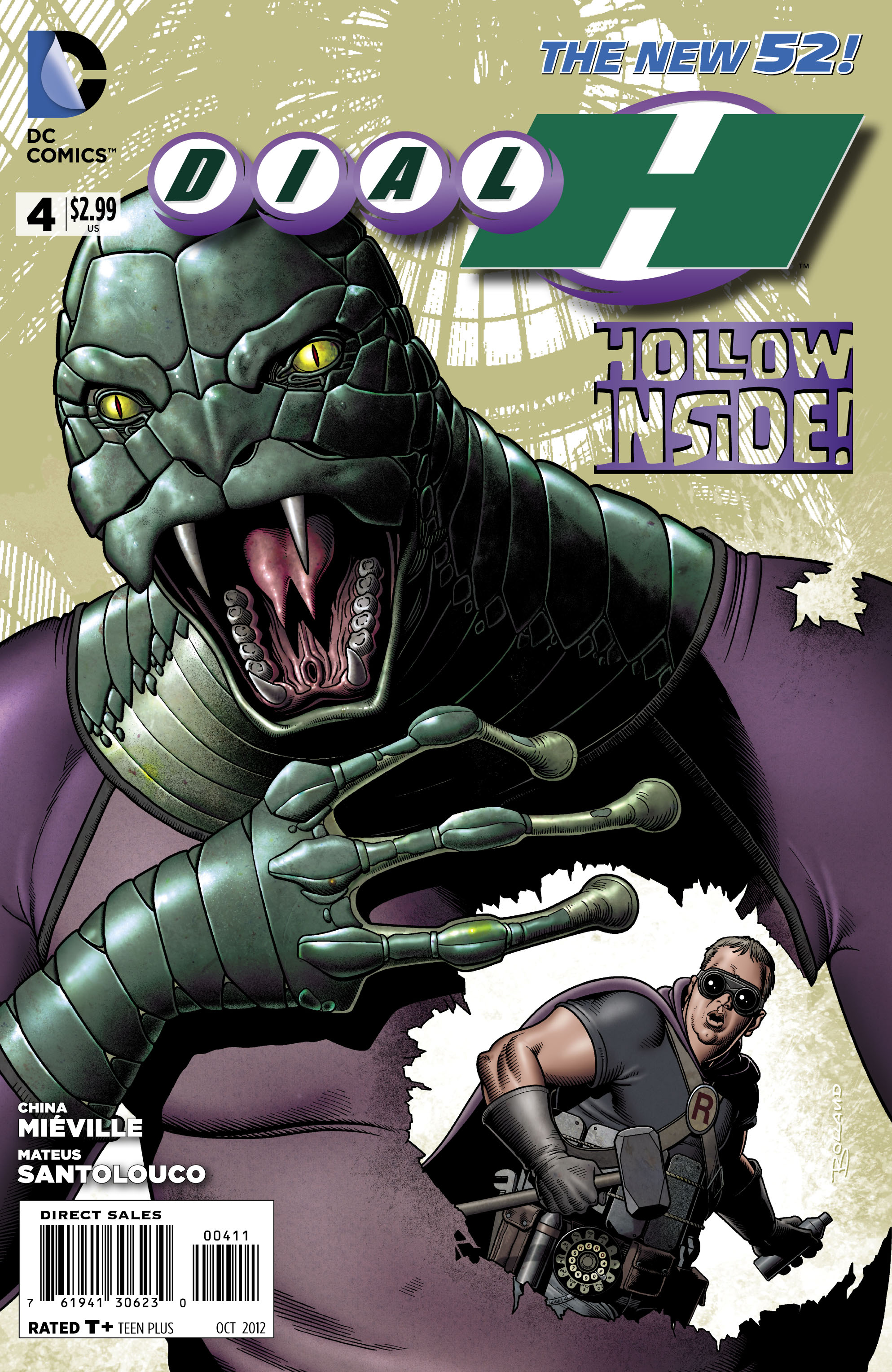
Dial H #4

"Into You"
written by China Miéville
art by Mateus Santolouco

The Abyss, Nihil Ambulans, a Nothing Walking has arrived, summoned by Dr. Wald and the Squid through the emptied mind of someone touched by its last visit to Earth.  And it is a fearsome, strange, and above all foreign enemy.  It inspires the simple, profound fear of something unimaginable.  And Dr. Wald, the self-named Ex Nihilo, is a zealot, a nullomancer, trained in the arts of nothingness and emptiness, and furious when her attempts to bind the Abyss fail.  She blames Manteau, whom she kidnaps for information, and Nelson, whom she leaves for dead by the poison of the Squid.

The Squid, though inhuman and somewhat baffled by human behavior and emotion, is not the unequivocal villain he might once have been assumed to be.  When his reunion with the Abyss goes unexpectedly bad and he takes a shot of nothingness to the chest, he spares Jent, attempts to intercede on behalf of Manteau who knows (appropriately) nothing of the Abyss, and ultimately joins with Jent against Wald to rescue Manteau.  The Squid's history with the Abyss—and subsequently his hurt at the insatiable Nothing's betrayal—is very much a surprise, though it makes perfect sense in the context of the story.  He was a wrangler of the darkness between spaces, and he and this Abyss explored the universe together for many years before Dialers banished them both for stealing jewelry, whose glints and glittering the Abyss is so drawn to.  It is an unquenchable appetite for light that drives the now mad Abyss, one that threatens to grow so large as to consume the sun.

Miéville's mythology is, even in a highly erudite and dense series, unusually difficult to follow here, but the heart of the series has never been clearer.  Jent's struggles with self-confidence and self-worth are tested.  Abandoned with a faulty Dial, Nelson must become a hero he cannot dial in order to save Manteau from the increasingly brutal Dr. Wald.  With a little motivation from the Squid, Jent comes through as Rescue Jack, an un-dialed hero of his own imagination.  But perhaps his greater achievement is his recognition and complete acceptance of Manteau's true identity, a slender old woman tied to a chair after being tortured.  Respectful of her privacy and sensitive to her alter-ego, he returns her costume to her.

Superheroes:  Baroness Resin, [unnamed muscled hero], Tap-Out, Rescue Jack (un-dialed), [unnamed Swiss Army knife hero]

[October 2012]

Wednesday, August 21, 2013

American Vampire #7

"Devil in the Sand," Part Two
written by Scott Snyder
art by Rafael Albuquerque and Mateus Santolouco

If, like McCogan, we suspected Skinner Sweet of being responsible for the recent spat of murders and de-sanguinations in Las Vegas, it seems we would be wrong.  Sweet's certainly taken up residence in the burgeoning "Sin City" as a pimp and businessman whose employee was one of the last to see Mr. Beaulieu alive, but there's another vampire on the loose, tracking down the bosses of the consortium tasked with the building of Hoover Dam.  And Felicia Book and her partner Jack Straw, under the pretense of being an FBI agent and his assistant, are in town to find the murderer.  They are, instead, representatives of an organization called the Vassals, whose mission seems primarily to track down and kill vampires, a turn which expands the universe of American Vampire considerably.

Likewise, although the evolution of Sweet into something new in contrast to the pack of European entrepreneurs in Hollywood necessarily entailed the possibility of variety in vampire species, the glimpse into the world of the Vassals also opens up that variety.  Felicia's forensic investigation into the death of Mr. Beaulieu allows her narrow the species of vampire which could have perpetrated the murder, all of which seem to be documented in her research materials.  This killer is a species we haven't seen before.

And what should we make of Sweet's arrangement with the Vassals?  Under what conditions could a vampire known to be a killer even in his human form be granted immunity from an organization whose purpose is to hunt down vampires?  It's a suggestive tease, one that Felicia is particularly troubled by, but one that grants even further grey over Sweet's ambiguous character.

The final scene throws a wrench in the proceedings of the second story arc, reintroducing us to Abilena and her so-far unnamed partner who have traveled to rural California to kill Pearl Jones, in her words "the deadliest vampire on Earth" (American Vampire, Vol. 2, p. 52).  This is, of course, another mystery, since Pearl may be deadly but her seemingly idyllic life with Henry seems far from requiring Abilena's attention, except that she is the only known offspring of Skinner Sweet, the American vampire.

[November 2010]

As collected in American Vampire, Volume 2 (ISBN 978-1401230692)

Saturday, April 27, 2013

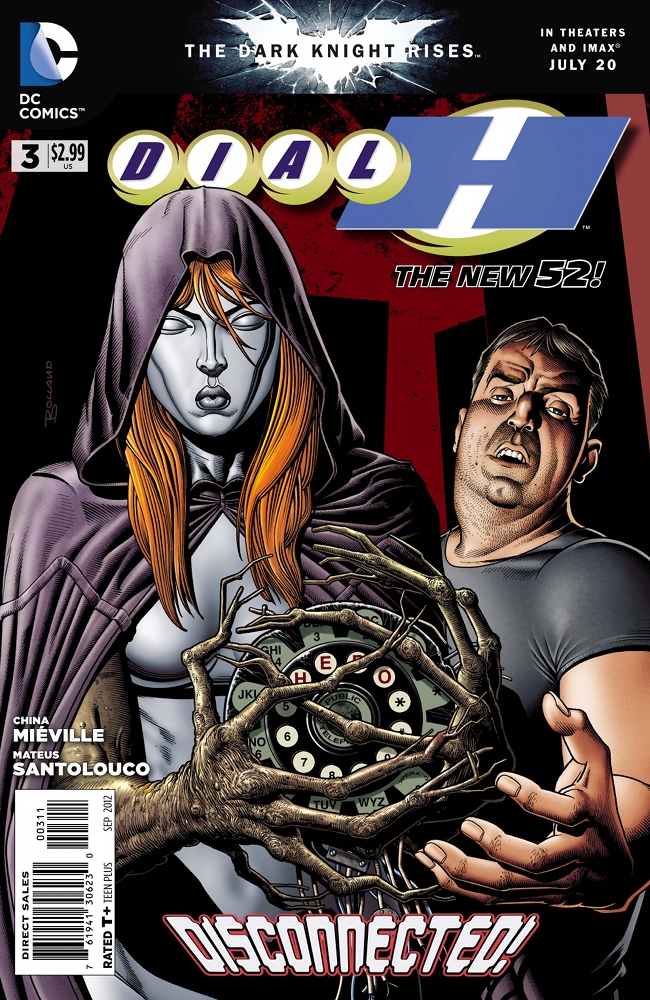
Dial H #3

"Come here!  I need you!"
written by China Miéville
art by Mateus Santolouco

After two episodes of Nelson's bumbling around with the Dial, making innovative use of whatever crazy hero he dials up after being unwittingly thrust into a criminal world of conspirators and non-humans he's not prepared to deal with, he finally meets fellow dialer Manteau.  Unfortunately, during a gunfight with X.N.'s goons, Nelson's Dial gets shot up.  Short on time and down a Dial, Nelson and Manteau make their escape to Manteau's house.  Now forced to trust one another the two begin to discuss the Dials, Nelson's de facto orientation to Dial history, and Manteau proves particularly knowledgeable.

Miéville's investment in the mythology of the Dials is brief but intriguing.  Manteau—a blend of historian, antiquarian and engineer—compiled a relatively detailed history of telephony, as she calls it, and relates it directly to strange and privately recorded conversations by the telephone's most famous and influential innovators, including Bell, Edison, Drawbaugh, Meucci, Reiss, and Gray, with a mysterious figure they each call "O".  Her conclusion:  "the entire history of telephony is a byproduct.  Of someone else's research.  Research into something else altogether" (Dial H #3, p. 9).

Meanwhile, Ex Nihilo and the Squid move closer to bringing back what they've been researching, Squid's companion Abyss.  Sensing remnants of himself in those he previously visited, using them as conduits for his return, he finally bursts through.  However, his relationship to the Dials remains very enigmatic.  Although he intuits their importance, Squid is unfamiliar with the Dials.  However, in her research on Dial activity, Manteau detects correspondences between the appearance of Abyss and clusters of Dial action, and she remains convinced that their is a connection and that it is also related to the shadowy figure that appears briefly when she and Nelson dial a new hero.

Although the main story remains strong and the revelation of Abyss a pleasant surprise, the greatest strength of Dial H continues to be Miéville's thoughtful exploration of the unexpected consequences of using the Dial.  Even after only a little while with the Dial, Nelson is already losing himself, collecting memories belonging to other heroes—most notably, Boy Chimney and the rest of Team House in the battle against Rake Dragon—making it increasingly difficult for him to differentiate between his own and others experiences.  In his continued insistence on thwarting comic expectations, including gender, Miéville also has Nelson dial up a woman.  His alarm and Manteau's sharp criticism of his overreaction were some of the issue's most thoughtful and funny moments.

Superheroes:  [Unnamed Fire Hydrant Hero], [Unnamed Twig Hero], Boy Chimney, Open-Window Man, Eavesdropper, Spiralstair, Door-Pilot, [Unnamed Muscled Hero], [Unnamed Condiment Hero], Baroness Resin, Giant Metal Spring, Super-Disco Dancer, Boomerang

[September 2012]

Sunday, March 3, 2013

Dial H #2

"Connection Lost"
written by China Miéville
art by Manteus Santolouco

Nelson Jent says it best himself, "Heroes is going on."  After blundering onto the Dial in issue #1, Nelson returns here to what he calls "research," dialing up as many different superheroes as he can.  Already his past time is showing some dangers.  Unhappy with himself, Nelson seems to enjoy disappearing into these new personalities, sometimes using them to thwart criminals in Littleville like more famous heroes in more impressive cities.  But after an encounter with another hero—the mysterious Manteau, mentioned in the first issue by thug Vernon—during a foray into the home of a coma victim, Nelson begins to realize he's losing track of himself, because all of his dialed personalities stay with him.

After spending most of the initial issue introducing Jent to the Dial, Miéville begins in issue #2 to develop the series' larger conflicts, including the connection between Nelson's friend Darren's breaking-and-entering job for a shadowy figure known to Darren only as X. N. and the recent epidemic of unexplained comas.  Perhaps best of all, Dial H doesn't yet have a clearly defined villain.  Instead, it proposes a network of independently self-interested characters threatening Jent, his friend Hirsch, and Littleville at large:  Vernon and his hired band of street criminals; the reptilian—and often masked—creature able to synthesize matter out of nothing, known to the others as the Squid; Ex Nihilo—X. N.—the doctor imprisoning, or attempting to imprison, the Squid and taking care of the coma victims while working to bring their cause to the city; and the mysterious force that touched those victims and which, according to the Squid, is on its way to Littleville.

Miéville continues his extraordinary character development and his refreshingly mundane depiction of ordinary life with all its little obstacles.  This issue's most poignant and believable moments are Nelson's failed conversation with his ex, Julie, who understandably wants to distance herself from her self-destructing former husband but leaves Nelson with no one to talk out his current disorienting problems with.  And unlike the bevy of heirs-turned-superhero-vigilantes, Nelson lacks the resources to conduct even the most rudimentary investigations, relying on internet cafés and local public libraries with shrinking hours of operation, or it appears much decent furniture.  Dial H is an oblique portrait of economic depression from a factory neighborhood rather than a family mansion or mayoral dinner party.

Superheroes:  Human Virus, Shamanticore, Pelican Army, Double Bluff, Hole Punch, Rancid Ninja, Skeet, Control-Alt-Delete, Iron Snail

[August 2012]

Sunday, February 10, 2013

Dial H #1

It should be fitting that my first review is the issue that finally prompted me to enter a comic book store.  This is not to say that I didn't already have a previous if sporadic history reading graphic novels and second-hand comics runs, but it is my first attempt at reading comics in their native medium—a monthly serial—and as such deserves the inaugural post.

"What's the 411?"
written by China Miéville
art by Mateus Santolouco

Quite simply, exceptional.  Nelson Jent—an unhealthy, recently dumped, out-of-work schlub—is about as common a superhero protagonist as Dial H is a comic book premise: a phone booth that temporarily transforms its user into an unpredictable heroic alter-ego.  But it's an idea that's only as good as the superhero personae it dials up, and it's here that Miéville distances himself from the creative pack.  Already, in one issue, he dreams up two—Boy Chimney and Captain Lachrymose—whose absurdity is tempered by their thematic and narrative efficiency.  They may be weird, but they are appropriately weird, as if conjured up by Nelson's own chain-smoking, lugubrious disposition.

As the series' central character, Nelson's self-pity and depressive malaise make him difficult to like, but his quick wit and his desire to make things right with his friend Darren make it possible to see his potential, a man who in the words of Darren "used to be interested in everything," a character through whom we readers can experience Miéville's world.  And it's a world dense with mysteries already:  the  dial itself, how it works, and where it came from; the identity and plans of the shadowy X.N.; the empty woman; strange comas at the local hospital; the seated and caged masked creature; and another hero, maybe, named Manteau.

However intriguing these mysteries make the future of Dial H, it's the details that are so cunningly refined.  Transformation sequences, while at first quite disorienting, are spectacularly fractured and continually nuanced on subsequent readings.  Nelson remains distinct and yet bleeds into his dialed characters, creating a visual cacophony of voice-bubbles and thought-boxes, masterfully navigated by Miéville and his collaborators.  But it's precisely this puzzle of identities that provides the strange but poetic voice to Dial H.  It's also quietly funny.  If Nelson's observation about Matthew McConaughey's disinclination to wearing shirts didn't elicit a chuckle, the homeless beggar's "Need Money 4 Karate Lessons" sign, the thugs' reaction to his transformation pyrotechnics—"Did that guy just explode?"—or the introduction of Captain Lachrymose as "some hipster" should.  Miéville enjoys words, and it's evident.  "Can't scratch my itch with even so elegantly twirled a cudgel," quips Boy Chimney.  "This is beyond miasmic intercession," he further concludes, looking down at Darren's beaten body.  There's a polish to Dial H's language that elevates it above even quite excellent comic fare, less ponderous and more savory.

For most of issue #1, Santolouco's art quietly grounds Miéville's world in a gritty, unglamorous reality, which he executes very well, tucking away background details that invite and reward close examination.  Like his writer, he seizes Nelson's heroic transformations with fervor.  Boy Chimney, in particular, jumps off the page, a lanky collection of joints and Victorian-era garb imposing himself on the layout, overlapping other frames.

Superheroes:  Boy Chimney, Captain Lachrymose

[July 2012]