Showing posts with label Eduardo Risso. Show all posts

Monday, September 23, 2013

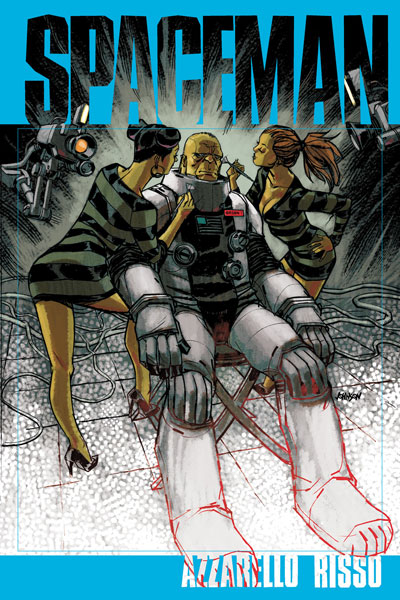
Spaceman #9

"Red Crater" (Part 9 of 9)
written by Brian Azzarello
art by Eduardo Risso

If its readers were expecting Orson's triumph, the conclusion to Azzarello and Risso's sci-fi fable must be devastating.

Engineered for survival in a proto-colony on Mars, Orson's apish looks and dim intelligence have made him an outcast whose destiny—as he feels his purpose to have been—is painfully unrealized.  And he fantasizes about the possibilities of a life in which he is capable, useful, and more morally and intellectually sophisticated than he is.  These flashes, though Spaceman teases several possibilities about their veracity, are actually allegorical alternatives to Orson's own bleak life, mirroring his problems but allowing the better Orson of his imagination to solve them.

Carter, on the other hand, is a darker, crueller but more capable, more intelligent, more manipulative and more self-interested counterpart to Orson.  He's confronted with the same existential failures as Orson, but he makes his own Machiavellian way in a strange world.  When his employer abandons his attempts to abduct Tara following the popular attention her kidnapping has attracted from viewers of her reality television show, law enforcement, and other criminal interests, Carter exploits Orson's generally trusting and overly naïve temperament as well as his deep-seeded desire to be a hero to steal the spotlight, recast himself as the selfless hero, and launch his own career as a "reality" superstar.  Orson and Lilly end up jailed—"charged" in a world in which that literally entails a financial transaction—for Tara's kidnapping.

In what might be the most surprising twist in an issue that defies expectation, Carter—at his own expense, though with money he acquired by selling out Orson—pays for Orson and Lilly to be freed and let into the "dries".  He even seems genuinely sorry, if unsurprised, that Lilly doesn't wait ten minutes for Orson.  If Orson's Mars-self is more morally compromised than he really is, Carter is less so.  He's out for himself, but he takes no pleasure in leaving Orson behind and, in his own way, makes amends.

But it's Orson's final visit to The Ark, where policemen Wade and Cass are now members of the Ark security team and Tara is returned to her adoptive family, that gut-punches.  Orson takes one more look, scattering the gathered fans in fear and garnering the derisive looks from the crew, and turns and leaves, not just the set but also the "dries".  He walks alone, into his even more desolate Mars imagination.  In a sly elision between Tara, the young girl, and "terra" the distant Earth seen from the Martian landscape, he gives his last painful goodbye.

[October 2012]

Thursday, September 19, 2013

Spaceman #8

"Floating Wait Less" (8 of 9)
written by Brian Azzarello
art by Eduardo Risso

Besides their genetically engineered origin, Orson and Carter share almost nothing in common.  Orson, though generally shunned because he's a Spaceman, yearns for community and recognizes the value of selflessness, or sometimes quite simply the value of people.  Carter is as self-serving as they come, quite literally amoral, willing to trade humans for a hefty bounty.  It's no wonder that Carter somewhat misunderstands Orson's arrangement with Lilly.  He sees it as the next best thing to sex, which of course he acquires for himself in all varieties.  For Orson, it's the next best thing to love.

In what is probably the most nightmarish perversion of a Kickstarter-style fund collection, Lilly's hired gun Lars has outsourced Tara's ransom to her fans.  Unfortunately for Tara, hostage situations make for compelling television, and her producers (and her "parents") are more interested in high ratings than her safety.

There are so many people in play in the kidnapping drama that it continues to be difficult to follow the plot.  Lilly, apparently within observation of Lars, intentionally overlooked Tara at the bridge in the previous issue.  The show producers continue to screw over everyone to get the most entertaining ending to the drama, including negotiating with current kidnapper Lars about the filmed "rescue" of Tara and initially unbeknownst to the police.  Her original kidnapper, the sheik, may or may not be employing Detective Wade's partner Cass to acquire Tara.  Alternately, his picture on her phone might mean she's tracked him down and is in no way in cahoots with any of the kidnappers.  Meanwhile, Carter—who is definitely hired by the sheik—doesn't kill Orson, despite stumbling on Tara's tracker with the corpses of the reality television crew and thus presumably not needing him anymore.  In return, Orson keeps Carter from killing himself on a booby trap, because, he says, he too might need Carter.  Whatever their differences, the two Spacemen seem particularly capable of working together.

The details of Azzarello's futuristic world continue to remain vague.  A few allusions in earlier issues to political turmoil and economic collapse may explain the abandonment of the Spaceman program, but the radical rise of the ocean, which explains the half-buried skyscrapers and underwater street signs must stem from some other perhaps environmental crisis.  Although one issue remains of Spaceman, I don't much anticipate these questions to be answered, nor do I find it particularly necessary.  Azzarello has postulated a world in which current dangers and close-to-home crises are each taken to their most logical extreme.  It makes the continuity of cultural distraction and the preoccupation with distant celebrity lives all the more resonant for the unfamiliarity of the city.

[September 2012]

Thursday, September 12, 2013

Spaceman #7

"Adrift...Off" (7 of 9)
written by Brian Azzarello
art by Eduardo Risso

I must say, Azzarello's Spaceman has me quite befuddled at this point.  The correspondence between the Mars missions and the current kidnapping, always somewhat unclear, is increasingly so.  What at first seemed Orson's fantasy of a life he wasn't allowed to live looks more and more like history.  With the death of Spender under mysterious circumstances and the growing possibility of Ottershaw's murder out of a conspiracy between Orson and Carter, the current conflict frames their familiarity and their seemingly sole survival in entirely different terms.  As before (or perhaps alternately), Carter has bullied and beaten Orson into acquiescing to his plans, which keep spiraling out of his own control.

Meanwhile, the confrontation between the two spacemen on the bridge forces the hand of the reality show producers who must air live footage to keep from being out-scooped.  This, of course, alerts the fuzz to their continued access to Tara via tracking chip.  They're not happy, to say the least, at being strung along.  But now Tara's been kidnapped again by Lilly and her fellow thugs, pursued by Carter and an unconscious Orson on behalf of her original kidnapper, the pedophilic sheik with a thing for celebrity girls, and whatever notions of safety the film crew felt when she was with Orson—though they considered him her kidnapper, erroneously, and still do—are exploded when they are shot with an automatic weapon by her new kidnappers.  It's a tribute to Azzarello's satire that I don't actually know whether this new turn of events will elicit a horrified reaction by the show's viewers at the irresponsibility of the production crew or simply raise viewership exponentially, since hostages have to be better television than an orphan-selection reality competition.

[August 2012]

Thursday, September 5, 2013

Spaceman #6

"The Shores of Mariana" (6 of 9)
written by Brian Azzarello
art by Eduardo Risso

Surely it's with his characteristic deliberateness, but Brian Azzarello's world for Spaceman is dizzying.  Orson's oceanside slum of crumbling buildings and impromptu junk yards exists somewhere in the same geographical world as Tara's adoptive celebrity parents and their plush mansion.  Each is situated somewhere in relation to a vast city separated from Orson's salvage ocean by a gigantic wall under military guard and which Orson and the other orphans, including Tara, plan to break into.  This says nothing of Mars, which may be easy to identify geographically, so to speak, but whose actions are so far impossible to verify even happening.

But they're both mercenary objectives:  Tara's kidnapping for the ultra-rich sheik and the subsequent scramble to claim the reward or re-ransom her, as well as the four spacemen's Mars mission to prepare the planet for lucrative human habitation, which is hijacked by Carter's self-aggrandizing quest for Martian gold.  Both have casualties, it seems, at the hands of Carter.  He's the muscle man for Tara's kidnapper, and he makes short work of Lilly and her fellow thugs with a butcher knife, and he's at least suspected by Orson and Ottershaw of having killed Spender because he wasn't happy with their decision to dig for gold.

At least Carter's plans are clear.  Orson's are, quite frankly, baffling.  He doesn't want to return Tara to her parents initially because he's not convinced they weren't responsible for her kidnapping in the first place, a suspicion the detectives in charge of handling the case also shared for a time.  Thanks to Tara, he now knows they're being followed by the producers of her reality television show, so he and his young orphan friends conclude that this stunt must be part of the show itself and that they therefore have an opportunity to win it as well.  Huh?  So the next steps are to buy a gun on the black market and tickets into the "Drise" beyond the wall.  What's the plan, Orson?

If his plot doesn't yet make any kind of sense, Azzarello's satire continues to surprise.  Instead of making his re-imagined world of urban decay and widespread flooding more foreign as his story progresses, it actually becomes increasingly familiar.  Though some remain as type-driven as ever, most of Azzarello's characters, including, for instance, the television producers, are becoming more human and nuanced.

[June 2012]

Saturday, June 8, 2013

Spaceman #5

"Acts and Man" (5 of 9)
written by Brian Azzarello
art by Eduardo Risso

More than any episode of Spaceman yet, "Acts and Man" feels genuinely medial, a chapter in a larger story that doesn't really hold up much on its own.  It does, however, bring into even sharper relief the mercenary media and opportunistic low-lifes that seem to overwhelm the series, foils to its outcast hero, Orson the Spaceman.

So, it turns out, Tara's got a tracking chip in her skull, which would be hugely helpful in the police search for her, but only the producers of her reality television show seem to know about it, and they're only interested in compelling and dramatic entertainment.  And, while camped outside Orson's apartment waiting to capture some film, they get more than they expected when Lilly and her armed thugs crash Orson's hoping to re-kidnap the celebrity girl to collect the ransom for themselves.  Instead, once again, Orson outwits his attackers, showing himself to be more resourceful and intelligent than his looks or his reputation, and explodes his own home, subsequently seeking refuge on his salvage barge among the other scrappers.  His friendship with Tara continues to develop nicely, particularly her sensitive insight into Orson's sadness and isolation.  Orson may feel intuitively protective of Tara, in whom he may see a little of himself, but Tara is the one who can articulate their similarities and their bond.  Her reluctant admission that she may need to be returned home, despite already acknowledging that she's enjoying her time on the lam with the spaceman, because she saw a producer of her show during their escape, was more poignant than I expected.

Azzarello often receives critical and fan admiration for his creative and expressive use of language, but I have to admit that five issues into Spaceman, I don't much care for the futuristic slang he's developed here.  He's certainly fond of wordplay, and some usage may be motivated by folk etymology—"ear" for "hear," for instance, or "funs" for "funds"—and analogy—"brain" for "think" on the model of ear/hear—but it's more distracting than illuminating.  However, and I have to admit surprise at this, Azzarello has turned this colloquial register into something more in the mouth of Tara, who more than once in the last few issues has stumbled in the slang and corrected herself:  "No, what I mean, I thought...I mean braind...Lilly was your girlfriend" (Spaceman #5: 6).  She doesn't always—"I think was Diana" (17)—but it shows a consciousness about language on the part of its fictional speakers that helps develop them rather than just give the series a futuristic aura.

[May 2012]

Sunday, June 2, 2013

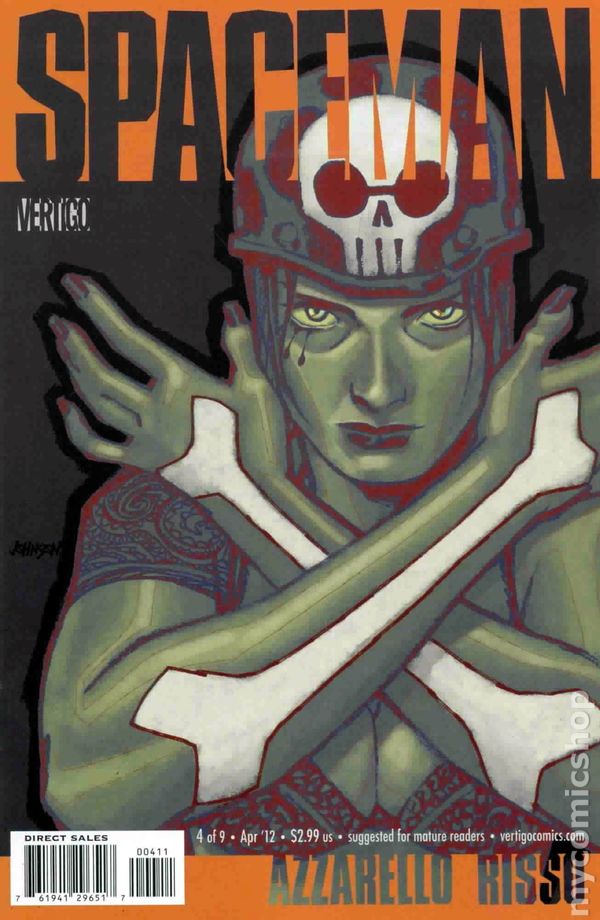
Spaceman #4

"Circus Dead" (4 of 9)
written by Brian Azzarello
art by Eduardo Risso

Although it's not exactly surprising, given his easy rapport with the friendly, drug-peddling children in his dockside slum, Orson's most reliable conspirators in keeping the kidnapped (then rescued by Orson) celebrity orphan Tara safe are those same kids.  They are seemingly the most reliable and honest people in Orson's life and, it turns out, Tara's as well.

The adults of Spaceman—the socially distant residents of Orson's neighborhood, the sheik and his goons who kidnapped Tara, the pirates who re-kidnapped her and manufacture new ways to exploit her prolonged disappearance with another kid after her rescue, her beautiful but difficult-to-read and sometimes short-tempered reality-show adoptive parents, their reality show directors and managers, the seemingly competent but brusque cops on her case, and Orson's internet sex appointment and her pimp—are, to a man, self-serving.  If their motivations are genuine, it's impossible to detect with any certainty.  It's no wonder that Tara takes so quickly to Orson, whose protective instincts must seem foreign.

Orson is stigmatized by his "Spaceman" origins, though as of yet, the precise details about why are unclear to the reader.  He is ostracized by human adults, and whether its because children are better judges of character or whether its because these kids are just too young to remember the Spaceman controversies, they're the only ones who will socialize with him outside the most minimal (if polite) of necessary interactions.  The sex professional hired by Orson didn't know he was a Spaceman, and when she finds out, she freaks out.  Orson must eat alone, at a table by himself.  Until now, the implied boundary between human and Spaceman was less well-defined, but "Circus Dead" makes it a major thematic point.  In his Mars episode, Orson and the other Spacemen must decide their priorities and confront their purpose.  Are they, as Spender insists, designed only to help mankind?  Can they pursue their own financial interests, as Carter and, it seems, Orson want?  Or are they, as Ottershaw concludes, part of mankind themselves?

[April 2012]

Saturday, May 18, 2013

Spaceman #3

"Past 1,000,000" (3 of 9)
written by Brian Azzarello
art by Eduardo Risso

Orson and Tara may arrive back and settle in at Orson's place, a decision NOT to return her home that is simultaneously stupid and savvy, but Spaceman #3 is mostly about her pursuit, both by the cops investigating her supposed kidnapping and by the sheik who ordered it.  Azzarello's disheartening and satirical vision of a world in which well-meaning but vacuously beautiful celebrities preoccupy public attention and reality television is more powerful than news outlets continues here, but surprisingly it's also a world filled with people who are more or less competent.  Policeman Wade, for instance, seems basically capable at his job and invested in Tara's return.  The intentions of these characters and their faith in Orson seem by the end of the issue poised to be tested, when both the neighborhood kids friendly with Orson and his prostitute confidante become aware of Tara's temporary residence with him.

"Past 1,000,000"'s best surprise, one that continues to complicate the relationship between Orson's fantasies about Mars and the events surrounding Tara, comes in its final few pages, in which Orson's fellow spaceman appears as a notorious bounty hunter hired by the sheik to locate Tara.  Like the Mars mission, in which he finds veins of gold by exploding the terrain and repurposes his companions in a new mission while they await reconstruction of the greenhouse, Carter is primarily interested in money.  What makes this of particular interest is that Orson is currently unaware of his involvement, making his incorporation into Orson's dreams a difficult aspect to reconcile with the general perception of what those dreams actually are or represent.

[February 2012]

Friday, May 3, 2013

Spaceman #2

"Chapter Two:  Missing Control" (2 of 9)
written by Brian Azzarello
art by Eduardo Risso

Orson may get badgered by the local kids for having the mental abilities of a child, but he certainly shows some swift thinking and a facility for deceit in his negotiations with Tara's kidnapper.  He feigns interest in his plan, lies about the strength of his "numb," and incapacitates him long enough to make an escape even if already being chased by another band of pirates drawn by the explosion.  If Spaceman #1 was about Orson's bravery—his willingness to rescue survivors of a boat fire at sea in hostile waters and his volunteering to brave the storm to save the Mars greenhouse—, then Spaceman #2 is about his keenness under pressure--his deception of the kidnapper and his quick-witted removal of his oxygen tank prior to the greenhouse explosion.

Although it still appears to be a fantasy world, i.e., Orson's imagining about the Mars mission he was engineered for, his exploits as a NASA astronaut are not as easily dismissed here as they were in #1.  Like the kidnapping plot, the trouble with the Mars greenhouse continues from the earlier issue.  Orson is not imagining independent adventures; he's imagining an entirely different plot, one that uses head trauma to connect with his current situation.  Either Orson is integrating or something more elaborate is going on here.

We also get, for the first time, a glimpse at Orson's past as a living genetic experiment caught in the throes of a culture war that simultaneously made him an outcast and a celebrity.  Their existence revealed at the edge of economic collapse and looming military threat from the Middle and Far East, Orson and his fellows get shuffled off into orphanages and forgotten with a tidy little news story.  It's precisely his tumultuous childhood that allows him to relate to the young kidnapped Tara, stolen as bounty for a pedophilic sheik after winning her celebrity adoption through a reality competition show.  It's not a relationship that demands investment yet, and the thematic strength of future issues will depend on whether or not Azzarello can credibly further their friendship.

[January 2012]

Monday, April 22, 2013

Spaceman #1

"Chapter One:  This I Land" (1 of 9)
written by Brian Azzarello
art by Eduardo Risso

"My life didn't come true" (Spaceman #1: 9).

Azzarello's vision of the future in Spaceman is singularly bleak.  The world is over-populated, over-polluted, and distracted by reality entertainment, sex, and drugs.  His protagonist Orson is a by-product, an apish man—with a heavy brow, a protruding mouth, large shoulders, long arms, and generous body hair—with low intelligence, engineered for travel to Mars, though his assignment never happens.  Instead, he's a fisherman whose confidante is an electronically facilitated distance-prostitute and whose friends are primarily drug-dealing kids, still dreaming of his would-be Mars mission, or with a little chemical stimulus imagining himself very literally on another world.  Though he's polite, gentle, and despite his intellectual shortcomings, fully understands his own position, there's little to redeem Orson's life.

By the end of Spaceman #1, though, Orson may have his opportunity to do and be something extraordinary.  Fishing well outside waters considered safe, Orson stumbles across a boat explosion.  In his efforts to help, he discovers the abducted adopted kid of mega-celebrities—chosen to be adopted, it should be noted, on a reality competition show—and, presumably, at least one of her kidnappers.

Azzarello's certainly got some interesting ideas in play with Spaceman, and though it's at times distracting, it probably helps that his futuristic slang slows the reader down.  The premise of a hero genetically designed for a specific purpose he is unable to realize is potentially fertile, and his depression and disappointment are inevitable, but the world Azzarello's built for Orson is so numbing throughout the issue that it's difficult to imagine relief for it.  It will take at least another issue or two to know whether his gamble with the tone pays off.

[December 2011]