Showing posts with label Jean-Paul Csuka. Show all posts

Tuesday, August 20, 2013

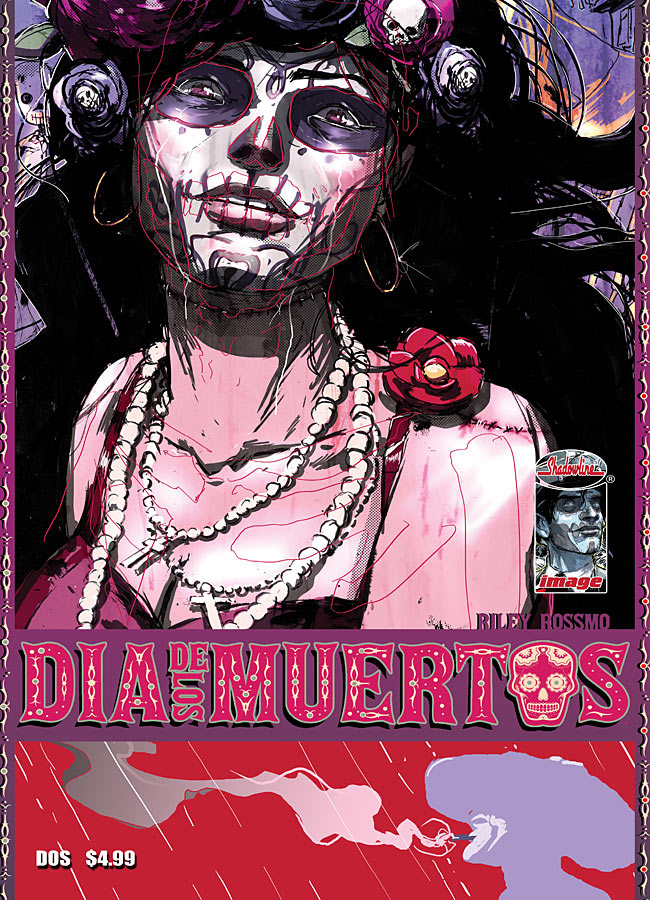
Día De Los Muertos #2

Dos
"Mine"
written by Joshua Williamson
art by Riley Rossmo
colors by Megan Wilson

"The Skinny One"
written by Ed Brisson
art by Riley Rossmo
colors by Megan Wilson

"Hellqueen"
written by Jeff Mariotte
art by Riley Rossmo
colors by Jean-Paul Csuka

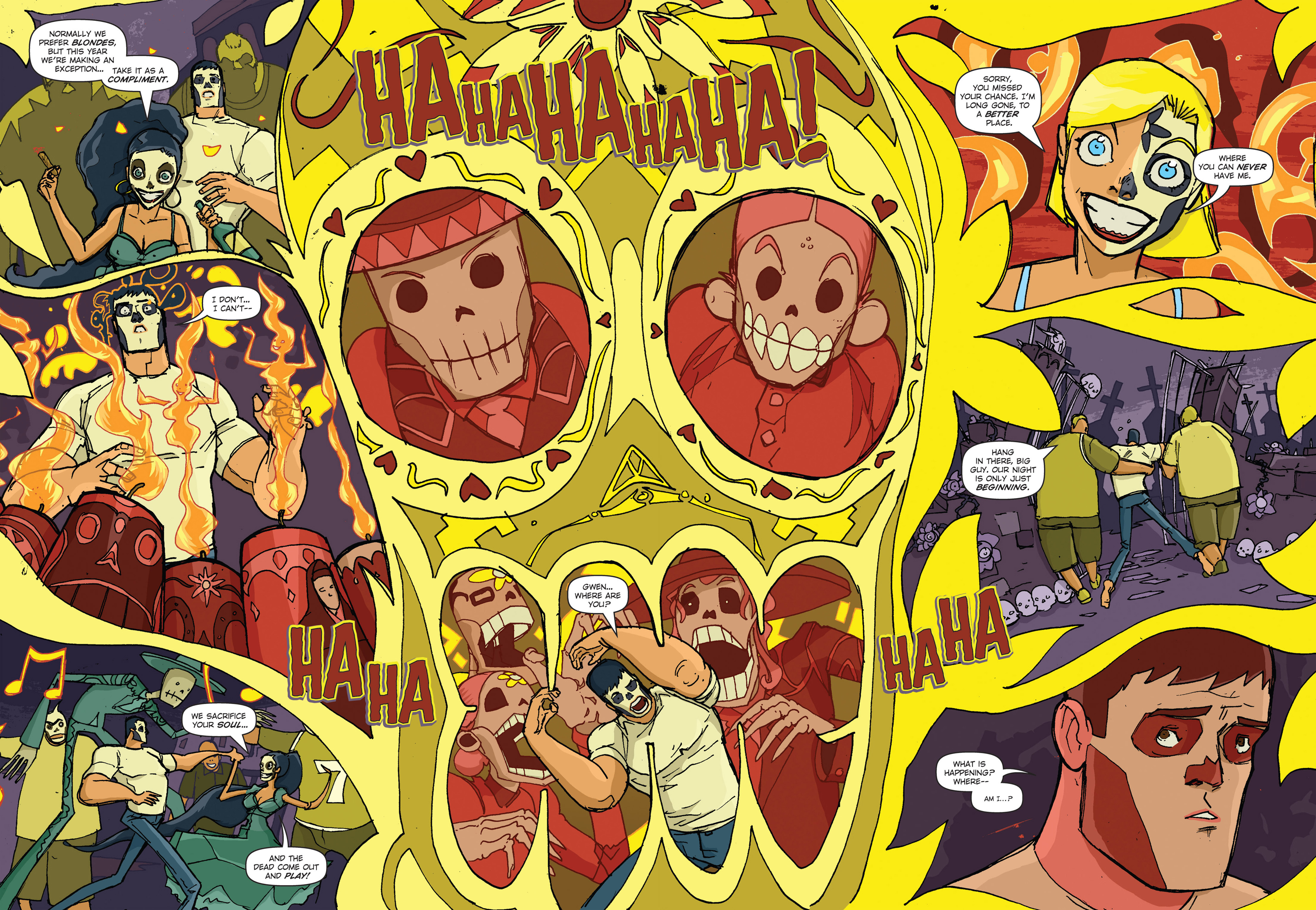
The first collection in Día De Los Muertos was occasionally dark to be sure, as any exploration of death is likely to be, but the second installment of Rossmo's themed comics is decidedly darker than its predecessor.  "Mine" initially seems little more than a stylish murder mystery when Gwen disappears during a Day of the Dead festival while on a Mexican vacation with her friends.  Her apparent champion is our unnamed narrator, a man with a very imposing physique and a dogged personality who discovers Gwen to be the latest victim of a serial murderer who specializes in beautiful blonde women who get their faces painted for the festival.  It seems for a while that, like George Sluizer's film Spoorloos (The Vanishing), her lover was about to share her fate, but quite unexpectedly it turned into a battle of competing serial killers, one ambushed by the other seeking revenge for stealing his special target.  Rossmo is responsible for all the artwork in Día De Los Muertos #2, and the variety of styles really testifies to his range, but his work in "Mine" is probably the most beautiful in the issue.  In particular, the two-page spread during the narrator's drug-induced trip (pp. 6-7) is very fine, beautiful and unsettling.

"The Skinny One" is far more straight-forward than "Mine" and a fine companion story to "Reflections" from Día De Los Muertos #1.  It is a story of bringing the truth to light.  On the Day of the Dead, the spirit of a dead, young train-hopper returns to the station of the abusive Mexican policeman who killed him, who is himself hoping for a visit from the spirit of his beloved wife.  But the boy doesn't come alone; he brings with him many other of the policeman's victims as well as Marissa, the policeman's wife.  In feeble defense of himself Jorge continues to throw slander at the ghosts, attacks their credibility as outsiders, and refuses to acknowledge his violence, but to no avail.  Hearing none of his excuses and denials, she leaves him, an embarrassment to her memory and no longer her love.  At first "The Skinny One" is a little difficult to follow, since there is little visual distinction between current events and the memories of its ghost, but once it settles in, it is easy to appreciate.  The strangely 'toon-ish aesthetic works well for its victim children, and the generous use of page-white throughout sets up Rossmo's evocative isolation of Jorge on the final page.  It is the account of a man who, though not held accountable for his corruption and cruelty during life, is by the dead, whose judgment is ultimately more important.
In contrast to the sobriety of "Mine" and "The Skinny One," though each uses it to widely differing effect, "Hellqueen" is a surprisingly humorous if morbid contribution.  Low-level, would-be gangster Gilberto and his younger brother Gabriel, whom he's trying to recruit into the life, are tasked with spiking several severed heads on a local bridge for dramatic effect on Día de los Muertos.  Gilberto is as puffed up about his newly discovered "importance" as he is wrong, convinced of his own power and the desirable things it brings, but in Mariotte's words, he's quite pathetic.  The gore is gruesome, but played for laughs, both absurd and brutal.  When visiting the grave of their grandmother after finishing the job, they are suddenly captured by demons and dragged through a hellmouth, summoned by the queen of Hell, who as it turns out is their grandmother.  And she's not happy with their lifestyle choices.  She berates them, scolds them, humiliates the demons under her rule with her magic spatula, and sends her grandsons back to the graveyard, freshly terrified and motivated to clean up their lives before they burn in Hell with the others.  Their first demonstration of their reformation:  picking up the litter in the cemetery!

Saturday, August 10, 2013

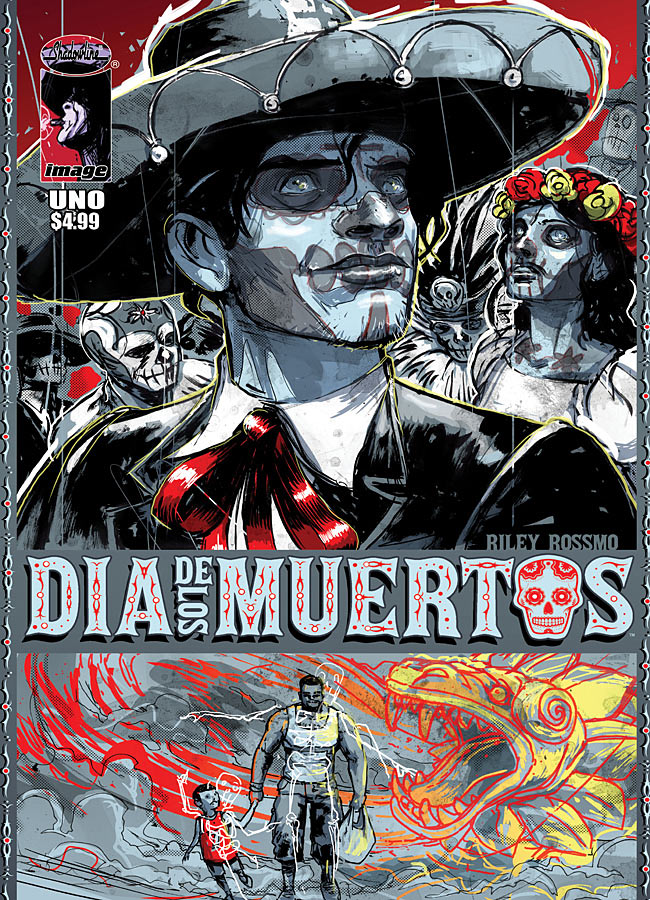
Día De Los Muertos #1

Uno
"Dead, But Dreaming"
written by Alex Link
art by Riley Rossmo
colors by Nick Johnson

"Reflections"
written by Christopher E. Long
art by Jean-Paul Csuka
colors by Riley Rossmo

"Te Vas Ángel Mîo"
written by Dirk Manning
art by Riley Rossmo
colors by Megan Wilson

In the first of three issues, artist Riley Rossmo has assembled a collection of shorts thematically tied to the Mexican Day of the Dead.  Each of the stories is a fine meditation on death, in particular the toll it can take on the living.  In "Dead, But Dreaming" a grown woman Katrina—a sly nod to La Calavera Catrina, the lady skeleton in fine clothes ubiquitous around the holiday—visits the Deadlands to find her mother who died giving birth to her.  It is a vision of death that is as vibrant and dangerous as it might be, and its heroine Katrina—beautiful, liberally tattooed, with long, wild hair and a fondness for her skeleton-helmed motorcycle—is fierce but vulnerable, still guilty for her mother's death and so eager to meet her.  This longing, never realized within the story, since Katrina never does meet her mother, is nevertheless content, feeling through her unexpected salvation in the Deadlands that her mother does love her and does not blame her daughter for her early death.

If "Dead, But Dreaming" tantalizes the reader but leaves the story unfulfilled yet hopeful, "Reflections" is refreshingly complete.  It is a ghost story, a mystery.  Hired to resolve a conflict with ghosts which lands a father Walt in the hospital, ghost-liaison Zan returns to the home they haunt.  It is swift paean to justice and as Zan calls it "laying bare the truth".  Using a mirror, a not so subtle instrument to reveal the truth, he recognizes the dead as ancestors protecting Walt's two young daughters.  Though his specific sins are never enumerated and Zan himself doesn't take any action against the abusive father, his ancestors—in a rush of supernatural verve reminiscent of Poltergeist—take care of Walt with the very mirror in which they are revealed.

In the final of the first three stories "Te Vas Ángel Mîo," a mariachi singer still mourning the death of his lover, spends the night with a strange but beautiful young woman.  Unlike Día De Los Muertos' other offerings, this one is written partially in Spanish with an English echo, a celebration of the beauty of the language as well as an appreciation of the culture.  It also mimics the nature of the lady, who herself seems an echo, an echo of both Juan's words and his former lover Aislara.  Whoever...or whatever...she is, "Te Vas Ángel Mîo" is a bittersweet lyric of lost love and hard comfort.