Showing posts with label Joe Hill. Show all posts

Friday, June 7, 2013

Locke & Key, Volume 4

Keys to the Kingdom
written by Joe Hill
art by Gabriel Rodriguez

The already stellar Locke & Key takes a turn for the more adventuresome and ambition in Keys to the Kingdom.  Joe Hill takes greater creative risks in his storytelling style in several of the issues in this collection, and he pulls off every one of them with spectacular aplomb.

"Sparrow," the first in the mini-series and a tribute to Calvin and Hobbes cartoonist Bill Watterson, is a structural delight:  a collection of pages each with four syndication-style panels, which culminate in a mini-climax punch-line of their own.  It is, in other words, an exercise in writing a comic book in the style of newspaper comics, and it doesn't miss a beat.  Rodriguez does a striking job imitating Watterson's illustration style for Bode's world, in contrast with the style he's already developed for the series in panels told from the perspective of the other characters.  The episode's sad and quietly heroic ending proves just how much Hill can do within the considerable restraints he gives himself.

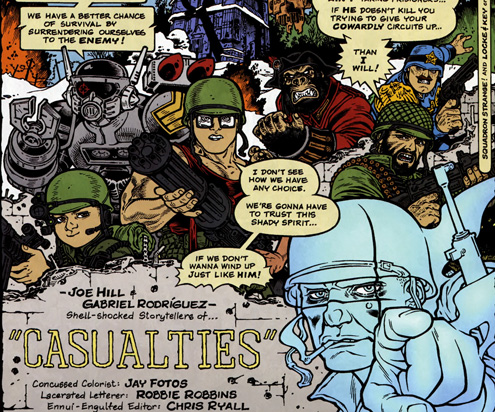
The second of these issues is "Casualties," an issue analogized to classic comic book forms, an imagining of Rufus's world from his perspective.  Locke & Key's Cassandra, able to see the truth—Keyhouse's ghosts and supernatural features as well as Zack's true character, and immune to the Head Key (and perhaps others)—but unable to communicate what he knows to others, Rufus is a delightful voice in the series.  His easy interaction with Bode, two boys with difficulty making friends, albeit for very different reasons, is a welcome, if brief, respite from the constant danger posed by Zack and his search for the Omega Key.  The titular casualty, however seemingly irrelevant, is actually quite touching, a loss felt as genuinely by the reader as by Rufus.

Keys to the Kingdom also raises the stakes considerably.  Zack's assault on the Locke family reaches a fevered pitch even in early issues.  His wolf attack in "Sparrow"—complete with the parasitic apparatus, first seen in his ghostly talk with Sam, on his back—is brutal and bloody and clearly fun for him.  By the end of "Detectives," Zack has accomplished the unthinkable.  Bode, always the heart and innocent center of Locke & Key and the Locke family, simultaneously its strongest and most vulnerable member, is seriously threatened, forced through the ghost door and re-inhabited by Zack himself.

But just as these events are growing more and more perilous for the Locke children, Tyler Locke is growing into a man capable of battling it.  He may be dealing with an angsty break-ups with both his girlfriend and his friend—same incident—and struggling to accept his sister's relationship with another friend Zack, but he also starts showing a lot of maturity in his school work and personal life.  Most importantly, however, he quietly and independently starts to suspect Zack of being the Dark Lady, begins systematically piecing together the details of her attacks in an attempt to solve their mystery.

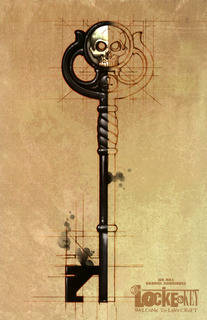
The Keys:

Animal Key, when used with the Animal Door, allows its user to turn into his or her animal counterpart until he or she returns through the door.

Skin Key allows its user to alter his or her racial appearance with the attached mirror until it is changed back using the same key.

Jester Key, when used with the Jester Door, opens a secret closet full of key-related gear and paraphernalia, including the Hercules Necklace, Angel-Wing Harness, and the Music Box.

Angel Key (or Engels-Schlüssel), when used with the Angel-Wing Harness, allows its user to fly.

Hercules Key (or Herkules-Schlüssel), when used in combination with the Hercules Necklace, gives its user superhuman strength and pleasure in employing it.

Philosophoscope Key, when used with the Philosophoscope itself in Keyhouse's observatory, allows its user to discern the truth about a range of people:  Best Teacher, Truest Love, Usefullest Soul, Untrustworthy Ally, and Grave Hazard.

Music Box Key, when used with the Music Box, forces those who hear its song to obey the words it sings, controlled by the user of the key.


Collects Locke & Key: Keys to the Kingdom #1-6:  "Sparrow," "White," "February," "Casualties," and "Detectives," Parts I and II

ISBN:  978-1600108860


Sunday, May 19, 2013

Locke & Key, Volume 3

Crown of Shadows
written by Joe Hill
art by Gabriel Rodriguez


Crown of Shadows takes place in the immediate aftermath of Head Games.  The night after Duncan's lover Brian is hit by a car and Zack Wells, formerly Luke "Dodge" Caravaggio, takes the memories or lives of anyone who knows his past, Nina must break the news to her children.  Meanwhile, life in the Locke family, particularly for Nina, is continuing to spiral.  Still traumatized by the death of her husband and her assault and rape, Nina continues to drink herself into crippling alcoholism.  Her actions—particularly her disabling self-hatred and irresponsible decision making—are beginning to alienate her children, especially the newly fearless (quite literally) Kinsey and Tyler, who's taken on several of the parental roles in the absence of his father and the poor state of his mother.  This portrait of a broken mother as both sympathetic and unacceptable is characteristic of what makes Locke & Key so excellent.  It does not make excuses for Nina, but it makes her human.  Because as an adult she is unable to recognize the keys' magic without being in an "altered state," Nina remains in many ways on the periphery of the series' central story—i.e., the rediscovery of the keys by the Locke children, the corresponding machinations of Zack/Luke/Dodge, and the slowly unveiling history of Keyhouse, including the childhood of Rendell Locke—but it does not deny her a full characterization.

Crown of Shadows also features the return of Sam Lesser, a ghost at the hands of Zack and left to haunt Keyhouse.  However, unlike the desperate, empty Sam of Welcome to Lovecraft, he now has a much clearer vision of himself, one that continues to feel more pity for himself than regret for his violence against the Locke family, but one that stands poised to act against Zack if he can find a way how.  We also begin to discover more about Zack himself, in particular the parasitic hardware in his back that seems to control his thoughts.  He is, as we have begun to suspect, not entirely human, and his increasingly desperate search for the mysterious Omega Key something to be genuinely feared.

Meanwhile, the newly fearless Kinsey begins to make her own discoveries about her family's past.  Her nearly fatal trip to the Drowning Cave reveals to her the names of her father and his band of high school friends, whose own trip in 1988 seems to have jump-started much of the current action:  Rendell Locke (recently deceased), Erin Voss (institutionalized), Kim Topher, Ellie Whedon (track coach housing Zack), Mark Cho, and Luke "Dodge" Caravaggio (Zack Wells).  More importantly, the reader (unlike Kinsey) sees a corpse at the bottom of the cave, one that looks suspiciously similar to Luke/Zack, particularly in his black dress from the Wellhouse.  All of which contribute to Locke & Key's general storytelling acumen and betray Hill's tight plot structure, which seems to have known all along EXACTLY where it was going and to have dropped hints, both textual and visual, from the very, very beginning.  Locke & Key is less a comics series than a long graphic novel, in the structural sense, each act building on the last, leaving no detail behind.

Rodriguez continues to prove his style perfect for Hill's particular brand of horror, which relies heavily on visual and cinematic strategies for its effects.  Some of Locke & Key's most frightening sequences are its silent panels, much like the first page of Crown of Shadows #1, which captures Zack's sneaking violations of the Locke family's home and heads.

The Keys:

Giant Key, an enormous wooden key which fits a lock-shaped window of Keyhouse, enlarges its user to gigantic proportions.

Shadow Key opens a small door in the basement of Keyhouse, which leads to the Chamber of the Living Shadows, which houses the titular Shadow Crown.  When fitted into the crown, the key activates it, allowing its wearer to control the newly animated and corporal shadows of the house.

Mending Key, when used with the iron mending chest, repairs what is physically broken or injured to its former state.

Collects Locke & Key: Crown of Shadows #1-6:  "The Haunting of Keyhouse," "In the Cave," "Last Light," "Shadow Play," "Light of Day," and "Epilogue: Beyond Repair"

ISBN:  978-1600106958

Tuesday, March 12, 2013

Locke & Key, Volume 2

Head Games
written by Joe Hill
art by Gabriel Rodriguez

Following almost immediately on the events at the conclusion of Locke & Key's inaugural mini-series, Welcome to Lovecraft, Head Games begins as the dangerous and mysterious creature from the wellhouse—now, newly re-re-gendered, introducing himself as Zack Wells and staying with Ellie Whedon as her "cousin," formerly Lucas Caravaggio, nicknamed Dodge, and close friend of Rendell Locke—befriends the new generation of Locke siblings, insinuating his way into their confidence.  And Zack/Luke/Dodge makes a great villain.  Cold-blooded and ruthless, he continues (as before) to seduce and intimidate those he needs to use and kill those who pose a threat.  Among the latter is Joe Ridgeway, an aging teacher who recognizes Zack as Luke and whose memories of Caravaggio begin to illuminate further Zack's mysterious past in Lovecraft, Massachusetts.  Despite several important revelations about his history and character, by the time Head Games concludes and we discover how most immediately Zack came to be at the bottom of the well, we still don't know exactly who or what he is...or why their school production of Shakespeare's The Tempest was so magical.

As an independent mini-series, Head Games is primarily about memories, what we remember and how we relate to those memories.  Like Welcome to Lovecraft, its central narrative concerns are thematized by its most prominent key.  The Head Key itself, pulled out of the pond by Bode with his magnetic "treasure-hunting" fishing rod in the closing panels of Welcome to Lovecraft, is a golden idea, one that fellow comics writer Warren Ellis laments that he himself had not had in his introduction to the volume.  It literalizes the head-as-storage-chest metaphor for memory, which can be opened, rifled through, sorted, and most importantly cleaned out or filled.  And Bode, with his characteristic boyish unflappability, finds it fascinating, though his siblings—at least initially—find it gruesome and unsettling.  Each, though, soon finds ways to put it to use for them.  Following on Bode's success with The Chef's Bible and feeling the pressure of mounting school work and nearing deadlines, Tyler starts by shoving textbooks into his brain and quickly discovers that he can make use of it to gain social leverage with his peers and, most importantly, his crush.  Frustrated at her reactions to the Locke family's recent trauma, Kinsey chooses to rid herself of fear and the ability to cry, which she traps in an empty soda bottle with surprisingly comedic results.

On the whole, whatever is happening currently with the Locke family, Head Games spends much of its time in the past, directly or indirectly.  It begins to accumulate—and then eradicate—details of events twenty years prior, involving the drowning deaths of several high school students, including Lucas Caravaggio, in particular, a memory of Duncan's, in which he remembers following his brother and his friends into a cave below the cliffs.  The already shadowy history of Caravaggio continues to recede, falling away from the other characters just as they are recovered.  The exception here is Rufus, Ellie Whedon's mentally handicapped son, who unlike the others is invulnerable to the Head Key's powers.  Although, like the others who all code their memories differently, blending them as much with imagination as reality, Rufus's observations are re-coded into his own brand of military jargon.  However, he proves far more perceptive than Zack gives him credit for, and therefore flies somewhat beneath his radar and consequently is not treated as other threats.

Like its first arc, Locke & Key continues in its details to show a strong awareness of the larger mythology and of the long history of Keyhouse.  This is nowhere more evident than in Bode's hunt for his new key's matching door, during which the reader is treated to a series of so-far unused but mysteriously antique doors in all parts of the house.  Hill knows where he's going with this series, he isn't afraid to drop hints, and the story we get here is the better for it. 


The Keys:

Head Key allows its user to open his or her head—literally, as a cranium-box, whose keyhole appears magically at the nape of the neck when the key is nearby—and insert or remove whatever he or she wishes.

Echo Key, when used in conjunction with the Echo Door in the wellhouse, brings back a dead loved one as an echo, who must remain in the wellhouse or face fading away unless an alternate door is found.  As an echo, like a ghost from the Ghost Door, they possess all the associated characteristics, such as levitation and the ability to project echoes into empty spaces even far away.

Collects Locke & Key: Head Games #1-6
ISBN:  978-1600104831

Wednesday, February 13, 2013

Locke & Key, Volume 1

Welcome to Lovecraft
written by Joe Hill
art by Gabriel Rodriguez

What subtlety Locke & Key lacks in title and town name—Lovecraft, from whom its mythological underpinnings and horror tone draw inspiration—it makes up for in excellent storytelling.  Relocated to a family mansion in Massachusetts named Keyhouse, a house as mysterious as it is unlikely, after a deadly home invasion by a vulnerable and unstable teen, the remainder of the Locke family soon find themselves again in danger from a strange creature living on the grounds.  As an opening chapter, Welcome to Lovecraft lays the foundations for a number of promising narrative possibilities:  the plethora of house keys, each presumably with its own door and magical power; the identity of the strange and seductive "echo" in the wellhouse; and the histories of the Locke family, particularly that of dead patriarch Rendell who seems once as a teen to have discovered many of the keys' secrets, and of Keyhouse itself.

Much like his father's, horror novelist and fellow Maine native Stephen King, Hill's New England is a moody, gothic landscape, which like Keyhouse itself is layered with half-forgotten histories of its residents and constructed to preserve their mysteries.  It's an aesthetic which Hill employs very knowingly and not entirely without humor, as when Tyler quips to his uncle Duncan upon their arrival in Massachusetts, "Was it weird to grow up in a house with a name?"  In this way, Hill invests his setting with a mystique independent of his other characters, with a personality all its own.  Perhaps most puzzling, given the apparent dangers lurking in Keyhouse's forgotten places, is Rendell Locke's conviction that his family would be safest there and his faith in the house's own inherent intuition, as Tyler recalls in a flashback at the funeral.

On its own, Welcome to Lovecraft is a rousing good horror thriller with villains both visible and hidden, known and mysterious, and protagonists both flawed and sympathetic.  The Locke family is convincingly faulty, full of character blemishes and insecurities that make them interesting and believable, particularly as survivors of personal trauma.  This resonates most with eldest brother Tyler, whose angst-riddled relationship with his father and whose violent role in defending his family from their attackers continue to burden him.  None, though, is more pleasantly surprising and refreshingly resilient than its most taciturn member, Bode.  The youngest sibling in the Locke clan doesn't get a great deal of dialogue, but thanks to some hilariously believable visual characterization by Rodriguez and his family's perceptible exasperation at his boyish mischievousness, Bode pervades the entire story.  At the edges of the family's troubles in California and kept uninformed about the lingering threat, Bode instead stumbles into the middle of Keyhouse's supernatural intrigue.  His impetuous curiosity and fearlessness make him most receptive to the weirdness, which he explores with unflappable wonder.

The Keys:

Ghost Key, when used with the Ghost Door, temporarily kills its user, who with his body being dead may wander then as a ghost within the grounds of Keyhouse, being flashed instantly to people, places, or objects he thinks about or to people who are thinking about him.

Anywhere Key transforms any door with a keyhole into any other door its user can clearly visualize.  Its use is not limited to Keyhouse.

Gender Key, when used with its corresponding door, transfigures its user into the opposite gender.

Collects Locke & Key: Welcome to Lovecraft #1-6
ISBN:  978-1600201370