Showing posts with label James Robinson. Show all posts

Sunday, March 9, 2014

Starman #8

"A (K)night at the Circus II"
written by James Robinson
pencils by Tony Harris
inks by Wade Von Grawbadger

With the clarity that comes as anger abates, Jack Knight gets a sudden jolt of perspective.
"For a moment there, I thought like a hero.  A big, tough, two-fisted, brightly-costumed hero.  And then I glanced at myself in the mirror."  (Starman #8: 1)
After losing a fight quite fantastically to a circus goon, Knight spoke heroic words, full of bravado and defiance, with little consideration for sense or moderation, words spoken in fiery indignation.  Now he must return for the strange, plaintive blue man with some plan to rescue him...or no plan, mostly none.  But he goes in anyway, partly perhaps out of some sense of obligation to his father, but mostly because someone must.

Jack Knight walks in mostly blind, and he finds his adversary far more powerful than anticipated—an incubus, ironically named Bliss, feeding off of the uniquely savory pain and humiliation of his "freak show"—but Knight finds far more allies than he imagined, weak and sometimes in Bliss's thrall, but eager for freedom and generous with information.  When his victory does eventually, and inevitably, come, it is at the side of Mikaal Tomas, the very man—a brief and very different former Starman—whom he came back to emancipate.  It's fitting enough, but hardly as meaningful or as soulful as Robinson seems to want it.  Instead, the issue's most powerful moment is easily its final splash.  At first glance, its a celebration with Knight's own self-instructions to make sure he receives payment—in the form of posters and props—for his service.  But it's Mikaal's longing and tearful and startlingly unengaged stare at the sky that steals the issue.

"A (K)night at the Circus II" tenses under some of its own anxieties.  There's a kind of uncanny beauty in physical peculiarities, in strangeness itself.  The line between looking and gawking is always a movable one, especially for the person on the other end.  But Starman is also a series that has shown great interest in cultural relics:  previously vaudeville, here the Dust Bowl freak show.  Why a "special person" would be more delectable for Bliss is otherwise unexplained, since other than Mikaal the freaks all seem human.  Starman and Robinson walk a strange line:  these are whole and complete characters with painful insecurities and strong wills, but the comic—like Bliss—insists that they are different, and though Knight may berate himself softly for imagining Tod Browning as an acceptable model for viewing these "freaks," we too are asked to marvel at their (admittedly fictional) oddities in Harris's fine artwork.

[June 1995]

Sunday, February 9, 2014

Starman #7

"A (K)night at the Circus"
written by James Robinson
pencils by Tony Harris
inks by Wade Von Grawbadger

I suppose it could be called urban prejudice, Jack Knight's uncanny foreboding in the dramatically rural farmland surrounding Opal City's abrupt city boundary, but in Robinson's sometimes purple but always gripping prose it becomes something almost magical.  His choice of pop culture reference is "American Gothic" by Grant Wood, erroneously interpreted as a husband and wife (rather than father and spinster daughter) keeping their dark midwestern secrets.  A more suitable painting might have been "Christina's World" by Andrew Wyeth, desolate and grey and seemingly malevolent.  There's a wildness and unpredictability to the landscape, as full of treasures and oddities as it is rife with uncertainty and danger.

It's in this strange, otherworldly territory that Jack Knight stumbles on a traveling circus, a somewhat anachronistic curiosity, a relic from the early century.  But it's the Freak Show that draws his attention, invited to marvel at its peculiar collection of physical aberrations like a warped echo of his own world of superheroes and villains.  Here he meets another Starman, Mikaal Tomas the "cosmic geek", enslaved by a devious carnival operator, who suggestively hints that all his freaks are real.  Deceived by the circus master and attacked by his legion of oddities, Jack Knight is left for dead in the grassy field outside the circus tents.  It is possible that only a few weeks ago, prior to his brother's death and the return of the Mist, Jack would have gone home wondering at the weirdness of his day, licked his wounds, and never returned.  But it is not likely.  It is precisely Jack's sense of justice, offended by the blue alien's enthrallment, that makes him the hero he is.  The staff and the superhero trappings are just decoration.

By integrating Mikaal Tomas, Robinson begins to make good on his tease from Starman #3, his predecessors and fellows scattered around the universe.  It's a promise that lends depth to Robinson's universe, one that reaches into Starman's past for continuity.  Jack Knight would approve.

[May 1995]

Friday, January 31, 2014

Starman #6

"1882 Back Stage, Back Then (A Tale of Times Past)"
written by James Robinson
art by Teddy H. Kristiansen
additional pencils by Christian Højgaard, Bjarne Hansen, and Kim Hagen

The Shade is something of a literary curiosity, a traveler from the milieu of Dickens and Wilde to Robinson's history-saturated Starman series.  He is, in Jack Knight's world, a man out of time, still donning his top hat and stylishly brandishing his eagle-headed cane.  He speaks with a thick poetry and writes with flourish, an aesthete with a particular fondness for the past.  It is perhaps for this very reason that Jack Knight—against his sometimes better judgment—finds him so compelling.  They are, in some strange, anachronistic way, of similar temperament.

But if Jack's defiance is motivated more by a sometimes misguided sense of independence, the Shade is morally slippery to be blunt, as comfortable slaughtering an entire theatre troop as defending a young woman from their predation.  He is a mercenary, if one doggedly faithful to his promises and sincerely invested in the future of Opal City.
"So am I, my boy.  Perhaps little if nothing more...  ...but I am a man of my word." (Starman #6: 6-7)
"1882 Back Stage, Back Then" is a dark little tale, a vaudevillian horror fable of deceit and retribution, of a gentleman who moves through the shadows.  Like Wilde's The Picture of Dorian Gray, alluded to frequently and without much subtlety in the episode, it is a gothic fiction, a Faustian tale culminating in the greedy and lecherous Lune's dramatic death among the carnage of his conspirators strewn across the stage with the devil leering on.  Again, like Wilde, the details are suggestive but opaque:  the waifish, flaxen-haired boy; the lavish, French-styled theatre; the menagerie of carnival performers; and, most of all, the rose he demands as payment from young Wayville and, of course, the missing page in his journal.  Jack Knight is perhaps right in thinking he might not want to know, but the mystery is so tantalizing, we just can't help ourselves.

[April 1995]

Monday, September 23, 2013

Starman #5

"Talking with David, '95"
written by James Robinson
pencils by Tony Harris
inks by Wade Von Grawbadger

David's a difficult Starman to like.  No doubt, it's partly because most of what we've seen of David is through the eyes of his younger brother, but even when it's not, he's proven to be petty, hostile, and belligerent with Jack.  Robinson doesn't yet illuminate the circumstances of Jacks' graveyard visit with his dead brother, but he takes the opportunity to humanize the elder brother.  David is insecure, unsure of who he actually is, and envious of Jack because he knows, and probably because he's still alive.  But that doesn't keep him from still being an ass.

David taunts and antagonizes Jack from the beginning, steadfastly refusing to tell him exactly where they are—dream and afterlife excluded—just "'cause," though he subsequently tells Jack that it's not his secret to tell, and jumping Jack because he's now Starman, despite Jack being reluctant to assume the role.  Between the two of them, they wreak some havoc on the graveyard, upturning graves and breaking headstones, and they spend most the night trying to repair some of the damage they cause, which unlike destruction, as most superheroes find out, is usually unable to be accomplished with superpowers or extra-special superhero gadgets.  Eventually, the two make enough peace to last a year.  David makes some minor amends, but more importantly he clears the air for Jack to more openly and confidently embrace the hero that he wants to be without the oppressive expectations of what his father and his father's tradition demand him to be. 

The decision to make this a black-and-white issue, aside from David's gaudy Starman costume, is a bold one that pays off in both the general unearthly mood it strikes and the impact that the first full-page, full-color panel of David flying away with the rising sun provides.  Whether or not this coloring choice is indicative of just where they are is provocative but ultimately irrelevant.

[March 1995]

Monday, September 16, 2013

Starman #4

"A Day in the Opal"
written by James Robinson
pencils by Tony Harris
inks by Wade Von Grawbadger

Jack continues to bring his off-beat pop culture perspective to bear on his fledgling superhero career.  He may have grown up in a superhero family, but he never understood their world the way they saw it.  Instead, he makes sense of his own life through the things he loves:  pop artifacts from bygone eras, art house film, urban myth, and his city's art and architecture.
"What?  No.  Look, I hate to sound rude, but this is all a bit too...   ...Bergmanesque for me.  Weird, half-finished bits of sentences.  Strange stares.  Pregnant pauses.  That might work in a Calvin Klein commercial, but not with meActually, I'm thinking of Felliniesque, aren't I?  Man, how embarrassing... getting my "esques" mixed up."  (Starman #4: 14)
And he's talking to just the right man:  the Shade, who also sees his own life in its relation to the art of his age, loves Opal City and its textured past, and suspects Jack might be something special that he doesn't even yet realize.

Robinson's prose can get a little purple; his description of the music of Opal City—admittedly in the florid imagination of Jack Knight himself—is humorously absurd.  But his ability to quietly give a fairytale tone to his superhero series is welcome.  This is nowhere more apparent than in his description of the mystical Hawaiian shirt, designed by mysterious artist Harry Ajax and supposedly showing the way to heaven.  Likewise, the shirt—never shown in the issue, but sold by Knight out of his new stock to a representative of Swiss businessman Albert Bekker, who disappeared (like Ajax himself) immediately after procuring it—is joined by another supernatural pop-art artifact, an animated street poster that sucks in a melancholy passerby.  Neither attracts much attention from Starman, yet, who's more preoccupied with re-establishing his shop.

[February 1995]

Sunday, September 1, 2013

Starman #3

"Night F(l)ight"
Sins of the Father, Part Four
written by James Robinson
pencils by Tony Harris
inks by Wade Grawbadger

And so the career of a hero truly begins, with a nighttime duel in the sky:  Kyle with his stolen cosmic belt and Jack with his borrowed cosmic rod.  After several issues and several violent encounters with the Mist's two children and many faceless henchmen, Jack Knight finally begins to realize that once there was a time he wanted to be Starman.  David may have been the eldest, may have always aimed to please their father, may never have appreciated subtlety or finery or rarity, and he may have bullied him relentlessly—and sometimes quite cruelly—for that lack of subtlety, but he was his brother, and when it came to defending him he was equally relentless.  But Jack's memories of himself and his father begin to take a softer and more honest shape.  Jack was once proud of his father's profession and would play dress-up himself in his own homemade Starman costume, but years of being unappreciated for his uniqueness left Jack bitter toward those he once admired.  And, with conditions, he agrees to assume the mantle.

Nash too, after years being uncomfortable with some of her father's more self-interested and murderous schemes, assumes the family inheritance when Jack kills her brother in their aerial duel.  She once showed mercy, once stammered in conversation with all but her brother, but, in her own words, "that was somebody else" (Starman #3: 18).  The more physically powerful Kyle is defeated, and his doddering and senile father the Mist, once a great criminal mastermind, is overcome with the help of the Shade and the O'Dare cops, but as Jack notes, "it's all self-propagating kid stuff" (19).  One villain falls, another rises to seek vengeance.  One hero falls, another rises to find justice.  But Jack might have just the right perspective to keep his heroic ego in check.

Robinson wraps up his fine opening arc of Starman with two intriguing revelations:  alien Starman Mikaal Tomas, imprisoned and kept drunk and drugged in a circus freak show, and previous Starman Will Payton, previously presumed dead but also held captive in an alien test lab.  Robinson, like Jack, even in completely re-imagining his world, has a great fondness for old things, for things with a history.  And by all accounts, he intends to honor that.

[January 1995]

Saturday, August 24, 2013

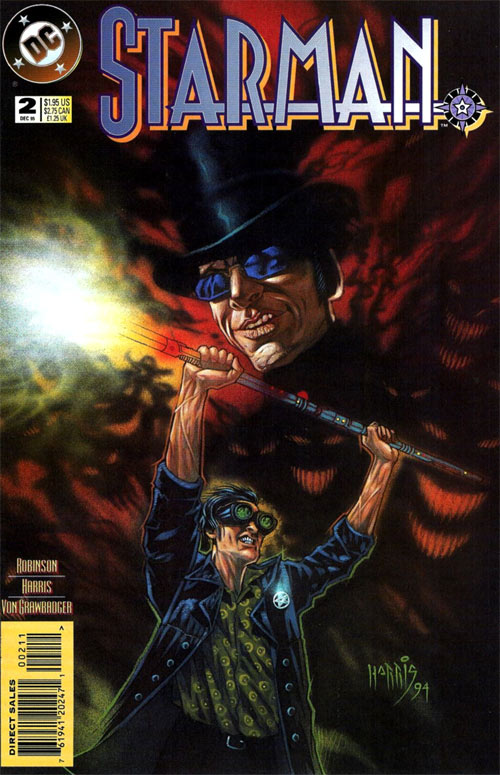
Starman #2

"Mercy"
Sins of the Father, Part Three
written by James Robinson
pencils by Tony Harris
inks by Wade Von Grawbadger

"Is it me, then, growing old?  Or do all the costumed do-gooders begin to blur into one annoying mess after a while" (Starman #2: 5), the aging Mist quips to the ageless Shade.  He might as well be talking about the entirely ordinary Theo and David Knight, but Jack Knight is proving to be something different, a reluctant superhero with a fondness for antique trinkets and an eye for practicality, less dogmatic and more feeling than his predecessors.  Jack is beginning to find his way as a superhero.  Or at least his costume...and his cosmic staff.

But "Mercy" is mostly about two women:  the Mist's stammering daughter Nash and the mysterious new fortune teller Charity, culled from her own early-70s DC title Forbidden Tales of Dark Mansion and clever enough to verbally spar with Jack.  Nash, however, proves the more tantalizing prospect, more poetic in her metaphors and hostage to their fathers' self-perpetuating feud.  She lets Jack go, against her knowledge of her father's wishes and even though she has him easily trapped on a rooftop.  She is—among all the loud, self-important men running around Opal City, swelling their egos and verbally fortifying their self-identities, and bashing one another where it hurts—a quiet, soft spot, not exactly vulnerable but susceptible to other rules and an idea of another world, neither war nor opera, much better than the one the men are playing out.

If Starman had a puppetmaster, it would be the Shade, who after seemingly allying himself with the Mist to annihilate the Knight clan, promises instead their safety.  For unknown reasons, he seems invested in Jack Knight becoming a hero.  And, by force of circumstance and not a little temperamental inclination, Jack is well on his way to doing so.

[December 1994]

Note:  Although release date and interior copyright dates read accurately "December 1994," the cover incorrectly lists Starman #2 as December 1995.

Sunday, May 5, 2013

Starman #1

"Oil (Paint) and Water"
Sins of the Father, Part Two
written by James Robinson
pencils by Tony Harris
inks by Wade Von Grawbadger

Still reeling from the Mist's full-on assault on the Knight family and the ongoing criminal chaos in Opal City, wounded younger son, Jack Knight, seeks out his father's hospital room.  Unlike his obedient brother David, who assumed without questioning or alteration his father's mantle of Starman, Jack is far more independent.  He's sees, for the most part, their actions for what they are and their devotion to an outdated idea of superheroics as somewhat foolish and not a little misguided.  Yet, Jack takes his father's undue criticism hard, and it's this family dynamic that makes Starman's universe so relatable.  Jack's struggle with his father's legacy—his current enemy, whose personal vendetta has enveloped the city, and his paternal disapproval at Jack's disinclination to be Starman—is the thematic center of #1.

However reluctant he may seem (to himself and his father), Jack continually seems to find himself being the hero...not playing it as David was accustomed.  His motivations, mostly family and devotion to the memory of his dead mother, still may be selfish or at least self-interested, but they are heroic.  And though his father may not see it, since his only idea of what a hero can be is the one that he once was, Jack may very well be the hero Opal City needs.  It takes an astute and charismatic former villain to realize it.  The Shade makes his debut in Robinson's Starman early, though with the Shade it can never be too early.  Unlike Theo Knight and the Mist's thugs, he sees Jack Knight for what he can be, and he sees something far better than his predecessors.  He's a hero, one who doubtless would decline the "superhero" moniker, but one who might deserve it for that very reason.

[November 1994]

Sunday, March 3, 2013

Starman #0

"Falling Star—Rising Son"
Sins of the Father, Part One
written by James Robinson
pencils by Tony Harris
inks by Wade Von Grawbadger

Starman belongs in a comic-book world, in the kind of fictional place in which a single billionaire can build a city and name it himself, one for which a hero inevitably emerges to keep its denizens safe and its streets clean.  "For Opal City's champion, no longer young or strong or filled with the same sense of righteous purpose of late had put the costume and cosmic power aside—turning, instead, back to the heavens to study them all the more.  With the need for a new champion...one arose.  His father's son.  Pure and true" (Starman #0: 1).  Robinson's prose is crafted, though not stilted or purple, but his expansive epic beginning is, as it turns out, the postured, somewhat egoistic heroic self-fashioning of David Knight, Opal City's soon-to-be-dead Starman.

"Into the street the piper stept,
Smiling first a little smile,
As if he knew what magic slept
In his quiet pipe the while..."  ("The Pied Piper of Hamelin," Robert Browning)

Robinson's Opal City is a fictional city with texture and history, one that exists outside and beyond the titular hero of the series even if their destinies are often irreversibly commingled.  For this reason, David's reluctant replacement, his younger brother Jack, is a hero much better suited to Robinson's freshly imagined superhero world, one as absorbed by its history as his elder brother though not as self-important or preoccupied with his own legacy.  And though his ascendancy to his family post is inevitable, since he already appears in fully re-imagined superhero garb with his preferred cosmic staff on #0's cover, the bloody beginning to his tenure as Starman is amazing to watch.

Issue #0 is an account of loss, which for Jack Knight includes a mental inventory of all the beautiful old things burned with his store—50s Dali-designed fabric, railroad workers' jackets, Thorne Smith, et al.—and the rest of the antique remnants of a lost time.  It's also simultaneously the story of how the Knight family is hit:  David's death; patriarch, astro-physicist, and former Starman Ted's hospitalization and his house's ruin; and the destruction of Jack's shop Knights Past along with his (wrongfully) presumed death among his things.  In doing so, it strips away the things keeping Jack from assuming Starman's mantle.

It also introduces the other family, the Mist and his children, Nash and Kyle, responsible for the events of the current issue.  It is a family feud, one whose members are each as pettily absorbed in its outcome as the other, and whose parties are just as snidely convinced of their own victory as the other, even if this confidence vacillates.  By the end of issue #0, it is the Mist who shows the piper's smile.

[October 1994]