Showing posts with label Jai Nitz. Show all posts

Monday, January 19, 2015

Dream Thief: Escape #4

written by Jai Nitz
art by Tadd Galusha

Dream Thief has always teased that there's something uniquely special about John Lincoln's mask.  It appears and disappears seemingly at its own volition, refuses to remain buried or destroyed, and shows some selection in its possessor.  And no other Dream Thief seems to have one like it.  Brown-Eagle paints his face in a poor replica, a pale shadow of the real thing.  The final issue in Dream Thief's second series confirms it.  As Patricio Brown-Eagle murmurs over the freshly dead corpse of Fischer Ayers, "The old man said your mask was special.  Maravilloso.  Let's find out" (Dream Thief: Escape #4: 4).  But when he turns over the body to remove the mask, it's already gone.  That Patricio thinks he'd have any more success taking it off an Ayers-possessed Ray Ray Benson is laughable.

The conclusion, however abrupt and satisfying to the immediate conflict, makes a few bold choices, none so bold as choosing to leave behind Lincoln's best friend Reggie—who gets another corker of a one-liner when Jenny accuses the trio of going after Brown-Eagle, "We're going to Six Flags" (7)—and Jenny herself, outed to Reggie as a conspirator to cover up Claire's murder of Cordero.  John Lincoln's at his best when he's with these two.  And Nitz is at his best when he's writing for Lincoln's personal life.  The confluence of John, his now-dead but spirit-possessing father, and an uninitiated Jenny is a masterwork of character beats.  Jenny's understandably unforgiving for her father's perceived abuse and neglect, mildly infuriated by Ray Ray's (i.e., her father's) attempts at charm when talking about him, surprisingly taken aback when informed of his death, but quick to recover her detective senses when she connects the John Doe murder to Brown-Eagle.  Jenny's sometimes infuriating herself, but criminally underused.

What their murderous inheritance isn't is honorable, which is something that had dazzled both Nathan Brown-Eagle and Fischer Ayers, the misconception that it was somehow about carrying out some sacred, honor-bound tradition rather than about evening the cosmic score.  John Lincoln is under no such illusions.  Unlike Ayers and both Brown-Eagles, who made this phenomenon about them, Lincoln remembers the victims instead.  The act of revenge itself is petty and largely inconsequential, that it is done is its only relevance.  As Ayers tells Brown-Eagle, "It's better that way.  He's pure.  Your dad and I thought we knew better than the universe.  We handed out our own justice.  Look where it got us" (18).  Ayers may be more right than he knows.  By leaving his family cold, he may very well have allowed John to become just what a Dream Thief should be.

Wednesday, December 10, 2014

Dream Thief: Escape #3

written by Jai Nitz
art by Tadd Galusha

John Lincoln now has a uniquely enlightened perspective on his absent, abusive father's condition, one that explains away his erratic behavior, his swings in temperament, his seemingly self-destructive friendship with Nathan Brown-Eagle.  As children of Fischer Ayers—particularly the elder Jenny, who saw their mother's bewildered suffering with greater clarity—it seemed like little more than the neglect of a crappy father.  It seems John's been thinking about those days a little more and with a lot more understanding.

It may be every parent's nightmare that their children will inherit their worst parts, but Ayers' loving anxiety whispered to his young son—"Don't be like me.  Please, God, don't be like me" (Dream Thief: Escape #3: 4)—makes his decision to ultimately abandon his family poignant.  The love is there, but how can you trust yourself around them when you're never sure who and in what murderous rage you're about to become?

Reggie, on the other hand, is to be absolutely trusted.  Dream Thief has always maintained a comic edge, a current of humor and absurdity that buoys the series, but Reggie's take-down—literal "take-down"—of Whiteboy Tim is a highlight, putting his college football skills to good use.  I also love that he has a straightjacket on hand for these kind of situations.

Ah...Whiteboy Tim.  He could easily be nothing more than a joke of a cliché, and he nearly is: a perpetually startled, scrawny loser of a drug dealer in a world of self-important, bullying low-lifes.  But his defense of his sister, knowing there's a high likelihood of it going against him, is sincerely affecting.  It's a revenge detour that derails John, Reggie and Fischer's most immediate objective—killing Ayers' killer Patricio Brown-Eagle—but, to be fair, that's more or less how this Dream Thief thing works.  At the most inconvenient times.  Nearly every time.

Tadd Galusha takes over illustration responsibilities from Greg Smallwood in this issue.  While he's more than adequate to the task—his grasp of Southern architecture and style is truly admirable—he doesn't quite have the command of the characters that Smallwood does. 

Sunday, September 14, 2014

Dream Thief: Escape #2

written by Jai Nitz
art by Greg Smallwood

Holy Miami Vice, Batman!  Dream Thief: Escape continues its cautionary fable with the mercy killing of Guy Hogan, a man driven mad along with the ghost inside him by not being able to satisfy his revenge.  Restrained in a straight jacket, kept locked in an abandoned alligator hunting shack off the Florida Turnpike, and having chewed off his own tongue, there was little left of Hogan in the end.  And only after fifty or so ghosts after nearly a decade as a Dream Thief.

John Lincoln is moving at a much swifter click than that.

Although Dream Thief: Escape #2 barely advances the plot of the prison break—Lincoln resolves to employ his "spectral law degree" (8) to release Ray Ray Benson, currently possessed by his father, on bond by questioning a signature and arrange for Patricio Brown-Eagle's killing while out for a psychiatric evaluation—but it does revisit Lincoln's attempts to reconcile his memories of his ghosts' lives.  While contributing to the G.B.I. report on Brown-Eagle for the murder of John's girlfriend Claire—a murder which he himself committed while possessed by Armando Cordero, Claire's undeserving victim—Lincoln is visibly shaken.  Though Agent Simon and John's sister Jenny assume it's the memory of Claire, it is, in fact, the visceral memories of Cordero:  his fear and confusion as Claire killed him and the fond, loving and a little regretful recollection of his father.  When Lincoln drops by to visit Lalo Cordero, the results are charming and a little heartsick.  John Lincoln is able to offer a lonely father some consolation but no resolution.  Nevertheless, he's never been more winning.

It may very well be that series artist Greg Smallwood understands Dream Thief's protagonist better than does its writer Jai Nitz.  While his character work is solid throughout, his settings atmospheric and often humorous, Lincoln's expressions and body language are flawless.  His sheepishly honest shrug as he admits he'll get Ray Ray out the old-fashioned way—"I'll lie" (7)—is perfect.

Friday, August 8, 2014

Dream Thief: Escape #1

written by Jai Nitz
art by Greg Smallwood

Dream Thief protagonist John Lincoln has inherited a legacy of revenge conspiracies that seem inevitably to end in incarceration and death.

Patricio Brown-Eagle, murderer of Lincoln's long-estranged father Fischer Ayers (now possessing the body of fellow Dream Thief and prison inmate Ray Ray Benson) and would-have-been murderer of John himself, is the son of Ayers' former partner Nathan Brown-Eagle, yet another Dream Thief.  Their partnership, glimpsed in a flashback to Boca Raton in 1985, is an unpleasant and foreboding peek at John's future.  Fischer and Nathan speak as themselves, no voice of a dead victim, though the memories of a young pawn in a drug empire echo through their actions.  They've been possessed by so many ghosts that neither man knows just how many, just a concatenation of memories and skills.  But they act like assassins themselves: hunting, surveilling, and attacking with cold precision.  Though Nathan seems to take some pleasure in their predestined task, itching to pawn their target's Chopard watch for "a helluva night at the Clermont Lounge" (Dream Thief: Escape #1: 7), for Fischer Ayers it seems much more of a burden.  He stares longingly at a picture of his family during their stakeout, and his final decline of Brown-Eagle's offer—"I just wanna get home" (7)—is heavy with his inborn responsibility.

And Lincoln's getting better at it as well, more comfortable with and adept at using his newly and supernaturally acquired expertise, especially with his best friend Reggie to help cover for his absences.  But it's John's visit to see his father, or more accurately Ray Ray Benson, that truly ignites Escape's mysteries.  Though he's currently awaiting trial for multiple murders, Patricio Brown-Eagle's reasons for killing Ayers and attempting to kill Lincoln remain unknown.  Unfortunately for him, Lincoln is now tasked with breaking both Benson (re: his father) and Brown-Eagle out of prison.

Saturday, September 21, 2013

Dream Thief #5

written by Jai Nitz
art by Greg Smallwood

Dream Thief resolves the mysteries that it needs to, but more impressively, it also knows exactly which mysteries it shouldn't solve.  Yet, at least.  After escaping the war-painted home-invader from the end of the previous issue with the help of his police detective sister and his former running back best friend, Lincoln comes partially clean to his sister—and calls her out on her involvement in the cover-up of Claire's murder of Cordero—and completely clean to Reggie.  To his credit, Reggie is baffled and intrigued but not judgmental, even (or especially) about the sex.  As one of those great unsolvable mysteries and sometimes fantasies, the memory of sex as the opposite gender is one of those insights John's "talent" uniquely gives him.

As it turns out, the initial home invasion itself was a chain-link in the series of events that led John Lincoln to his current position.  Anticipating that the mask would find John, Patricio Brown-Eagle—who might actually be mentally ill, or might be exploiting the seemingly outrageous truth of the mask to exploit the penal system in his favor—broke in to eliminate Lincoln, and he returns to finish the job.  Even after re-reading the issue, Brown-Eagle's motivations are still very unclear.  Though he—along with John, John's father Fischer Ayers, and Ray Ray Benson—Brown-Eagle is a Dream Thief and therefore a supernatural avenger of unjust murders, but he seems to be acting on his own motivation when he tries to force John to kill himself.  Is he trying to eliminate all Dream Thieves?  Does he want to be the only one?  Why did he kill John's father as well?

Dream Thief steadfastly refuses to resolve some of the more intriguing and dangerous implications of the mask's memory sharing.  Though sometimes, especially initially, possessed by the murdered ghost of another person, John Lincoln appears to maintain his personality in the wake.  He has a plethora of new memories and experiences from which to draw, but he is fundamentally himself.  Yet, he writes to his father earnestly, though he is now dead, one memory collection among many in the repertoire of fellow Dream Thief and Georgia State Prison inmate, Ray Ray Benson.  It's a tease that makes me hopeful for more in Nitz's world, but there are enough answers to make this a satisfying conclusion to a far better-than-average mini-series. 

Friday, August 23, 2013

Dream Thief #4

written by Jai Nitz
art by Greg Smallwood

Despite his pattern of possessions and his complete loss of his body to his possessor in his sleep, John Lincoln shows a little more self-confidence in Dream Thief #4, more comfortably asserting his independence from the competing spirits:  "I'm not Frank," he repeats on two occasions.  Frank Best, Lincoln's latest dead spirit body-companion, was a con man and a gambler, and a good one, who seemingly ran afoul of a loan shark.  This time, Lincoln (and Frank) are burdened with Father Tommy Logan, a local priest and another apparent victim of hitman Joe Ferragamo, the dead body in the sinking car.  Against Frank's wishes and for the first time since the mask, John Lincoln saves a life.  It's little moves like this that allow Lincoln to continue to be quite likeable despite the string of murders that's carried him across the South.  He is, at heart, a good guy with a strong sense of humor and profound sympathy for the dead folks who keep using his body for their revenge.  And he internalizes their perspectives with admirable ease:  an Hispanic boxer; a gay, ex-Army porn star; a Black, female lawyer; and a con man.

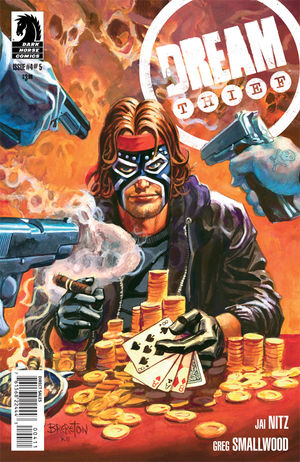
To Lincoln's surprise, the near-dead priest recognizes his condition and seems able to help...in exchange for help of his own and over half a million dollars won in a poker tournament.  Lincoln, being generally short on explanations for his activities or the supernatural mask, accepts his offer.  And he cuts a rakish, charming figure at the poker table.  Brereton's cover illustration gets the swagger right, but his devil-may-care stare down the barrels of three pistols misses Lincoln's sly charm.  Instead, newly bearded Lincoln, posing as Vernon Wells in his grey suit and open-collar black shirt, wins the table and the chips with his good looks and his borrowed poker skills.  The twist comes at the table:  "Father" Tommy isn't much of a priest at all, but a con man who's been turning confessional secrets into revenue for forty years, and Lincoln's just the latest of his marks.  So, Lincoln turns him over.

In the issue's denouement, and a scene which sets a fraught tone for the miniseries' final chapter, John returns to Atlanta from Memphis to find his sister Jenny held captive in his apartment by a man with a painted mask.  John's final thought before taking a baseball bat to the head:  "If he knocks me out, I have no idea who is going to wake up" (Dream Thief #4, p. 22).  Nitz has developed several threads in his story, none more prominent than the letter from John's father and Jenny's possible knowledge of or participation in Claire's murder of Cordero, which haven't yet been resolved, and as a consequence there's a lot he needs to address in the final act, but the density of story in Dream Thief has remained high.  Here's hoping Nitz's closing chapter is as excellent as his first.

Saturday, August 10, 2013

Dream Thief #3

written by Jai Nitz
art by Greg Smallwood

John Lincoln is becoming a dangerous and perhaps different man in his mask.  After two episodes of fulfilling the vendettas of dead men in his sleep, keeping their memories but himself unaware of his actions while he commits them, Lincoln is starting to take matters into his own hands, becoming increasingly comfortable with other people's revenge.

It begins differently, not remembering anything.  Though it slowly comes back, piece by piece, an accident of the relevant ghost as much anything, it certainly is a sign the rules of his new life are changing.  The hanging of a Mississippi Ku Klux Klan leader may have followed the pattern thus far, but his actions against the rest of his Klan chapter's pick-ups and his investigation into the life and death of his new ghost are all Lincoln's own.  And he's using the expertise he's accumulating from the other ghosts to help him out.  He's spending more and more time in each issue in the mask and even more time out of the mask serving the mask's purposes.  And, as John Lincoln himself says, "No problem.  I'm getting good at this" (Dream Thief #3, p. 22).

Dream Thief seems to be moving toward a fever-pitch of a finale.  Lincoln's relationships are suffering.  His friends are disappearing from his life, he's becoming increasingly suspicious of his sister who may have known about his now-dead girlfriend's murder of his first ghost Cordero, and his estranged and incarcerated father looms near in the future.  Dream Thief may at first seem episodic, with its vendetta-of-the-issue format, but more than that it's one man's struggle not to lose himself to forces outside of himself.  Issues #2 and #3 aren't as tightly packed or as individually satisfying as the series' exceptional opening chapter, but Nitz and Smallwood have crafted an excellent story.

Saturday, August 3, 2013

Dream Thief #2

written by Jai Nitz
art by Greg Smallwood

The first issue of Nitz's thus-far stellar mini-series relied heavily on disorientation for its effect, protagonist John Lincoln waking to increasingly incriminating evidence of his sleepwalking actions.  With Dream Thief #2, the rules—if we can call them that—of the mask are becoming clearer.  When John falls asleep, the memory of a murder victim possesses his body to enact revenge upon his killers.  Though he has no control over his actions in this state, John is subsequently able to recall them, as well as all other memories of those who possess him, gathering a collection of talents, abuses, and interests.  Seemingly, the mask itself cannot be discarded or destroyed.

His second time behind the mask, Lincoln finds himself possessed by Jimmy Oliver, a gay ex-army man turned stuntman turned porn star, whose lover betrayed and killed him when he refused to participate in their drug-running business.  There's nothing particularly mainstream about Jimmy, but Nitz writes him with sensitivity and ease, and from his perspective there's nothing particularly exceptional about his life.  It's the kind of storytelling sleight of hand that makes Dream Thief such a stand-out.

Though structually Dream Thief is more an action/horror story than anything, it continues to surprise with its healthy sense of humor and whimsy, one Nitz is willing to acknowledge:  "Jimmy changed my ringtone to "Yakety Sax."  Note to self:  The dead still have a sense of humor."  (Dream Thief #2, p. 2)

Lincoln repeatedly struggles to differentiate his identities, slipping pronouns in flashbacks and imagining/remembering some of Jimmy's most intimate moments—conversations with his father, his first on-screen sex scene, his death—and, though he takes this slippage in stride, John cannot help but be changed by it.  After all, who are you when you are suddenly flooded with someone else's memories? 

Tuesday, June 4, 2013

Dream Thief #1

written by Jai Nitz
art by Greg Smallwood

Wow!

"What would you do if you woke up in a strange room and didn't know where you were, or what you'd done the night before to get there?"

What begins as a familiar motto for any hangover-blurred, morning-after daze turns into something genuinely sinister and uncomfortably electrifying by the end of Dream Thief's first compact, thriller of an issue.

Despite disposing of it with the body of his dead girlfriend, the mask finds him again, like a supernatural bad penny, which transforms its wearer into a conduit of vengeance for dead men.  While the mask seems to play some role in John's weird and violent actions in his sleep, Dream Thief is innovative in its inclusion of several possible triggers for his change:  not only the mask, but a mysterious letter from his estranged father, now incarcerated in a state prison for unspecified crimes.  John himself blames the weed, the most unlikely to have been solely responsible, but a possible contributing factor alongside a supernatural mask, especially in obtaining it, or paranormal genetic trait.

Most impressively, Nitz pulls off some deft character reveals, more jarring—but still perfectly credible—than his plot twists.  John Lincoln is mostly a good guy, but opening a series as the protagonist wakes up after cheating on his girlfriend and then hops out to buy weed, doesn't exactly scream "hero".  But it turns out John's instincts about his girlfriend's weirdness and paranoia after their break-in are bang-on.  She's a mistaken and not a little bit racist murderer, who'd apparently been planning an escape to Belize to evade prosecution, but who ends up in the trunk of a car sinking into the Okefenoke Swamp thanks to John, his mask, and the spirit of the man she killed.

Note:  Never has punctuation been more seamlessly incorporated or concisely used in comic art.  Certainly the exclamation point/question mark hybrid used with the same face frame in each of John's wake-up scenes is appropriate, but it's the two-page spread on pages 12-13 whose use is particularly clever, as John moves from early-morning disorientation to full realization as he's confronted with the body of his dead girlfriend.