Showing posts with label 2010. Show all posts

Sunday, December 14, 2014

Chew: Omnivore Edition, Volume 2

Just Desserts and Flambé
written by John Layman
art by Rob Guillory

In the elevator to Amelia Mintz's office floor at the Mercury Sun there's a memo posted:  "Vomit bags can be found near Amelia's desk.  —Mgmt" (Chew: Omnivore Edition, Volume 2: 61 [Chew #13: 7]).  Undoubtedly is a little (mostly) teasingly hostile office revenge for her nauseating reviews of D-grade restaurants in Taster's Choice, but it's also a nice anticipation for Colby's reaction to Tony and Amelia's kiss hello:  "Egad.  Where's a barf bag when ya need one?" (62 [8]).  Really, it's the little things.

Layman and Guillory have made a point to speckle their series with self-referential in-jokes, clever pop culture references (Fringe, in particular, is the gift that keeps on giving), and delightfully absurd background detail as a complement to the already delectable, bombastic physical humor, sardonic but often sweet dialogue, and often daffy plot action.

And John Colby is my favorite:
"Look, dickhead.  I just spent the better part of the morning convincing your current girlfriend you're not some sort of nutcase--  because you're holding on to the toe of your ex--who actually was a nutcase.  Don't go ruining all my hard work by starting a shit-fire--on our day off--with your family--who already hates you."  (Vol. 2: 121 [#15: 17])
He's simultaneously a loose cannon, who would fit comfortably in most rebel cop dramas, and one of the most personally intuitive and considerate characters in Chew.  Colby's defense of his partner Tony in his showdown with Savoy at Montero's mansion—and Tony's equally heartbreaking appreciation of his loyalty, holding his battered and unconscious body—exemplify just how strong a hold Layman has on his tonally expansive series.

Just Desserts is quite a personal departure for Chew's protagonist.  His romance with saboscrivener journalist Amelia Mintz is in its early blush, and his rivalry with former partner and rogue cibopath Mason Savoy returns to the fore.  But in the collision between Tony's compartmentalized lives, his family has to win:  bitter older sister Rosemary, her matchy-matchy husband Tang Shen, their children Chip and Bree Chu-Shen, Tony's effervescent twin sister Toni (Antonelle) Chu, older brother and black-market poultry cook Chow, transvestite—or transsexual—younger brother Harold (aka, Miso Honey), younger sister Sage, mother Bao, and grandfather Ong.  Their Thanksgiving dinner together is borderline epic, and not just because it ends with flaming alien writing across the sky, worthy every bit of Guillory's "Last Supper" spoof cover.  The biggest surprise, however, is Olive, Tony's very teenage daughter.  She's a surprise—and potentially a deal-breaking complication for their relationship—to Amelia, but in the moment of fear, staring into the fire-writing across the Thanksgiving sky, Tony, Amelia, and Olive find themselves holding hands with all the promise of a very real (if culinarily unconventional) family.

Ostensibly about the mysterious—perhaps alien—fiery message in the sky, Flambé explodes the poultry conspiracies even as it shies away from enforcement of the poultry prohibition with the apocalypse seemingly at hand.  Tony's new partner Caesar Valenzano is Savoy's old partner, and they're still in illicit cahoots; former FDA agent and self-destructing voresoph Daniel Migdalo has apparently eaten himself into perfect, genius understanding of the whole thing but flings himself out of his apartment lunging for breath mints; an angsty high-schooler with a new food power apparently takes down a space station studying zero-gravity food, including a gallsaberry targeted by the mysterious "vampire"; anti-prohibition revolutionaries making meteor-metal bullets; solar-mutated, zero-gravity babies conceived by NASA scientists in a panicked directive to save the human race during the avian flu pandemic; and an egg-worshipping cult with scripture in a mysterious language.

But in all of the potentially world-ending machinations, Flambé's most victorious turn comes from a death-wielding gamecock: "Concentrated mayhem.  Feathers, rage and hate. *P*O*Y*O*!!!*" (Vol. 2: 196 [#18: 21]).  He's taken down innumerable rooster peers, a fighting cock crime boss and his muscle, and now the army of bio-terrorist General Jontongjoo.

[unnamed]:  someone who can determine all the constituent ingredients (chemically) of a food dish only by its taste.

Voresoph:  someone whose intelligence is directly correlated with how much food he or she ingests.  The more one eats, the smarter one gets.

[unnamed]:  someone who can compose recipes that control other people.

Collects Chew #11-20

ISBN: 978-1607064268

Saturday, January 18, 2014

Northlanders, Book Four

The Plague Widow
written by Brian Wood
art by Leandro Fernandez

With a brutal abruptness plague comes along the river just before an equally brutal winter begins, afflicting an isolated Viking settlement along the Russian Volga with a gruesome disease, fatal to all infected.  The Plague Widow breaks with many of the historical conventions in earlier Northlanders arcs, the dependence on datable events, battles and migrations, in favor of apocalyptic horror.

The world is ending.  The Volga, once a thriving vein of trade from the rich south to the wild north, now brings only death and decay and the threat of desperate, plague-ridden marauders.  Faced with an outbreak they do not understand, the settlement is torn between the thuggish bigot Gunborg and educated foreigner Boris with his mysterious theories about contagion and disease.  Boris' solution to the pandemic is radical, demanding strict adherence and complete commitment:  the settlement will be sealed for the winter and all currently infected will be banished to prevent further contagion, a de facto self-quaratine to thwart its spread.  It's a proposition that passes the assembly only by a single vote, that of newly widowed Hilda, wife of a wealthy plague-dead merchant, who then finds herself the target of Gunborg's savage intimidation and terrorizing.

Despite the success of Boris' plan, as the winter lengthens, fear and hostility in the settlement continue to grow.  Gunborg mobilizes his band of warrior thugs to pillage his neighbors already enduring meager rations to stir discontent against the settlement's leader, a clever but feeble man ailing under age and the harsh winter, and Boris his man.  His is the rise of a tyrant in the wake of others' fear and cowardice, the opportunist among the carnage, the social infection that undoes the river town.  "We sealed these doors to keep the death out.  In doing so, we shut ourselves in with what proved to be the greater danger" (The Plague Widow: 165 [Northlanders #27: 21]).

Hilda is not only the arc's central figure, she's its strongest.  Women are often the most vulnerable, and Hilda's beauty, wealth and prominence in the decision to close the settlement make her particularly so.  But, despite Gunborg's intimidation and his nephew Jens' lustful possessiveness, Hilda manages to be far more than a victim of their brutishness.  Her defiance in bearing their humiliation, her savvy in turning it against them, and ultimately her willingness to take her daughter and flee into the winter wild elevate her courage without compromising the injustice she's subjected to. 

Wood's horror fable is in many respects absent of the narrative subtlety characteristic of earlier arcs.  There is little mystery about the town's tragic trajectory, and what suspense it generates is less a question of whether death will come than it is how death will come.  It is the slow descent into hell with eyes wide open.  But Hilda's particular plight is more ambiguously nuanced.  When she is first approached by Jens while hauling her tithe to the great hall, her coarse refusal of his ostensibly well-intentioned help seems rude and unprovoked.  Though his later actions would seem to justify her decision, Jens—like so many of the settlement's residents—might also be a casualty of Gunborg's hate-mongering.  When Thorir first brings food to her door at night, the threat of rape is tangible, though had he lived Hilda might have returned his affection.

Leandro Fernandez illustrates The Plague Widow with gruesome, apocalyptic fervor.  The plague-infected, like so many walking dead, made mad and desperate by their affliction, lay siege on settlement.  The entire world seems to be in decay:  starving wolves feeding on human corpses littering the frigid landscape, timber shattering into frozen shrapnel, boats of dead and dying stagnating in the icy river, the only color from warm flowing blood and the occasional life-preserving fire.

Collects Northlanders #21-28:  "Seven Hundred on the Volga," "Heads of Household," "The Death Ships," "Exposure," "Lives of Crime," "The Descent," "Splinter and Bleed," and "Of Mothers & Daughters"

ISBN:  978-1401228507

Wednesday, January 1, 2014

The Unwritten, Volume 3

Dead Man's Knock
written by Mike Carey
art by Peter Gross
additional finishes by Ryan Kelly (#17)

It's not at all shocking to discover that Wilson Taylor once belonged to the power-hungry cabal he would eventually contrive to undo.  He's callous and utilitarian and sometimes brutal even as he defends an honorable idealism: freedom from the hegemony of story, or rather, freedom to tell the stories we choose.  A shadowy presence at the edges of The Unwritten for many of its early issues, frequently spoken of but never appearing—like Harry Lime in The Third Man, presumed dead if under mysterious circumstances, a commanding personality even when long absent—when Taylor finally does appear, he's just as cold, willing to murder Chadron for the slight chance Ambrosio may once again use him as a doorway into the world.  He freely admits, with no discernible guilt, that he stole Tom away from his real mother and fabricated a myth to take her place so that he could shape his son into a savior.  If he's calculating with his son, he's inhumane with Lizzie/Jane, experimenting on an orphan to create a bridge between real and literary worlds, then brainwashing her into believing herself a Dickens character destined to aid Tommy in his quest.  He and Callendar may angle for different ends, but they're cut from similar cloth.

Volumes 1 and 2 of The Unwritten are immersed in the intellectual possibilities of Carey's meta-literary premise.  The mechanisms by which stories work in the world, by which they shape the way we understand it, are well articulated, particularly in the two-part "Jud Süss," but Volume 3 gives the concept an emotional resonance and more meaningful stakes.  By the time Tom finally realizes the real implications behind his father's revolution, so do we.
"That most times, the truth is like a close-up conjuring trick.  You can look straight at something and think you're seeing the truth of it.  But really, you're seeing what someone else wants you to see.  So fuck the truth.  We don't know where it is, and we probably won't know it when we see it.  She just chose the story she needs right now.  The story that keeps her standing.  That's probably all any of us get to do."  (Dead Man's Knock: 131 [The Unwritten #17: 31])
Unlike the earlier volumes, which are rich with surprises but play far less on expectation, Dead Man's Knock pulls off a very clever sleight of hand on both its characters—even the cunning and suspicious Pullman—and its readers.  The double-deception of the false Tommy Taylor book and its last-minute replacement by a real Tommy Taylor book were both well earned.  Nevertheless, the finest single issue in the collection is "The Many Lives of Lizzie Hexam," which borrows, at least superficially, the structure of a Choose-Your-Own-Adventure book.  Even now, I'm not entirely convinced how the issue should be read.  Though I perhaps prefer a sequential reading, one which ignores the "instructions," since its juxtapositions and time-skips are suggestive the way they are, the more traditional participation in the issue's chosen structure is also effective.  In the end, its strongest commendation is that it sustains both readings.

Also, we finally discover who Pauly Bruckner is and what he did to deserve being transformed into a talking rabbit in a waistcoat.

Collects The Unwritten #13-18:  "Dead Man's Knock: Monsters," "Dead Man's Knock: Atrocities," "Dead Man's Knock: Bloodletting," "Dead Man's Knock: Conversations," "The Many Lives of Lizzie Hexam," and "MIX"

ISBN:  978-1401230463

Thursday, December 12, 2013

Chew: Omnivore Edition, Volume 1

Taster's Choice and International Flavor
written by John Layman
art by Rob Guillory

Bold premise #1:  Protagonist is a law enforcement officer who gets psychic sensations from and about whatever he ingests—a so-called "cibopath"—and he uses this "talent" to solve crimes.  Often by cannibalizing victims and/or perpetrators, or sometimes their dead dogs.

Bold premise #2:  His partner, after being hit in the face with a butcher's knife chasing a serial-killer sous-chef, is rebuilt with half a cyborg face, complete with internal computer and laser eye.

Bold premise #3:  The world has suffered a catastrophic pandemic of bird flu that killed 23 million Americans, 116 million worldwide, leading most nations to institute a poultry prohibition.  Many, however, believe the flu to be a hoax and the prohibition to be a cover-up.

Bold premise #4:  In the wake of this disaster, a strange maybe-fruit seemingly from space, but tasting just like chicken, appears to fill the market demand.  This may or may not have something to do with a mysterious (and hedonistic) international space observatory tasked with studying a single planet.

Tony Chu's world would be oppressively bleak if it weren't so damn whimsical.  Don't get me wrong, Tony Chu suffers.  The only thing he can eat that doesn't assault him with psychic residue is beets.  Beets!  His job, which he's quite good at though his boss is nothing but caustic and bullying, requires that he regularly ingest dead people.  And those are the good days, since his boss also goes out of his way to assign Tony the most repellent cases.  But Layman and Guillory have cooked up a world so vibrant and absurd that even the macabre has a tone of glee.

Taster's Choice introduces the seedy underbelly of a post-pandemic city, complete with black-market poultry mobs, corrupt and licentious politicians, a commensurately empowered F.D.A., now the most powerful law enforcement agency in the country, and food terrorist organizations, believing the bird flu and poultry prohibitions to be little more than government conspiracy.  While each chapter bears some plot connection to those around it—and some resurface as exceedingly important in later arcs—Taster's Choice is primarily a story about the brief, but educational, partnership between rookie F.D.A. agent Tony Chu, formerly of the Philadelphia police department, and Mason Savoy, his powerful but portly mentor with a penchant for Victorian turns of circumlocution.

On the other hand, International Flavor immerses Tony into an international plot by a small island nation Yamapalu and its petite, bug-eyed governor to launch the gallsberry—a mysterious space fruit that tastes like chicken—into international cuisine, and he's kidnapping the world's most respected food experts, including chefs (like Tony's brother Chow) and food critics (like Amelia Mintz, a saboscrivener and Tony's crush), to make it happen.  There are multiple conspiracies, and Layman's constantly juggling a handful of storylines at once, but he never lets them drop.  The poultry muscle, primarly a mercenary named Caesar in the employ of faux-poultry tycoon Ray Jack Montero, is attempting to sabotage Yamapalu's governor and his emerging gallsberry industry; Chu is tracking down the space-fruit, but gets sidetracked chasing down a local murder over a prize cyborg gamecock named Poyo for the local fuzz, who ends up stealing him anyway; and one of the governor's kidnapped chefs, mute cibolocutor Fantanyeros, is rescued in a multi-front assault by the ominously named Vampire.

Cibopath: someone who feels a psychic sensation about whatever he or she ingests, except beets.

Saboscrivener: someone who can write about food so accurately and vividly that it conveys the sense of taste to whomever reads it.

Cibolocutor: someone who can communicate through food.

Collects Chew #1-10

ISBN:  978-1607062936

Saturday, August 31, 2013

American Vampire #8

"Devil in the Sand," Part Three
written by Scott Snyder
art by Rafael Albuquerque

Whatever I may have anticipated from the closing moments of the previous issue, I certainly didn't suspect that gun-toting Brit Linden Hobbes and crossbow-wielding Abilena Book would have tracked Pearl down to Northern California so that they could ask a favor, and a very big favor at that.  As members of a shadowy organization known as the Vassals of the Morning Star, a name with strange implications, Hobbes and Book need Pearl to inform them of her own mortal weaknesses so that they may kill her creator Skinner Sweet.  It's a devil's bargain, but as these things go, sometimes it's difficult to tell which party is the devil.  Hobbes and Book are fanatics belonging to a fanatical organization with a mission rooted in a precept that unilaterally condemns an entire race for being what they are.  And they're willing to threaten non-vampires, including Pearl's human lover Henry Preston, and seemingly violate their own agreements, such as theirs with Sweet, to achieve their genocidal objectives.  But, with the possible exception of Pearl and self-loathing James Book, American Vampire's vampires have by and large proved to be easy killers, though many—like Sweet—could easily have been villains before their transformation.  It's little surprise, then, that Pearl's refusal to cooperate with the vampire killers is a welcome display of loyalty and future self-preservation.

Meanwhile, Abilena's daughter Felicia and her partner Jack Straw attempt to convince Las Vegas lawman McCogan that the recent bout of murders is the work of a vampire—to quite humorous effect.  Despite his irritation at even the idea of conceding that the FBI imposters may have a plausible explanation for recent events, however fantastical it may seem, McCogan finds himself teamed with them for the evening, chasing down a large, winged vampire killing executives in charge of Boulder Dam.  Snyder and Albuquerque's slow reveal of the responsible vampire is exceptional, pieces of his extremely inhuman form and unique abilities dropping in each issue.

It's a testament to Snyder's tight, labyrinthine storytelling that I honestly didn't see either twist in this issue coming, but in retrospect they make absolutely perfect sense.  Henry, never one fond of Sweet and sometimes frightened by Pearl even if he still loves her profoundly, would be far more likely to cooperate with Sweet's hunters.  Cashel McCogan's father, a ghostly presence whose death has been hanging over Cashel's early tenure as Las Vegas sheriff, was just too heavy a narrative weight not to return. 

[December 2010]

As collected in American Vampire, Volume 2 (ISBN 978-1401230692)

Friday, August 23, 2013

Northlanders, Book Three

Blood in the Snow
written by Brian Wood
art by Dean Ormston (#9-10), Vasilis Lolos (#17), Danijel Zezelj (#18-19) and Davide Gianfelice (#20)

The third collection in Brian Wood's stellar series Northlanders assembles Wood's shorter and stand-alone episodes early in its run.  The first, "Lindesfarne," narrates the famous raid on the rich Saxon monastery in 793 A.D. by Norse pillagers from the perspective of a young boy Edwin, raised by a brutal and zealous father in the shadow of the rich monastery.  In his mind, factions of gods—his father's weak, distant, joyless Jehovah and his dead mother's wild, terrible Germanic pantheon—battle for followers and power.  Abused by his father, whose religious fervor cultivated by monks after the untimely death of his mother in childbirth he blames for that abuse, Edwin turns to Woden and his followers, the viking invaders, who he thinks have arrived to save him, an answer to his prayer to the mighty god.  Edwin directs the Norsemen to the oppressive monastery and, after the massacre which orphans him, wins a place among the invaders by wounding their leader in single combat to first blood.  But years later, leader of his own raiding parties and faithful to his heathen gods, he remains a Saxon outcast among his Norse peers, still a victim of the ruling and religious factions which wrecked his childhood.

In "The Shield Maidens," three women—Grettr, Thyra, and Lif—living in the ninth-century Danelaw flee from Saxon invaders seeking to reclaim land north of Humber River.  Having fled their villaige with Thyra's husband's hoard, they make their stand in an abandoned Roman fort near the tide plain against a siege of Saxon warriors.  The women's perspective is welcome here.  Though women had played key roles in earlier storyarcs, they were fundamentally about men.  The strength of the Norse women as well as their vulnerabilities remain foreign to the men.  The threat of rape and slavery as well as death is unknown to their abusers, and their ingenuity at escape is unexpected.  "They were in a full panic, and if this is what viking was like, I forgave my husband his long absences" (Blood in the Snow, "The Shield Maidens": 109 [19: 11]).  Its ending is also a welcome respite from violence.  Having weathered the onslaught and improbably escaped their Saxon attackers, the three women reconvene in triumph and grateful for the mercy of their fates.

"The Viking Art of Single Combat" is a one-shot that narrates a duel between champions Snorri the Black and Egil Sleggja, a practice abstracted from centuries of custom and distilled into a single narrative.  Though each fighter receives characterization—Snorri, the crude bastard son of the lord with only legitimate daughters, and Egil, second son to the lord, once a leader but now dim and brain-damaged from an arrow to the head—this episode's interested in the anthropology of the duel, the archaeology of its weaponry, and the psychology of a culture of violence.  It's refreshingly non-judgmental about any of it.  There's a bleakness and a futility to the feuding cycle, but there's a conscious recognition of its place in a hard world, an unfair one, one that favors Loki over Thor.  "Little consolation to the conquered, but the gods only made one Earth.  Probably to laugh their asses off while we fight over it.  So be it" (Blood in the Snow, "The Viking Art of Single Combat": 67 [17: 15]).  Quite honestly, "The Viking Art of Single Combat" may be one of Northlanders' quirkier issues, but it's also one of its finest.


Blood in the Snow's other one-shot, "Sven the Immortal," revisits characters from Northlanders' first story-arc Sven the Returned.  Sven, now an old man, an exile living with his wife Enna and their two children on Faroe, is the subject of famous songs sung about his return to Orkney, his vengeance against his abusive, usurping uncle, and his fight against the Saxons.  As such, he is a target for fame-mongers, foolish young men seeking to aggrandize their own reputations by killing a legend.  The men find him far fiercer than they anticipated.  They lose a "holmgang" and kidnap Enna to force his hand in the face of their humiliation.  But these men never return home; none survive.  It's a fine conclusion to a collection that gives a satisfying story to one of Northlanders' most charismatic figures.

Collects Northlanders #9-10, 17-20:  "Lindesfarne" Parts 1 and 2, "The Viking Art of Single Combat," "The Shield Maidens" Parts 1 and 2, and "Sven the Immortal"

ISBN:  978-1401226206

Wednesday, August 21, 2013

American Vampire #7

"Devil in the Sand," Part Two
written by Scott Snyder
art by Rafael Albuquerque and Mateus Santolouco

If, like McCogan, we suspected Skinner Sweet of being responsible for the recent spat of murders and de-sanguinations in Las Vegas, it seems we would be wrong.  Sweet's certainly taken up residence in the burgeoning "Sin City" as a pimp and businessman whose employee was one of the last to see Mr. Beaulieu alive, but there's another vampire on the loose, tracking down the bosses of the consortium tasked with the building of Hoover Dam.  And Felicia Book and her partner Jack Straw, under the pretense of being an FBI agent and his assistant, are in town to find the murderer.  They are, instead, representatives of an organization called the Vassals, whose mission seems primarily to track down and kill vampires, a turn which expands the universe of American Vampire considerably.

Likewise, although the evolution of Sweet into something new in contrast to the pack of European entrepreneurs in Hollywood necessarily entailed the possibility of variety in vampire species, the glimpse into the world of the Vassals also opens up that variety.  Felicia's forensic investigation into the death of Mr. Beaulieu allows her narrow the species of vampire which could have perpetrated the murder, all of which seem to be documented in her research materials.  This killer is a species we haven't seen before.

And what should we make of Sweet's arrangement with the Vassals?  Under what conditions could a vampire known to be a killer even in his human form be granted immunity from an organization whose purpose is to hunt down vampires?  It's a suggestive tease, one that Felicia is particularly troubled by, but one that grants even further grey over Sweet's ambiguous character.

The final scene throws a wrench in the proceedings of the second story arc, reintroducing us to Abilena and her so-far unnamed partner who have traveled to rural California to kill Pearl Jones, in her words "the deadliest vampire on Earth" (American Vampire, Vol. 2, p. 52).  This is, of course, another mystery, since Pearl may be deadly but her seemingly idyllic life with Henry seems far from requiring Abilena's attention, except that she is the only known offspring of Skinner Sweet, the American vampire.

[November 2010]

As collected in American Vampire, Volume 2 (ISBN 978-1401230692)

Tuesday, August 13, 2013

American Vampire #6

"Devil in the Sand," Part One
written by Scott Snyder
art by Rafael Albuquerque

Leave it to Skinner Sweet to monetize vice in the most notorious party city in the United States at the very inception of its reputation.  You could even say Sweet lent Las Vegas its character.  Just over ten years after turning Pearl and taking down several Hollywood moguls, Skinner Sweet has set up as a brothel owner in Las Vegas' red light district, a city once relatively small and obscure made bigger and famous by the construction of Hoover Dam (olim Boulder Dam) twenty-five miles to the southeast and the economy of gambling, drinking and whoring that blossomed to entertain its massive workforce.

Enter Cashel McCogan, newly minted chief of police following the untimely death of his father the former police chief, father-to-be, and increasingly frustrated citizen of the growing metropolis.  He already has a history of run-ins with Sweet, whom he knows as Mr. Smoke and whom he suspects of orchestrating his father's murder.  If opening sequence in Colorado is anything to go on, he will have at least one more bloody confrontation with the vampire, one that leaves his as-yet unborn child a vampire himself.  And re-enter Felicia Book, daughter of Jim Book and Abilena Camillo and now assistant to FBI agent Jack Straw, both of whom seem fully aware of the existence of vampires and are readily capable of identifying their handiwork.

Interestingly, McCogan and Sweet receive similar artistic treatment.  They've got similar coloring, handsome facial features (even if McCogan lacks the sinister snarl Sweet achieves), comparable builds, and the same hat casting the same shadows out of which their eyes seem to pierce through.  The similarities are so convincing that I wasn't certain at first that the figure with the baby wasn't in fact Sweet himself.

[October 2010]

As collected in American Vampire, Volume 2 (ISBN 978-1401230692)

Monday, August 12, 2013

American Vampire #5

Chapter Five:  "Curtain Call" and "If Thy Right Hand Offend Thee..."
written by Scott Snyder and Stephen King
art by Rafael Albuquerque


However pervasive, action sequences are difficult to do right in comics.  They always seem stiffer than on film and thinner than the quieter, more verbal moments.  Relatedly, it's very difficult to right action dialogue without sounding like a throw-back to bad puns, cheesy one-liners and empty bravado.  Pearl's revenge on her European vampire attackers and her back-stabbing best friend and roommate Hattie shows just how well they can be done.  Snyder's set-up—a meditation on the natural hierarchy of predators and the delusional overconfidence of the vampire movie moguls—is very fine, but his best move is stepping out of the way to let Rafael Albuquerque's artwork tell the tale.  The details of the scene—including the dismembered and perhaps still living body of a young woman, their cache of bladed weaponry, and their pleasure in boasting of their earlier tortures—showcase the vampires' hubristic sadism.  But it's her more personal revenge on Hattie, the vampires' new starlet and a popular embodiment of the American desire for instant celebrity and validation, that is truly satisfying.  Just as Hattie's meteoric rise is on its surface the realization of the American Dream, the reality of her "break" is a more faithful representation:  self-promotion at the expense of others, spurred by jealousy and competitive friendship, and the willingness to achieve success at any cost.

Pearl's final scenes on the boardwalk with Henry, whom it is exciting to see collaborating in Pearl's earlier revenge, is a fine and gentle moment for a character whose recent actions could threaten to change her nature as well as her form in ways more cruel than I would like.  It, in some ways, validates her earlier actions by reinforcing that she is, in fact, still Pearl.  It's also a fine moment for Skinner Sweet, who once again manages to make honesty both charming and menacing.

Jim Book is the other side of Pearl's coin, the only other person Sweet has been known to turn.  Unlike Pearl, who has reluctantly but successfully embraced Sweet's transformation, Book resists it for over three years, barely surviving on groundhogs and sheep, trying large-scale transfusions and blood treatments to cure his condition.  Finally, he enlists Abilena, his former partner's daughter, to help him kill himself.  She agrees on the condition that he impregnate her, continuing a cycle of inherited revenge, handed down from one generation to the next.  Sweet, it seems, may outlive his enemies, but not his injustices.

[September 2010]

As collected in American Vampire, Volume 1 (ISBN 978-1401228309)

Sunday, June 2, 2013

American Vampire #4

Chapter Four:  "Double Exposure" and "One Drop of Blood"
written by Scott Snyder and Stephen King
art by Rafael Albuquerque

Pearl and Skinner each survive their first moonless night.  Lured back to Block and his Hollywood vampires by her roommate and close friend Hattie Hargrove, Pearl discovers her friendship to have been little more than pretense and Hattie to be murderously jealous and self-promoting and entirely lacking in loyalty, i.e., the exact inversion of Pearl herself.  Her transformation—perhaps better described as the revelation of her character—happens entirely within "Double Exposure".  The opening flashback of her introduction to Pearl is charming and believable, two young women struggling to make it as actresses in Hollywood and struggling to find friends in a strange city.  That she would stab her newly transformed vampire friend in the back is surprising enough.  That she colluded with Bloch and his buddies to kill Pearl in the first place is fully black-hearted.

In contrast, Pearl's burgeoning love interest, Henry, continues to prove himself.  Despite her running off alone, Henry comes to her rescue under, quite literally, the shadows of the Hollywoodland Sign.  Knowing about her new condition, he still recognizes her as the same person she was before.  Though the correlation between vampiric feeding and sex is old-hat, Snyder pulls it off well.  Henry's offer is both generous and loving, and Pearl's response liberating and honest.

Sweet's showdown is considerably less interested in saving his friends than it getting revenge on the Pinkerton agent and his friends responsible for his capture.  Still figuring out the rules of his unprecedented bloodline—rules that continue to be a little too explained in every issue, for my taste—Sweet finds himself weaker and more vulnerable than he has yet experienced.  This doesn't prevent him from getting the better of Felix Camillo and Jim Book.  Yet Book's biggest ambush is the kiss from goddaughter Abilena, and his look is one of complete shock and not a little horror in itself.  Sweet's revenge is creatively cruel, befitting the outlaw himself, the infection of Book with his blood.


[August 2010]

As collected in American Vampire, Volume 1 (ISBN 978-1401228309)

Sunday, May 19, 2013

Locke & Key, Volume 3

Crown of Shadows
written by Joe Hill
art by Gabriel Rodriguez


Crown of Shadows takes place in the immediate aftermath of Head Games.  The night after Duncan's lover Brian is hit by a car and Zack Wells, formerly Luke "Dodge" Caravaggio, takes the memories or lives of anyone who knows his past, Nina must break the news to her children.  Meanwhile, life in the Locke family, particularly for Nina, is continuing to spiral.  Still traumatized by the death of her husband and her assault and rape, Nina continues to drink herself into crippling alcoholism.  Her actions—particularly her disabling self-hatred and irresponsible decision making—are beginning to alienate her children, especially the newly fearless (quite literally) Kinsey and Tyler, who's taken on several of the parental roles in the absence of his father and the poor state of his mother.  This portrait of a broken mother as both sympathetic and unacceptable is characteristic of what makes Locke & Key so excellent.  It does not make excuses for Nina, but it makes her human.  Because as an adult she is unable to recognize the keys' magic without being in an "altered state," Nina remains in many ways on the periphery of the series' central story—i.e., the rediscovery of the keys by the Locke children, the corresponding machinations of Zack/Luke/Dodge, and the slowly unveiling history of Keyhouse, including the childhood of Rendell Locke—but it does not deny her a full characterization.

Crown of Shadows also features the return of Sam Lesser, a ghost at the hands of Zack and left to haunt Keyhouse.  However, unlike the desperate, empty Sam of Welcome to Lovecraft, he now has a much clearer vision of himself, one that continues to feel more pity for himself than regret for his violence against the Locke family, but one that stands poised to act against Zack if he can find a way how.  We also begin to discover more about Zack himself, in particular the parasitic hardware in his back that seems to control his thoughts.  He is, as we have begun to suspect, not entirely human, and his increasingly desperate search for the mysterious Omega Key something to be genuinely feared.

Meanwhile, the newly fearless Kinsey begins to make her own discoveries about her family's past.  Her nearly fatal trip to the Drowning Cave reveals to her the names of her father and his band of high school friends, whose own trip in 1988 seems to have jump-started much of the current action:  Rendell Locke (recently deceased), Erin Voss (institutionalized), Kim Topher, Ellie Whedon (track coach housing Zack), Mark Cho, and Luke "Dodge" Caravaggio (Zack Wells).  More importantly, the reader (unlike Kinsey) sees a corpse at the bottom of the cave, one that looks suspiciously similar to Luke/Zack, particularly in his black dress from the Wellhouse.  All of which contribute to Locke & Key's general storytelling acumen and betray Hill's tight plot structure, which seems to have known all along EXACTLY where it was going and to have dropped hints, both textual and visual, from the very, very beginning.  Locke & Key is less a comics series than a long graphic novel, in the structural sense, each act building on the last, leaving no detail behind.

Rodriguez continues to prove his style perfect for Hill's particular brand of horror, which relies heavily on visual and cinematic strategies for its effects.  Some of Locke & Key's most frightening sequences are its silent panels, much like the first page of Crown of Shadows #1, which captures Zack's sneaking violations of the Locke family's home and heads.

The Keys:

Giant Key, an enormous wooden key which fits a lock-shaped window of Keyhouse, enlarges its user to gigantic proportions.

Shadow Key opens a small door in the basement of Keyhouse, which leads to the Chamber of the Living Shadows, which houses the titular Shadow Crown.  When fitted into the crown, the key activates it, allowing its wearer to control the newly animated and corporal shadows of the house.

Mending Key, when used with the iron mending chest, repairs what is physically broken or injured to its former state.

Collects Locke & Key: Crown of Shadows #1-6:  "The Haunting of Keyhouse," "In the Cave," "Last Light," "Shadow Play," "Light of Day," and "Epilogue: Beyond Repair"

ISBN:  978-1600106958

Wednesday, May 15, 2013

American Vampire #3

Chapter Three:  "Rough Cut" and "Blood Vengeance"
written by Scott Snyder and Stephen King
art by Rafael Albuquerque

How can a vampire who retains its human memories and emotions also transform into a calculating, brutal killer?  It's a difficult line that Snyder walks to perfection in Pearl.  Skinner Sweet, however charismatic a character, was always an outlaw who unflinchingly murdered his enemy's lover, fed on an entire town of strangers, and shows no remorse for collateral carnage.  Pearl was not.  Her new strength and predatory acumen exists alongside her sisterly love for her roommate and her burgeoning romance with Henry.  Yet, she shows no hesitation in getting her revenge:  slaughtering the self-promoting movie star who lured her into the vampires' lounge, ripping the face off one of her attackers, and skewering another on cactus thorns.  That she is more discriminating than Sweet in selecting her targets doesn't make her any less intuitive about her kills, and it's precisely this that gives her transformation such credibility.

"Blood Vengeance" continues Sweet's story as told by Bunting, his personal feud with Jim Book in the years following his re-emergence.  However, it is his untold history with the European vampires, alluded to in "Rough Cut," that is intriguing in its suggestiveness.  Having once eluded assassination by the Europeans in America—indeed, having decapitated the lot—Sweet seemed to have come to some tentative agreement, the "Treaty," which seems to be on somewhat tenuous ground and on the verge of being broken at any moment.  The meeting of the vampires early in the issue also alludes to "the Vassals," presumably another rival vampire organization.

[July 2010]

As collected in American Vampire, Volume 1 (ISBN 978-1401228309)

Friday, May 3, 2013

The Unwritten, Volume 2

Inside Man
written by Mike Carey
art by Peter Gross

Arrested and arraigned in Switzerland after the mysterious and murderous events at the Villa Diodati, perpetrated by The Unwritten's goon Pullman but pinned on Tom Taylor, Carey's protagonist is transferred at the request of the French to the Donostia, Maison d'Arrêt de Roncevaux, made famous by the massacre of Charlemagne's rear guard and its commemoration in the anonymous medieval poem La Chanson de Roland,  where he will stand trial.  Extradited with his future cellmate and (unknown to him at the time) undercover blog reporter, Richard Savoy, Taylor is forced to navigate prison life, at which to his surprise as much as the reader's he proves alarmingly adept; confront continued incursions of the literary world into his own at his command, sort of; and make his escape from bribed prison guards and agents of the Committee.  However, the "Inside Man" portions of Volume 2 are more about the transformation of prison governor Claude-Louis Chadron, whose love for his children and their faith in Tommy Taylor leads him to compromise his principles, cooperate with the Committee, and suffer the consequences of his interference.  Like Tom, who must face the ramifications of being written into and therefore transformed by his father's novels, Chadron becomes what literature tells him to be.  Bereft of his children and consumed by his blame of Taylor, Chadron becomes exactly the enemy that has already been written for him:  Count Ambrosio.  If literature can make and remake people, like Frankenstein's monster or Taylor himself, it can unmake others.

Following their escape, Tom Taylor, Lizzie Hexam and Richard Savoy find themselves IN Jud Süss, on a different kind of rescue mission, to reclaim the "unhappy novel," as Savoy calls it, from its unstable heritage.  A story whose multiplicity makes it a "canker," a monster created by conflict between its composition and its appropriation by Nazi propagandists.  Tommy, by virtue of his sporadically appearing and glowing hand-tattoo, restores the novel.  It is a prime example of the un-writing Paul Cornell points to in his short but unusually fine introduction when he comments, "The title of the series itself might refer not to something that hasn't been done, but to something that's being undone, a tapestry that's being unpicked."

However, the real gem in this collection is the final issue, "Eliza Mae Hertford's Willowbank Tales," which like closing issue of Volume 1—"How the Whale Became"—is tangential to the primary story.  A sort-of parody of children's animal literature (à la The Velveteen Rabbit or The Wind in the Willows) which is re-imagined as a singularly cruel punishment.  Pauly Bruckner, a man who crossed Wilson Taylor, is banished into a geographically finite children's story as a white rabbit in a waist coast named Mr. Bun.  Gruff and disgruntled at his capture, Bruckner repeatedly makes attempts at escape, always to find himself whisked back home for tea with the other forest animals.  If the premise is cruel, and the ending quite grim, its execution is very comical. 

Collects The Unwritten #6-12:  "Inside Man,"  "Inside Man: The Song of Roland," "Inside Man: Interlude," "Inside Man: Conclusion," "Jud Süss, Part I: The Liar," "Jud Süss: The Canker," and "Eliza Mae Hertford's Willowbank Tales"

ISBN:  978-1401228736

Tuesday, April 16, 2013

American Vampire #2

Chapter Two:  "Morning Star" and "Deep Water"
written by Scott Snyder and Stephen King
art by Rafael Albuquerque

Once again, an otherwise excellent story is slowed by its double-billing, and in this case an extra helping of exposition.  Following fast on the heels of her attack and desert disposal by a swarm of European vampire movie-execs, Snyder's "Morning Star" finally transforms his heroine Pearl into a vampire herself.  And once again, Skinner Sweet steals the scene.  Dying in a hospital bed of blood loss and internal damage after having been found staggering and bleeding in the desert by Hattie and Henry, Pearl is rescued by Sweet, and her "infection" is strangely delicate, a delicacy that is all the more surprising after his uninvited and somewhat predatory entrance through the window of her hospital room.  Though it does mimic his own transformation, Sweet chooses to infect her by kissing her eye with his bloodied lip.  Though, presumably, any means of entering her bloodstream would have transformed her, Sweet's choice is both tender—he could have simply dripped into any of her multiple open wounds—and politely restrained—he could have kissed her lips.

Their conversation following Pearl's awakening in the morgue and return home is considerably less dramatic, even as it is considerably longer.  While it imparts some necessary information to the reader, though, to be fair, an attentive reader could probably have pieced together most of it on his own, and it provides Pearl with a slight vampire-orientation lesson, the elaboration of the differences between Skinner and Pearl—the American vampires—and Percy, Bloch, and the rest of the Europeans is somewhat dull and a bit pedantic.  It does, however, continue the ambiguous characterization of Skinner Sweet, whose motivations and personality remain as enigmatic as before.  Because he jests almost out of habit and oozes wryness out of his greasy pores, its nearly impossible to pin him down.  He makes no secret out of his desire to use Pearl and her revenge to poke back at his own enemies, to use Pearl against Bloch for his own purposes, but his response to Pearl's question about why he turned her seems equally honest and true, even as it is triple-sided:  "Oh, I don't know—maybe because I'm just sick of Bloch and his kind having their way with pretty little country girls.  Or maybe because I can't keep out of trouble.  Maybe just because I like you, Dolly."

If "Morning Star" is heavy on exposition, "Deep Water" is structured by it.  One week after Pearl's transformation, author of Sweet's non-fiction "fiction" story Bad Blood, Will Bunting, hosts a re-issue reading at which he recounts his story.  Thus, Sweet's story becomes a dramatic flashback rendering the events between his transformation and his exhumation by divers scavenging outlaw memorabilia over a decade later.  And Bunting's account reads like a summary, a whirlwind version of Bunting's time at the coat-tails of Jim Book and Felix Camillo during the hey-day of western expansion and settlement.  The telling of it may be a little dry, that is, relevant but flat and compressed, but Albuquerque's artwork is excellent, particularly of Sweet's captivity in his coffin—his first meal on a rat, his awakening under water, and his re-emergence from his grave.

[June 2010]

As collected in American Vampire, Volume 1 (ISBN 978-1401228309)

Saturday, March 30, 2013

American Vampire #1

Chapter One:  “Big Break” and “Bad Blood”
written by Scott Snyder and Stephen King
art by Rafael Albuquerque

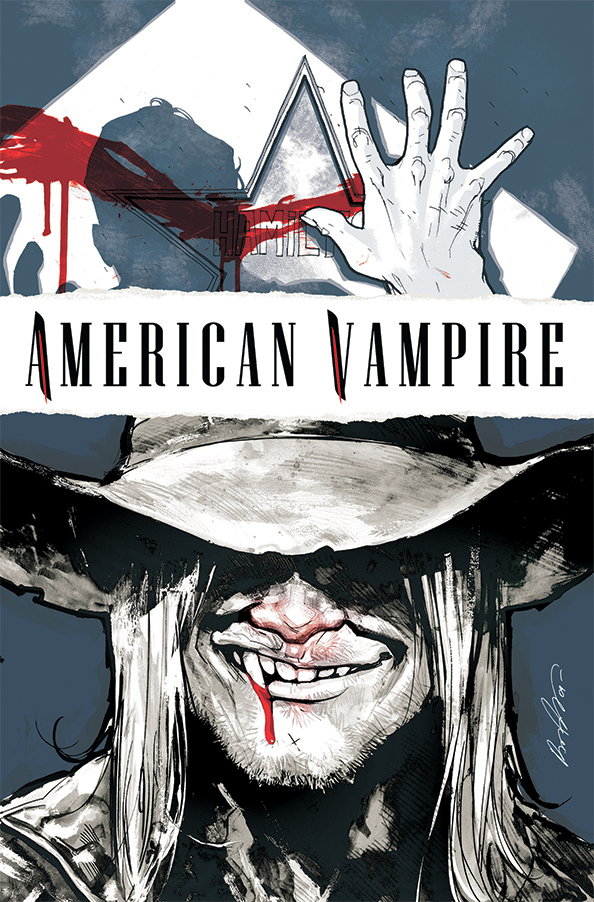
Ladies and gentlemen, may I present Skinner Sweet!  Already in its first issue, Scott Snyder’s epic ambitions for his American-Dream horror saga are evident, but its ambition takes a minor toll on the structure and pacing of its opening episode.  American Vampire #1 introduces so many characters—aspiring starlet Pearl Jones, her roommate Hattie, her amatory admirer Henry, leading man Chase Hamilton, vampire movie producer B. D. Bloch, vampire scoundrel and American outlaw Skinner Sweet, writer Will Bunting, Pinkerton agent James Book, his fiancée Ella Langum, Ronnie Jeeks and the rest of Sweet’s posse, deputy Felix Camillo, Henry Finch, vampire banker and European capitalist Percy—that none receives much nuance…yet.  Though the immediate characterizations of Snyder’s cast are sporadic and patchy, they betray a larger sense of history and detail underlying the episode’s action and characters.  The issue’s clutter of characters, then, ultimately becomes a strength, a tantalizing suggestion of a deeper history and a cast with complex motivations.

Without a doubt, bank robber and outlaw cowboy Skinner Sweet is the most instantly charismatic of the lot.  Introduced first as a pair of cowboy boots dangling from a folding deck chair, he spends “Big Break” lounging outside Pearl and Hattie’s apartment in shorts, a snugly fitting tank top, and a fedora and exchanging barbs with strong-willed Pearl.  While he quite easily could have remained little more than a leering, predatory stalker—and certainly his smirk maintains that possibility—Sweet’s body language instead invites attention, positioning himself as the object of the ladies' sexualizing stares more than the aggressor.  Sweet, no doubt, is fully aware of his cruel nature, and when he half-jokingly admits to Pearl that he's something "much worse" than an elephant man, he's not lying.  But his follow-through--"...but I'm pretty on the inside"--strangely doesn't come off like a lie either.

As he so often does, Snyder opens his series with a childhood recollection, a moment of innocence and wonder superimposed on the issue’s creepiest and most horrific sequence, the dumping of Pearl’s barely living body with a host of young female corpses.  The events that led to her disposal fully flesh out the underlying metaphor of Snyder's European vampires:  they are social, sexual, and economic predators, here feeding at will on the aspirations and Hollywood dreams of young, defenseless women.

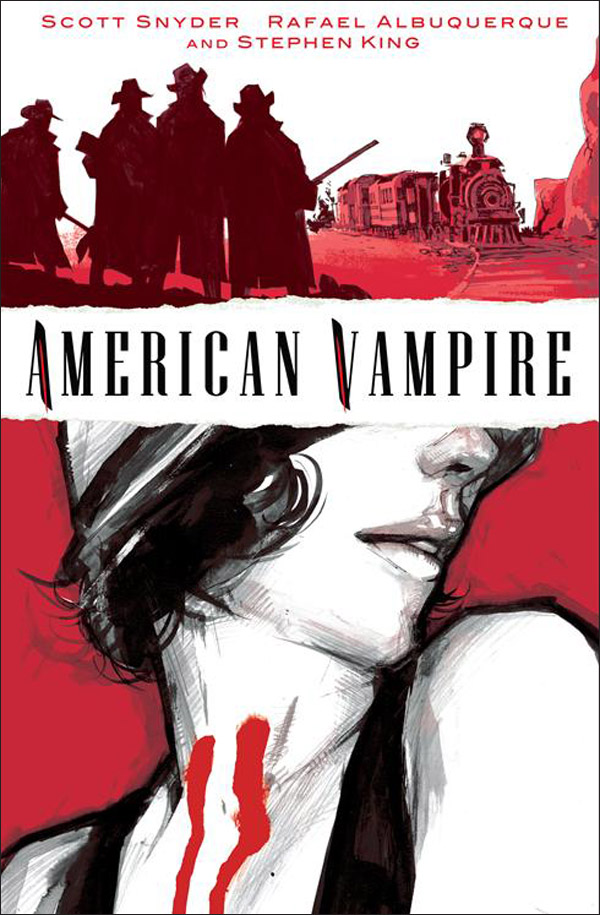
The second act of American Vampire #1 offers a portrait of an alternative—or perhaps complementary—metaphor of the American variety.  Sweet is a fiercely independent, seemingly sadistic outlaw with a disdain for authority, a casual disregard for human life, and a predilection for candy.  His unintended transformation at the teeth of Percy solidifies him as something apart from them.  While the supporting cast of his backstory barely amounts to more than western stereotypes here, King—as Snyder for Pearl—offers great promise for the further unveiling of Skinner Sweet's saga as told by the train wreck's bystander, reporter Will Bunting.

[May 2010]

As collected in American Vampire, Volume 1 (ISBN 978-1401228309)

Tuesday, March 12, 2013

The Unwritten, Volume 1

Tommy Taylor and the Bogus Identity
written by Mike Carey
art by Peter Gross

No comic, perhaps ever, has been more rooted in the literary tradition than The Unwritten, Mike Carey's epic series on the power of story.  He has literally invested his world in the stakes of the literature that comes before him.  As a result, the boundary between the literary world and the real world is as porous in the comic as it is from the outside.  Carey blends together factual details from the known biographies of historical authors and the circumstances behind their most famous publications, fictional details from independent works of literature, and his own inventions, characters and story, into a single literary universe.  And his characters must themselves negotiate these treacherous and blurred borderlands.

The Unwritten's foundational premise is that story is a powerful cultural mechanism, one that can open up or control the way we think and act, even without our knowing it.  As Pullman, Carey's muscleman for the series' villains, so memorably puts it during his chase of aspiring author Lauren Sedgewick at the Villa Diodati:

"It does no good to run.  And it does no good to hide.  But I know what it's like.  Your brain shuts down, and you follow your instincts.  Or you think you do.  But you know what you're really doing?  When you flee through the night, or crawl into your little bolt-hole?  You know what's really guiding you?  Controlling you?  Pushing you on?  Genre conventions."  (The Unwritten #4, pp. 8-9)

All said, like the literature it recalls and invokes, The Unwritten points to a world on the brink of an apocalyptic endgame fueled by story, those who would use it to open up the world, and those who would use it to bind and control it.  Although this conflict undergirds most of Volume 1's main narrative, it only comes into sharp relief in the final collected issue, "How the Whale Became."  Featuring cameos by fellow authors Mark Twain and Oscar Wilde, it tells of Rudyard Kipling's recruitment by The Unwritten's antagonists, his subsequent regret, the personal consequences of his regret, and his final literary counterpunch, a short story called "How the Whale Got His Throat."

Peter Gross's artwork admirably tackles the task of turning large portions of Carey's prose "excerpts" of Wilson Taylor's novels into comic formats, a task the TPB's meager extra features does elaborate somewhat.  What's more notable is that visually sequences taken or adapted from prose are more interesting and more finely wrought than the artwork for the main narrative thread.  This is particularly true of "flashback literature," for lack of a more accurate term.  Gross's two-page introduction to Chapter 3, featuring Frankenstein and his monster, and his illustrations in the Kipling-centric "How the Whale Became" are easily Volume 1's finest art.  Even Tommy Taylor sequences, which fail to achieve this quality of representation, regularly exceed the standard.  While this discrepancy might be somewhat thematic and intentional—even within The Unwritten story is more "real" than reality—it still contributes to an overall disappointment in the series' artistic output.  Although most of The Unwritten's interior artwork is functional and, even if in keeping with the series' literary tone, not particularly interesting in its own right, something should be said for Yuko Shimizu's gorgeous cover illustrations, which get somewhat lost in the compact, continuous TPB format.  Her covers unfailingly feature fine sinewy lines, which give a lush texture to the page and along with the slight variation in color density, contribute to an general print aspect; rich, warm antique colors, even which derived from a cool palate; and delicate, finely articulated facial features on Tom Taylor, a stark contrast to the flat, line-less faces in the interior.


Collects The Unwritten #1-5:  Tommy Taylor and the Bogus Identity, Chapters 1-4; "How the Whale Became"

ISBN:  978-1401225650