Showing posts with label Yanick Paquette. Show all posts

Thursday, February 13, 2014

Swamp Thing #9

"Broken Bones"
written by Scott Snyder
art by Yanick Paquette (pp. 1-8) and Marco Rudy (pp. 9-20)

Boasting.  The unrelenting habit of villains and heroes alike to brag about their power, their superiority, and their plans.  "Broken Bones" has a lot of fight-talking.

Seethe, ruler of the Rot, is arrogant and cocksure, entirely convinced of the inevitability of his victory.  No doubt, his pride is elemental to his characterization.  There's very little sly about the Rot.  Beyond a few early ploys to cripple its enemies—the assault on the Parliament of Trees by an infected Amazon explorer and the infection accelerated by Maxine's interference in Animal Man—Seethe's strategy has been unflaggingly straightforward.  Using brute strength to construct a stronghold in the desert and amass an army of corpses, the Rot will simply suffocate all life.

Seethe also enjoys gloating.  It is not enough to metamorphose Abby into a skeletal insect queen for the Rot, and it is not enough to dispatch the Swamp Thing, champion of the Green, with little mess or delay.  Seethe enjoys the irony of inviting a newly transformed Abby to kill her former lover as he tries to save her.  Because he is so convinced of his victory, Seethe can imagine no alternative outcome.  This is his mistake.  He underestimates their affection for each other and their defiance of those—himself and the Parliament—who would force them into anything else.

Alec's solution is elegantly simple:  he sweetened her canned peaches with orchid seeds.  When needed, he grew them out of her, breaking the Rot's control over her.  But as always, Paquette and Rudy deliver an alternately beautiful and bleak vision of a mediocre script with a strong story. 

[July 2012]

Sunday, January 12, 2014

Swamp Thing #8

"Eye of the Storm"
written by Scott Snyder
art by Marco Rudy (pp. 1-9) and Yanick Paquette (pp. 10-20)

Paquette's Swamp Thing design wins the episode.  Alec Holland emerges not as the sometimes soft (if powerful), mossy swamp foliage of most earlier incarnations, but a rough warrior armor-plated with thick, gnarly bark, masked with horned branches, and sprouting dense, leafy wings.  His rage is palpable, which is good, since most of the issue is dedicated entirely to his first real battle with the Rot.

Seethe has built a dead kingdom, erected out of bones and carcasses, festering flesh made animate by his will.  And he speaks from the rigid mouths of his dead hordes.  It is certainly a grotesque sight, and Rudy's architecture is suitably bleak, if not particularly surprising.  The layouts, often echoes of flies, a fractured vision of decay that takes a kind of insect anatomy, are intriguing and fine complements to Paquette's earlier cellular and floral patterns for the Swamp Thing's green world.

Alec's instant affection for Abby, an emotional echo of a life that wasn't his, continues to be the series' best element.  When she emerges transformed, Seethe's queen with a hardened black exoskeleton and sharp, piercing teeth, it is a blow for Alec, seemingly overmatched by his would-have-been lover, but the ultimate fate of Abby never really feels threatened here, though the mechanism for her salvation is more difficult to discern.

[June 2012]

Sunday, September 22, 2013

Swamp Thing #7

"Swamp Thing"
written by Scott Snyder
art by Yanick Paquette

Good lord, this book is beautiful!  Paquette's contributions to Swamp Thing have been exceptional from the beginning—incorporating organic green filigree between panels, inspired both by cellular structures of plants and art nouveau design, and elegant human figures—but in Alec Holland's transformation into the Swamp Thing, his work is invaluable.  As the Green shoots its roots into his body, invading his heart, lungs, brain and blood stream, the juxtaposition between the aggressive green fibers and the pink fleshy matter overlaid on a leaf pattern is both gorgeous and unsettling in its anatomical realism.  The following full-page close-up of the new Swamp Thing's face and eye is brimming with awakening power.  Nathan Fairbairn's colors, while always solid, are rarely as notable as they are here, with the orange fire started by the Rot in the Parliament competing with the newborn Swamp Thing's spreading green, casting shadows and warm, menacing light on the birth.

Snyder's also in prime form in this issue.  It doesn't progress the main plot anymore than can be easily surmised by its cover:  Alec Holland finally becomes the Swamp Thing.  However, it articulates some of Snyder's finest ideas for the relaunched series.  The Parliament, in particular, while it was always a strange and foreign mind, shows itself here to be cold, vindictive, and profoundly inhuman.  Frustrated with Holland for not eagerly assuming the mantle they assigned to him and angry at being infiltrated by the Rot, they use their last remaining power to save Holland long enough to watch them die before dying himself.  But Holland, even as he asks them to transform him, calls them out on their heartlessness and selfishness:
"Though maybe, it's for the very reasons you think us humans so scared and so weak—   —that we were chosen to be your conduits.  Because, as your brethren told me when he visited me in the swamp—   —what we offer you isn't power or strength.  It's restraint.  For a long time, I made the mistake of thinking of the plant world as a peaceful place...   ...a place of beauty and balance and wonder.  But the truth is, it's no different than the Red or the Rot.  It's a force of nature, volatile and wild and conscienceless."  (Swamp Thing #7: 9)
And when Holland is finally turned, he turns not to save the Green, whose own cruelty and vengefulness and inconsiderate persistence he's experienced so much of his life, and not even really to stop the Rot, though he has no love for it; it's for Abby, his lover equally coerced into playing a part she wants nothing to do with.

[May 2012]

Thursday, September 12, 2013

Swamp Thing #5

"Dead Meat"
written by Scott Snyder
art by Yanick Paquette

If William Arcane's slaughterhouse beasts, the assembled parts of dead cattle and pigs, weren't disgusting enough, their evisceration by Holland's roots and trees is downright stomach-churning.  In lesser hands, Snyder's relatively sparse action sequence would have floundered as boring, but Paquette brings his lush illustration style to the grotesque party.  Details—including, for example, the boa and monkey in the opening illustration and the faces in the trees of the Parliament in the last—more than compensate for the sparse dialogue in the issue.

As before, scenes shared by Alec and Abby are periodically stellar.  The two, even when providing little more than exposition, show significant sparks, and for the most part, neither knows what to think or do about it.  Are their feelings any less real because they're somehow reliant on the memories of a dead former Swamp Thing?  Does he know her less because he knows her through another's experiences?  How much of her lover was always Holland, the consciousness Swamp Thing absorbed?  How much was not?  As Alec says, "This is a place between" (Swamp Thing #5: 6).  Either way, she remains the thing he's most willing to fight for.  Each of them, recalling memories of each other from their childhoods, before the other Swamp Thing ever was, feel certain they are warned to stay away from one another.  Perhaps their attraction is a result of each one's perverse stubbornness to resist the call of their respective dominions:  Green and Rot.  Perhaps, though, their perverse stubbornness is the result of their attraction.  Even as the Rot has invaded the Parliament of Trees and William is maniacally and gleefully certain of the Rot's victory, Alec and Abby share their first kiss, something their own and surely we are meant to see a victory, probably much greater, there as well.

[March 2012]

Saturday, August 24, 2013

Swamp Thing #3

"Come Hither, Child"
written by Scott Snyder
art by Victor Ibáñez and Yanick Paquette

Children are cruel little sociopaths.  Even in the children's ward of a hospital in which everyone has a potentially terminal disease, kids find a way to bully each other, and the target of their creative torture is William, a young kid allergic to chlorophyll, a by-product of photosynthesis that fills the air we breathe.  What the bullies don't yet realize is that this boy is hearing voices, voices of dead things.  He is William Arcane, and he can control the rot, the little pockets of disease and death in their bodies, and he is merciless with it.

The tripartite mythology that's forming between Swamp Thing and Animal Man is compelling if not entirely logical.  Life forces—the Green and the Red—of plant and animal life respectively are established in defense against the Rot, the power of death.  Abby's declaration that the Rot was in part kept at bay in the swamp makes little sense, since decay and rot are proportionately rich in places filled with life.  Many things live and many things die.  The sanctuary of the Rot in the desert is equally baffling, because, however sparse life may be there, death is proportionately diminished, though the absence of life may provide some protection against the defenders of it.  Even if the logic of the set-up is incomplete, the dynamic between the titles' heroes and the emerging villains is excellent.  Snyder has tapped into several details of earlier Swamp Thing runs, in particular, incorporating the Arcane household.

[January 2012]

Wednesday, March 6, 2013

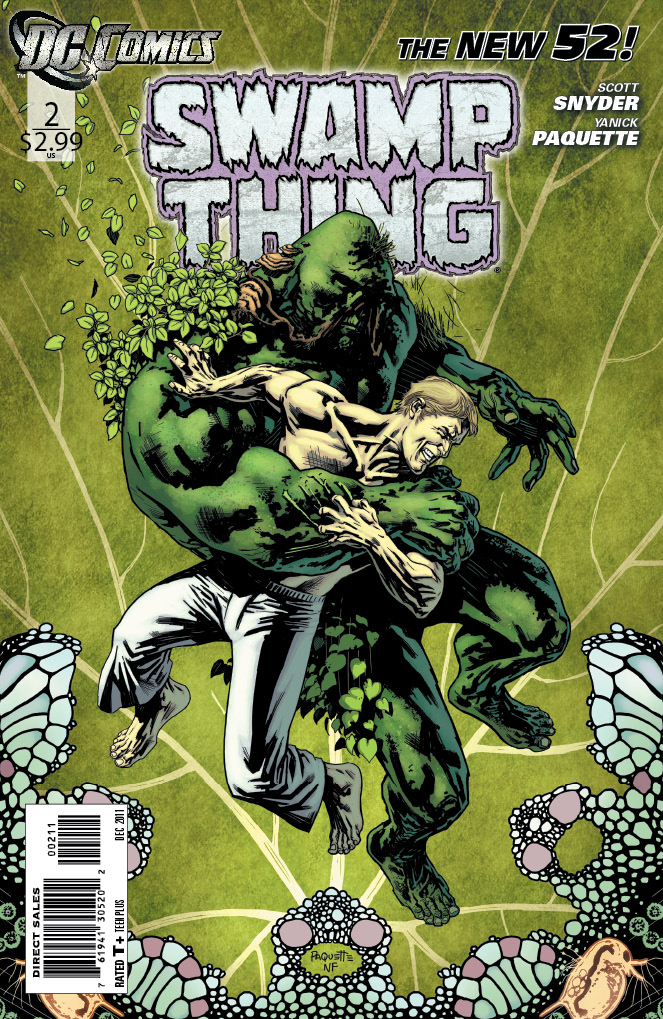
Swamp Thing #2

"When It Comes A' Knockin'"
written by Scott Snyder
art by Yanick Paquette

With Swamp Thing #2, Snyder's brings his revised mythology for the rebooted series, which he began in the earlier issue, into much clearer relief.  As a defender of the Green, the power of plant life, Holland is the next in a long line of Swamp Things, warriors in a perpetual struggle to maintain balance with the Red and the Rot, the rapidly expanding threat of death and decay we saw mobilizing in Swamp Thing #1 and continuing here in its pursuit of Holland.

However, most of the issue is a conversation between a frustrated Alec Holland and the remaining consciousness of former Swamp Thing Calbraith A. H. Rodgers, who interrupted his destruction of the bio-restorative formula at the close of the last issue.  Now, this wouldn't normally sound like great comic book material, two people talking, but, as ever, Swamp Things talk so well, and Snyder's is no exception.  He is still and tall but not imposing, and in no way brutish.  He exudes patience and resolution, and as sincerely as he wants Holland to heed his warnings and follow his advice, he respects Holland's right to decide, just as he accepts fully the consequences of his own decisions.  And it is this humility and understanding, far more than any words he speaks, that calms Holland and persuades him, though feeling his inadequacy for the task, he does not yet acquiesce.

As in Swamp Thing #1, this issue offers several allusions and homages to Swamp Thing storytellers past:  Totleben's Motel, a "1971" safe combination, Abby's Bissette Motors bike, and a young Alan Moore drinking coffee at Wrightson's Diner.  None of them very subtle, but reverent to a history this new series is working both with and against.  Snyder's decision to reconstitute Alec Holland, to restore his human identity, is a potentially fruitful one, particularly in the context of the Green mythology.  Like Moore's inhuman creation, the one for whom retrieving a remembered human body was impossible, Snyder's Swamp Thing must also contend with the memories of a stranger and the inescapable sense of a far away if always immediate past, and the reintroduction of Abby Arcane, as she now calls herself, is a crucial piece of this continuity puzzle.

[December 2011]

Sunday, March 3, 2013

Swamp Thing #1

"Raise Dem Bones"
written by Scott Snyder
art by Yanick Paquette

As for many of the New 52 runs, a significant portion of issue #1's task is to establish its character in the continuity of its comic past as well as its place in the current DC universe.  For Swamp Thing, this is no small feat, especially since Snyder re-establishes Alec Holland as Alec Holland, not yet the hero he may become but with the memories of a Swamp Thing he wasn't, not entirely unlike the sentient plant creature of Moore's imagination with the memories of a human he never was and never could be.  This convoluted mythology makes fairly good sense, even if it does not yet explain Holland's mysterious reappearance.

Swamp Thing has always been somewhat incongruous with comic hero expectations, and Snyder doesn't shy away from his unusualness.  Immediately, Holland is juxtaposed with Superman, Batman and Aquaman, full-time defenders of their respective cities, professionals, and costumed superheroes.  Holland, the wayward Ph.D. botanist, is a blue-collar construction worker in Louisiana, a far less intuitive if no less deserving locale for a superhero home, living out of a motel and doing his best not to be exceptional and not to be found.  His conversation with the concerned Big Boy Scout is for these reasons delightful.  Despite his explanations, Superman does not seem ever to understand how being a hero might not be the most satisfying choice Holland could make, how helping could dangerously upset a delicate balance.  Though newly reborn or reappeared, Holland is the wizened sage, replete with understanding gleaned from some other creature's experiences, and Superman is the naïve, if well-intentioned, schoolboy.

As an introduction to the series' villain, the sudden and simultaneous deaths of birds, bats and fish is unnerving enough, but the reanimation and recombination of dead corpses is truly creepy.  And Paquette's illustration of the revivified monster is all the more so for its piecemeal depiction, never once showing it for what it is and allowing the reader to imagine the rest.  Paquette's artwork is, in fact, exceptional elsewhere as well, and particularly adept as scenes of lush vegetation, such as Holland's newly Edenic hotel room.

The finale of issue #1 is suitably momentous, and the appearance of a Swamp Thing other than Holland decently surprising, emerging from the foliage to warn Holland, "I wouldn't do that if I were you," a stern but subtle reminder of their similarity.

[November 2011]