Showing posts with label Colder. Show all posts

Wednesday, February 4, 2015

Colder: Bad Seed #3

written by Paul Tobin
art by Juan Ferreyra

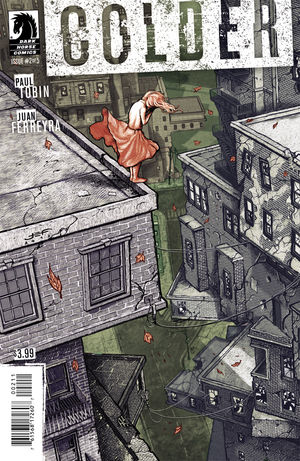
The horror of Colder has always relied on destabilizing the familiar, transforming something ordinary and comfortable into something threateningly strange.  Juan Ferreyra's homage to Andrew Wyeth's Christina's World—which imposes a depression-era Declan, a hatchet-wielding, shotgun-toting, long-john-wearing Sam Elliott look-alike, and a murder of crows hovering over the faraway barn into the oppressively sparse landscape—is just the same.  You know it, but you don't know it at all.

The explanation offered in Colder for Declan's extraordinary ability to heal the insane has never quite been satisfactory.  Why Declan?  Nimble Jack fed on so many, but none of them ever showed Declan's skills.  He touches people and cures them of their insanity, growing slightly colder with every touch.  That his fingers might not be entirely his own, that his history with the finger-obsessed farmer Swivel might go back farther than his history with Nimble Jack, makes some sense of the origins of his talents.  That is, of course, if the vision in the Hungry World can be believed.

Swivel's reign of urban terror remains a bizarre spectacle.  In each issue, he roams the streets, leering at hands, collecting fingers in his planting pot with his harvesting knife, leaving behind him a wake of bleeding and horrified victims as he slinks away unimpeded.  It's like walking through a nightmare.  We may imagine them un-restored, but there's some necessary illusion required to keep his reputation from outing him, like the unassuming invisibility of Nimble Jack.  And now we know that might somehow be the case.
"Barton has my gifts.  He is my hand.  And he is my grasp."  (Colder: Bad Seed #3: 16)
Declan keeps finding the same tenant building, some mirrored bridge between the real world and the Hungry World.  And he finds inside a collection of versions of himself, or perhaps just a hall of mise-en-abyme mirrors.  They show him himself, and himself doesn't have his own fingers.  Interrupted by a disorienting but resolute Reece, the couple go searching the building to find the truth, if the truth can be found in the Hungry World.  What they do find is a horror fable, featuring a dull-minded thief Declan Barton and a ruthless farmer with an axe.

Tobin's nightmarish villains may be the charismatic appeal of his horror story, but the companions-turned-friends-turned-lovers Reece and Declan are its heart.  Their gentle flirtation and easy intimacy in brutal circumstances make their love affair compelling, but Reece is weary of the danger and fearful of losing her mind again.  And Declan is little help in clarifying his own past, which continues to be unknown to him.  By the end of Bad Seed #3, paralyzed and consumed by Swivel, the Hungry World is no longer his to navigate.  Instead, it falls to Reece, should she choose to do so.
A door appears out of thin air as Swivel strides away with Declan in his belly.  "That doorway works.  You can show yourself out." (23)

Thursday, January 22, 2015

Colder: Bad Seed #2

written by Paul Tobin
art by Juan Ferreyra

If Nimble Jack was a villain of sly (and rambunctious), psychological anguish, a creature who took pleasure in cultivating nightmarish insanity in his victims, Swivel is a villain of body horrors, of fine and precise and skin-crawling tortures.  His collection of fingers harvested from passing pedestrians, his flaying of a man's back for "paper," Swivel considers the human body little more than a store of resources to be gleaned at his pleasure or need.  But it is his startling moment of spine-tingling generosity that's really creepy:  helping pull a small splinter from a young girl's hand with his face full of fingers.  She hardly blinks.  He compliments her "pretty fingers" (Colder: Bad Seed #2: 8).

Declan's past has always been a fine mystery, a dark, probably dangerous history both criminal and mentally ill, one that Nimble Jack used to taunt him.  But it was always assumed that his abilities, his particular command of insanity and the nightmare world were a gift, so to speak, from Jack himself, a consequence of Jack's command to "grow colder," but Declan may not be any more mortal than Nimble Jack or Swivel.  After all, "He's a killer.  Yes.  The Killer.  The HarvesterThirty-two men.  Seven women.  A dog" (10).  And it has something to do with an apartment building that exists in both worlds.

Tobin's agents of insanity bring with them an unusual, but surprisingly insightful perspective.  What a man is is very often what he has done, though we sometimes like to think differently.  How much time before we leave our past actions behind us, before they no longer define who and what we are?
Reece:  "I've known Declan for almost six years.  For five of them he was catatonic.  For the others he's been helping people.  He's not a murderer."

Swivel:  "Neither am I.  Well, not for almost twenty minutes, now." (11)
Only a few minutes later, after wishing them a happy goodbye with the promise of their new marriage, Declan callously sucks a freshly healed couple's insanity to take him to the Hunger World, dragging them along with him.  Death, perhaps not, but certainly life-destroying.  The Bad Seed offers the promise of finding out who Declan really is.

Friday, January 16, 2015

Colder: Bad Seed #1

written by Paul Tobin
art by Juan Ferreyra

For all its talk of "insanity," Colder isn't really all that interested in mental illness.  It's interested in the horror imagination, the illogical dark whimsy of nightmares.

Colder: Bad Seed, even more than the first series, teases the erotic potential of its horrific fixations.  Nimble Jack cursed Declan to "grow colder," to fall closer and closer to freezing the more he negotiates the nightmare world.  While Reece teases Declan about his temperature, demanding "four minutes of notice" and "three on the weekends" (Colder: Bad Seed #1: 8) before her lover jumps her, it's also clear she finds the uniqueness of his body arousing.  Her co-worker's infatuation with Declan's shaggy, luscious hair somewhat uncomfortably echoes the series' new villain Swivel's obsession with fingers, Declan's own but also his harvest:  "Oh.  This one is very good.  Look at the soft skin.  The fine tapering" (6).  Sitting at his café, admiring the busy sidewalk, Swivel leers at the pedestrians' fingers, mirrored in Ferreyra's delicate close-ups of them sliding over backpack straps, making rude gestures, grasping a dog leash, typing on a smartphone or tapping a table, and holding an ice cream cone, the subtle sexualization of a somewhat unexpected body part.  It's no coincidence that the phone conversation he overhears is one of jealousy and sexual desire, a young man whose friend's girlfriend "drives [him] crazy" (5).  Sexual infatuation and violent obsessions don't fall far from one another in Colder's world.

And, of course, we meet Swivel.  While he lack's some of Nimble Jack's charisma, he surrenders nothing of his creepiness.  He's a ravenous, finger-faced farmer, a relic of a staid, ragged era.  He looks something like a depression-era Pennsylvania farmer, perhaps a conservative minister of an small, old church.  (He also seems to owe something to Scott Snyder and Scott Tuft's shark-toothed salesman in Severed.)  He makes little sense, though he doesn't really need to, but he seems to know something about Declan's past, and he's come to see it to fruition.

Sunday, September 15, 2013

Colder #5

written by Paul Tobin
art by Juan Ferreyra

Apparently 0ºF is the perfect temperature for crazy.  Nimble Jack, having followed Declan and Reece back from the Hunger World and ambushed them in her kitchen, returns with Declan for the world's most sinister date night:  wine, candles, and conversation before Jack eats Declan's mind out of his living body.  Most of their dinner conversation is more of the same—Nimble Jack's malevolent and arrogant prodding and mockery, succulent but familiar—but it takes a turn for the interesting when they return to the asylum to revisit Declan's incarceration and the fire that let Jack into our world.

Declan's life before the asylum has remained a persistent mystery in Colder, but it's a mystery that Jack brings to our unsuspecting attention.  "Do you remember why you were brought here?  No?  You have a remarkable story, you know.  Oh, it's a happy tale of murders.  A hanging.  Betrayal.  And monsters, Declan.  Forty monsters.  Each one with a secret....  You were a monster, Declan.  An absolute monster" (Colder #5: 5).  Certainly, Tobin had dropped ominous hints about Declan's past, particularly since he was committed to an asylum for the criminally insane, but Declan's potential for violence hasn't been fully appreciated in the story until this issue.  As yet, even when he does morally questionable things, he does his best to rectify them, but his battle with Nimble Jack is supremely violent.

Once Nimble Jack wakes him back up, Declan puts a wooden post through his eye from under his jaw; bashes a wine bottle down his throat, breaking most of his teeth with apparent glee; punches him viciously and with pleasure in his genitals; crushes him with a wine bottle again; lets loose the dog-monsters from Hunger World, which Reece has to look away from; and ultimately sucks away Nimble Jack's mind/life just as Jack did others.  There's moment—mostly as Jack explodes and Declan manically exclaims, "And after all those decades, after these past couple of days, after all those times of you telling me everything gets hungry...   ...did you still think you were the only one?" (22)—when he seemed dangerously close to assuming Nimble Jack's role, which makes it so relieving when he settles back against the wall with Reece and into an awkwardly sweet and embarrassing conversation about his feelings for her.

Sunday, September 8, 2013

Colder #4

written by Paul Tobin
art by Juan Ferreyra

Colder #4 spends a little too much time wandering around the Hunger World with relatively little narrative progress.  Certainly, Tobin and Ferreyra's vision continues to impress and dizzy.  It's a world of dog-things—half-pit bulls, half hands—in which crashing through a window lands you on the other side of a different window.  Declan's companion this trip is considerably more likable than most; he's crazy as well but he's clever and self-deprecating (and, as it turns out, also self-defecating).  He's got the most honest beggar's sign I think I've ever seen:  "Feel Good about Making ME Feel Good!!!  Only $1.99!!!" (Colder #4: 3).  He's generous and personable; he just thinks dogs' teeth are talking to him.

Colder persistently undermines its readers' expectations.  The woman in the toothpaste aisle couldn't seem more like Nimble Jack with her exaggerated smile lines and near fetishistic preoccupation with her prominent teeth, but ultimately she's just another woman in a drug store, and Declan's crazy (but true) rant summarizing his current predicament makes her suitably and hilariously uncomfortable in the check-out line.  Declan's attempts at making amends even more so.  After being confronted in the Hunger World by a giant bone-and-muscle monster, the creature unexpectedly backs off, smelling Nimble Jack all over Declan.  It's a moment that reinforces the universal fear of Jack—since a creature that terrifies even the Hunger World's vicious dog creatures is itself frightened of Jack—even as it unsettles the reader about the rules of this foreign world.

The most resonant scene is, however, Declan's discovery of Reece on an abandoned playground swing in the Hunger World.  She is quietly despondent, and her answer to Declan's plea to say something sane—"I hate you for ever bringing me here" (19)—is both relieving and devastating for Declan.  He brings her back to her apartment, where she assumes the helpless role that he inhabited for so many years, until the Hunger World starts making its way into her apartment, washing out its colors and bleeding down the wall beneath her pictures.  And Nimble Jack comes to take his due.

Wednesday, September 4, 2013

Colder #3

written by Paul Tobin
art by Juan Ferreyra

Insanity in Colder is more a supernatural phenomenon with symptoms familiar to psychological diagnoses than it is a medical condition.  It's a condition that gives access to other disturbing and dangerous worlds and makes one vulnerable to predators from those worlds.  And Declan had entirely underestimated the consequences of showing Reece the Hunger World.  The stress and sheer unreasonable-ness of it all has chipped away at her sanity, so that she's having difficulty distinguishing between what is and what is not real and losing faith in that distinction entirely.  It's also landed her soundly on Nimble Jack's radar.

After a failed attempt to flee in the real world, Declan forces Reece back into the Hunger World, where he gluts and confuses Nimble Jack by making others crazier.  Once again, Ferreyra's depiction of the Hunger World—in particular, Declan and Reece's transition into it through a kind of rotating mirror—is darkly compelling.  It's a nightmarish and decaying world, now filled with grotesque monsters.

The highlight of Colder #3, however, is Declan and Reece's conversation on the park bench.  In the unusual situation of having spent the last five years living together with Declan in a feigned catatonic state, Declan and Reece are beginning to realize the surprisingly deep feelings they have for one another.  Even sexual.  After all, she did choose to read Anaïs Nin to him.  But Declan is reluctant to admit his feelings for Reece to her, though he is more open with the delightfully witty crêpe vendor.  Despite her warmness toward Declan and her seemingly surprised pleasure at his kiss on the forehead, Declan's got a lot to make up for, including dragging her into his dangerous world.  And Reece isn't shy about letting him know it, as the vendor notices:  "You cheat on her or something?  Because that was a 'Sorry I slept with your sister' level slap" (Colder #3: 15).

By the end, Declan's confronted with his own crimes, particularly making others in the Hunger World crazier to facilitate his escape.  They find him.  To his credit, he recognizes his need to fix what he has broken, which he seems uniquely capable of doing, but it takes a toll on his body, and he needs to warm up before he can do so.  Unfortunately for him, Reece is kidnapped before he is able to.

Monday, August 12, 2013

Colder #2

written by Paul Tobin
art by Juan Ferreyra

This is what it is to be crazy in Tobin's universe.  One constantly exists in both worlds:  the one all sane people know and see and live in and the other the world of hungry monsters feeding on the insane, sucking them slowly dry like Nimble Jack, haunting them with voices only they can hear.  And, as fate—or possibly Jack—would have it, Declan can cure the insane, rescuing them from the Hunger World by poisoning it with his coldness.  Ferreyra's vision for the Hunger World is truly grim, a metropolis of crumbling, improbable architecture and populated by strange, cloaked feeders.  The detail is impeccable, ghosts of a real city lost in a gothic, Escher-esque wasteland.

Meanwhile, Nimble Jack takes them there to stimulate their fear even more, conjuring up their worst nightmares, devouring their spirits, and leaving them to kill what remains of their bodies.  Ferreyra works in these stories into the background details of his artwork.  Following panel by panel the violent death of the runner with the three dogs, for instance, is part of Nimble Jack's drama that largely gets lost in the immediate story around Declan, but it contributes considerably to the texture of Tobin's tale.

Now that he's awake, Declan's relationship with his longtime nurse Reece gets complicated.  Perhaps the urgency of the situation now that Jack has resurfaced in his life, perhaps his catatonic condition makes human contact all the more rewarding now that he's awake, perhaps because after five years in her care Declan has cultivated real trust and a kind of silent friendship with Reece, he is very quick to open his world up to her.  Perhaps because of his constant presence in her life, Reece is willing to listen to him and, against her better professional judgment, trust him.

Friday, June 7, 2013

Colder #1

written by Paul Tobin
art by Juan Ferreyra

I may have no idea where Tobin is taking this mini-series, but I think I like it that way.  During a mysterious fire at an insane asylum in Massachusetts in 1941, in which maniacal doctors are apparently testing a new drug, one of the more menacing villains in recent memory steps naked through a glowing portal and familiarly greets one of its inmates.  He whispers intimately and threateningly into Declan's ear—"You will grow...colder" (Colder #1, p. 6)—and, as we soon discover, against all reasonable physical possibility or medical explanation, Declan complies, his body temperature slowly dropping, now at forty-seven degrees, preserving his state for more than seventy years.

Declan may be positioned to be the series' hero, or at least its protagonist, but Colder #1 belongs entirely to Nimble Jack, the Joker/Punch/circus-contortionist hybrid who climbed through during the fire.  He's always hungry, and he eats people.  Not their flesh, their spirits, which he draws out of them in swirls of color.  And he disguises their deaths as suicides, as with Declan's falling temperature, by simply suggesting it to them.  Colder picks back up when Jack smells Declan on his caretaker, the psychiatric nurse Reece, who assumed custody of him after their clinic folded five years earlier.  Following her home after a mugging, Jack confronts the comatose Declan once again, and in the issue's closing moments wakes him.

Ferreyra's artwork is exceptional and perfectly suited to Tobin's story.  There's a surprising degree of polish in both the lines and the colors, more pastel, pencil and charcoal than computer finish.  But it's Ferreyra's characterizations that are truly impressive.  His decisions for Nimble Jack, in particular, provide him with a extremely wide expressive range.  In addition to Jack's physical...well... nimbleness, his facial features—all eyebrows and wide grin—are equally so.

Note:  I have no idea why Tobin chose ergotamine as his evil drug of choice or, indeed, why psychiatric doctors or neuro-physicians in the 1940s might be using it on mental patients.  It is an actual drug, a vasoconstrictor most commonly prescribed to treat migraines.  To my knowledge, it has no effect on existing chemical imbalance or mental instability, nor can it trigger them, making its selection for Tobin's story seem arbitrary.