Showing posts with label Jim McCann. Show all posts

Friday, August 16, 2013

Lost Vegas #4

"Fourth Hand  |  Know When to Run"
written by Jim McCann
art by Janet Lee

If gambling could be a philosophy for life—which I suppose it can be and has been in the right hands—its most vehement and articulate advocate would be Roland.  Lost Vegas—despite its escape plans, heist ambitions, and grassroots freedom fighting—is really the story of how Roland learns to, in his words, play with the table, to conspire with your fellow gamblers against the house and to trust that they won't screw everyone else over for their own hand.  The table:  Roland; Loria; his telepathic, amorphous roommate Ink; dreadlocked technician, Rinny; abdicated princess, Lady Kaylex; her large, stoic deer (with science) Atho; and now, somewhat ambiguously, the very same Godspark that destroyed Roland and Loria's home planet years before.

McCann's conclusion to the short series is satisfying precisely because it is incompletely resolved, even if its execution is a little stiff and heavy-handed.  If this were a more essentially political story, an unequivocal victory for the insurgents would perhaps have included the overthrow (or perhaps the death) of authoritarian despot Ensign Scotsorn and the Akians, who are responsible for the war and the subsequent oppressive "peace," the reinstatement of Lady Kaylex as the ruler of her people, the restoration of Loria, and the universal freedom of all the prisoner-servants aboard the Lost Vegas.  That its core characters escape alone in a stolen spaceship to explore personal freedom—and perhaps to return Loria to her adopted home from which she was unjustly exiled—and that we have little knowledge what becomes of the rest of the disabled and all-but-destroyed ship and its passengers, both gamblers and staff, make its ending only rewarding within the personal scope of the series.

The same may be said for the actual plan itself.  Lost Vegas may aspire to heist cleverness and action thriller, but the series of events leading to the Godspark explosion in the combat arena are underwhelming, relying on little more than the extremely convenient special skills of its conspirators.  (A less jaded way of articulating the same point would be that Roland creatively used precisely the skills to hand.  I am jaded.)  His denouement on board the getaway ship is, on the other hand, delightful.  It playfully teases the competitiveness of the ladies, both queens in their own right and both vying in some manner for Roland's attention, whether romantic or not.

But if McCann's action sequences are less than thrilling, Lee's artwork remains beautiful.  In particular, Ink's loopy, organic arms provide interesting and intricate page designs.  Atho, whose substantial mass often pushes out of the insufficient frames, as well remains one of the most physically compelling figures on the page.  And Lee's two-page spread at the center of the issue withdraws from the ship itself to allow an epic perspective on the ship's explosion from space, suggesting both the enormity of the ship and the even greater vastness of space in which it is now stranded. 

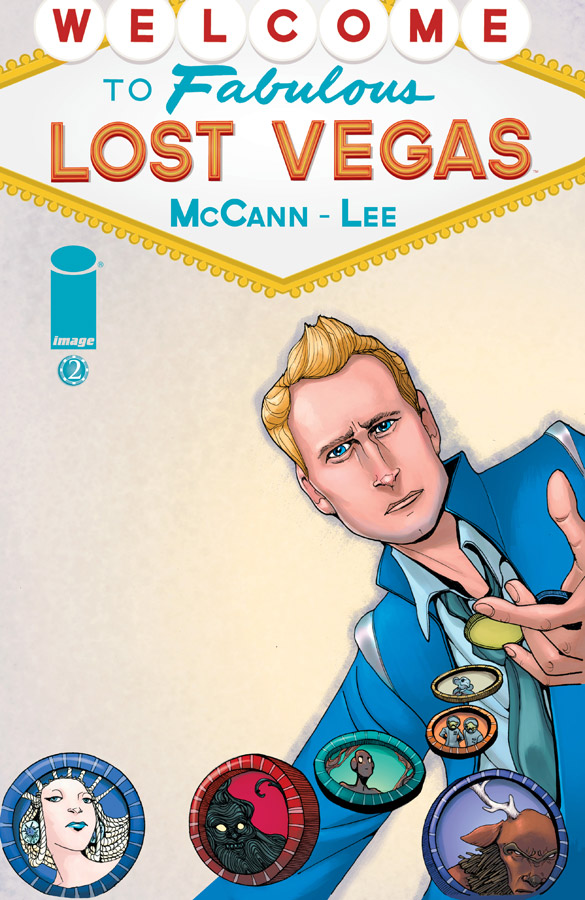
I had fleeting hopes leading up to the release of the final issue in this mini-series that, like Lost Vegas #1, Lost Vegas #4 would feature a glorious wrap-around cover by series artist Janet Lee.  And certainly, the cover delivers, even if it's not the panoramic spectacle of the first issue.  It's a portrait of space destruction, the floating detritus of a wasted spaceship, which is itself a mirror of the extravagant Earth city.  Only after finishing the story do we discover that it is a first-person perspective, from the eyes of protagonist Roland astride the magnificent science deer Atho, whose horns—one broken—peek out from the bottom right of the composition.

Friday, May 31, 2013

Lost Vegas #3

"Third Hand  |  Down to the Felt"
written by Jim McCann
art by Janet Lee

As suggested by closing pages of Lost Vegas #2, by improbable happenstance and Roland's own oft-suppressed principles, his personal escape plan has evolved into an all-out rebellion.  His allies—once only telepathic roommate blob Ink, tech man Rinny, and fellow Janus exile Loria—are multiplying.  Now seemingly in collusion with Princess Kaylex, her physically imposing science deer, and apparently a Godspark itself, though its motivations are less clear than he would like, Roland finds himself on the same ship with Ensign Scotsorn, the military commander directly responsible for the complete Death-Star-like annihilation of his planet, the brutal end of the God-War, and the political and military composition of the galaxy.  And as much as he'd like to think he'd selfishly save himself, Roland, like Loria, can't pass up the opportunity for revenge.

We also finally learn Loria's history, in particular her history with Roland himself, with whom she fled her soon-to-be-destroyed planet, and the circumstances of her employment on the Lost Vegas.  It is, in all appearances, even worse than Roland's own, a series of exploitative foremen, near-rape, and betrayal jealous servant, before being marooned on the casino spaceship.  Her bitterness is easily understood.

For the most part, however, Lost Vegas #3 feels like a penultimate episode.  The confrontation between the clever and willful Kaylex and the cruel power-monger Scotsorn is satisfying, despite for the moment his victory.  As is her spat with the semi-desperate Loria, whose humiliation and frustration at her failure are palpable, but whose willingness to recover and make amends is admirable.  But its cliffhanger is both appropriate and well-earned.  Roland, the gambler, is set to make the "final bet," a gladiatorial-style combat in which he is hopelessly over-matched.

Saturday, May 18, 2013

Lost Vegas #2

"Second Hand  |  Sharks and Whales"
written by Jim McCann
art by Janet Lee

Lost Vegas, which began as a rather straightforward heist-and-escape story, takes a dramatic turn toward espionage thriller in its second issue.  And, while the groundwork for this turn was well established in its opening chapter, it certainly comes as a welcome surprise.

Roland was undoubtedly the narrative center of "Stays in Vegas".  The motivations and agendas of the conspirators in his escape—mysterious, telepathic roommate Ink; quirky tinkerer Rinny; and clever dealer Loria—remained unclear.  "Sharks and Whales" develops that uncertainty.  As it turns out, Ink communicates independently with Rinny.  Loria knows more than she lets on about the politics on board the Lost Vegas.  And Roland's new acquaintances, Lady Kaylex and her stag-with-science Atho, have their own secrets.  Suddenly, the escape of a single indentured servant on board seems a small accomplishment among larger plans.

In a stroke of timing worthy of Roland's spectacular gambler's luck, in the process of his escape he finds that the Lost Vegas is itself being extorted by some of the galaxy's most powerful and corrupt war-mongers.  Forced to surrender a large portion of his ship's profits, to provide a de facto site for secret political meetings, and to give over his daughter Kaylex during her period of courtship, Admiral Kyule is strong-armed by one of the Post-God War's most notorious figures, Ensign Scotsorn, known as the Architect.  Not only this, his private security team of Nighthawks and fellow Akians are poised to transfer to him the Godspark, a thus-far unexplained weapon of unprecedented power.  Confronted with the creature who destroyed his planet, Roland makes a decision which, I suspect, surprised him more than the reader.

Saturday, May 11, 2013

Lost Vegas #1

"First Hand  |  Stays in Vegas"
written by Jim McCann
art by Janet Lee

Roland is a gambler.  And a cheater.  After being caught swapping chips and marking cards, his resulting debt is purchased by Nighthawks of the Lost Vegas spaceship casino, and he's forced into indentured servitude in the hospitality industry until he pays off his balance.  The casino has fixed it so that this never happens.  As the issue title suggests, once you're in Lost Vegas you "stay in Vegas."  Roland has other ideas, mostly escaping ideas.  He with a few conspirators—his mysterious, telepathic roommate Ink; out-moded technology tinkerer Rinny; and dealer and fellow cheat Loria—plan on taking the house, stealing a spacecraft, and making his escape.

As a heist/escape story, Lost Vegas has a fair degree of intrigue.  Some of McCann's conceits could fit comfortably in a tale of espionage.  The eerie, identical sameness of the enthralled employees under their holographic masks, fully disguising their identities and making them dangerous for Roland, since he cannot know which of them might recognize him or whether he might trust them.  Despite Roland's characterization of the scheme as "Clean, foolproof plan A.  Nothing left to chance" (Lost Vegas #1, p. 17), it's anything but simple.  Combine that with his growing sense of sympathy for his fellow inmates, his occasional ideas of a full-scale break, and his detection at the end of the issue, and Roland's plan has just about every chance of going wrong.

Although it's not particularly heavy-handed about it, Lost Vegas is also a critique of capitalistic exploitation.  That Roland is a degenerate cheat, if a charming and charismatic one, is certainly more true than not.  He'd already amassed a personal debt from his gambling habit before attempting to swindle Bisa and losing his debt to the casino.  But his work-scheme on the Lost Vegas is exploitative and predatory, eliminating any possibility of actually earning his freedom while perpetually holding hope of it in front of him.  It's a system the house is designed to win, and Roland is here to make sure it doesn't.  That he shows inklings of conscience and ideas of mounting a collective revolt against the casino guards is evidence of a social principle at work in some of his actions.

Janet Lee's artwork is mesmerizing, sometimes quite literally in a way that draws the eye out of the representation and into the shapes and colors independent of it.  Her use of texture and pattern—as in Rinny's dreadlocked hair or the piping on the ceiling of the servants' hallway—integrates the images into a more abstract, but equally beautiful, opening.  Sometimes the opening has its own narrative structure, and occasionally it's a unified representation, but in either case it has a visual coherence sometimes entirely divorced from the story it's representing.  Her differentiation of styles on the ship—a mechanical ulilitarianism in the staff areas; a lithe, organic art nouveau on the gaming and entertainment decks—reinforces McCann's thematic interests and provides credibility for the posh casino.  She also employs some interesting layout designs, including card-shaped image blocks in the "First Hand" portion of the issue.  The remainder continues to capitalize on this scheme, preferring small rectangles in short sequences overlaid on ostensibly full-page illustrations.

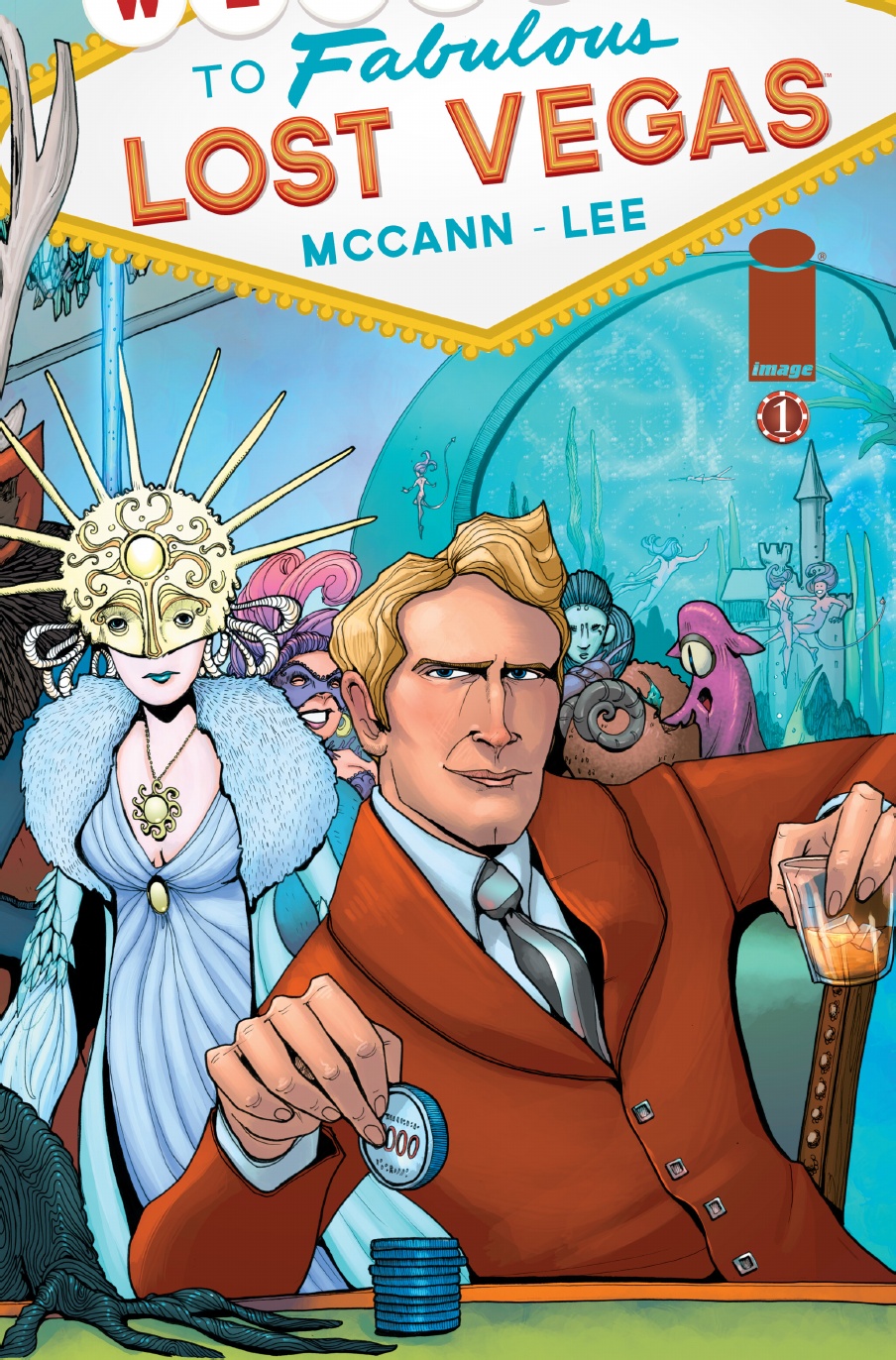
Lost Vegas #1 featured a number of variant covers—including quite excellent ones by Skottie Young and Francesco Francavilla and heavier, darker, angrier ones by Dan McDaid—but Janet Lee and Chris Sotomayor's wrap-around cover takes the prize.  It captures all the otherworldly background hubbub of the story, the futuristic luxury of the space casino, but it's Roland himself—all dapper swagger and suave, coolly staring down the viewer seated across the table—that, much as he commands the story, commands the page.