Showing posts with label Stephen King. Show all posts

Monday, August 12, 2013

American Vampire #5

Chapter Five:  "Curtain Call" and "If Thy Right Hand Offend Thee..."
written by Scott Snyder and Stephen King
art by Rafael Albuquerque


However pervasive, action sequences are difficult to do right in comics.  They always seem stiffer than on film and thinner than the quieter, more verbal moments.  Relatedly, it's very difficult to right action dialogue without sounding like a throw-back to bad puns, cheesy one-liners and empty bravado.  Pearl's revenge on her European vampire attackers and her back-stabbing best friend and roommate Hattie shows just how well they can be done.  Snyder's set-up—a meditation on the natural hierarchy of predators and the delusional overconfidence of the vampire movie moguls—is very fine, but his best move is stepping out of the way to let Rafael Albuquerque's artwork tell the tale.  The details of the scene—including the dismembered and perhaps still living body of a young woman, their cache of bladed weaponry, and their pleasure in boasting of their earlier tortures—showcase the vampires' hubristic sadism.  But it's her more personal revenge on Hattie, the vampires' new starlet and a popular embodiment of the American desire for instant celebrity and validation, that is truly satisfying.  Just as Hattie's meteoric rise is on its surface the realization of the American Dream, the reality of her "break" is a more faithful representation:  self-promotion at the expense of others, spurred by jealousy and competitive friendship, and the willingness to achieve success at any cost.

Pearl's final scenes on the boardwalk with Henry, whom it is exciting to see collaborating in Pearl's earlier revenge, is a fine and gentle moment for a character whose recent actions could threaten to change her nature as well as her form in ways more cruel than I would like.  It, in some ways, validates her earlier actions by reinforcing that she is, in fact, still Pearl.  It's also a fine moment for Skinner Sweet, who once again manages to make honesty both charming and menacing.

Jim Book is the other side of Pearl's coin, the only other person Sweet has been known to turn.  Unlike Pearl, who has reluctantly but successfully embraced Sweet's transformation, Book resists it for over three years, barely surviving on groundhogs and sheep, trying large-scale transfusions and blood treatments to cure his condition.  Finally, he enlists Abilena, his former partner's daughter, to help him kill himself.  She agrees on the condition that he impregnate her, continuing a cycle of inherited revenge, handed down from one generation to the next.  Sweet, it seems, may outlive his enemies, but not his injustices.

[September 2010]

As collected in American Vampire, Volume 1 (ISBN 978-1401228309)

Sunday, June 2, 2013

American Vampire #4

Chapter Four:  "Double Exposure" and "One Drop of Blood"
written by Scott Snyder and Stephen King
art by Rafael Albuquerque

Pearl and Skinner each survive their first moonless night.  Lured back to Block and his Hollywood vampires by her roommate and close friend Hattie Hargrove, Pearl discovers her friendship to have been little more than pretense and Hattie to be murderously jealous and self-promoting and entirely lacking in loyalty, i.e., the exact inversion of Pearl herself.  Her transformation—perhaps better described as the revelation of her character—happens entirely within "Double Exposure".  The opening flashback of her introduction to Pearl is charming and believable, two young women struggling to make it as actresses in Hollywood and struggling to find friends in a strange city.  That she would stab her newly transformed vampire friend in the back is surprising enough.  That she colluded with Bloch and his buddies to kill Pearl in the first place is fully black-hearted.

In contrast, Pearl's burgeoning love interest, Henry, continues to prove himself.  Despite her running off alone, Henry comes to her rescue under, quite literally, the shadows of the Hollywoodland Sign.  Knowing about her new condition, he still recognizes her as the same person she was before.  Though the correlation between vampiric feeding and sex is old-hat, Snyder pulls it off well.  Henry's offer is both generous and loving, and Pearl's response liberating and honest.

Sweet's showdown is considerably less interested in saving his friends than it getting revenge on the Pinkerton agent and his friends responsible for his capture.  Still figuring out the rules of his unprecedented bloodline—rules that continue to be a little too explained in every issue, for my taste—Sweet finds himself weaker and more vulnerable than he has yet experienced.  This doesn't prevent him from getting the better of Felix Camillo and Jim Book.  Yet Book's biggest ambush is the kiss from goddaughter Abilena, and his look is one of complete shock and not a little horror in itself.  Sweet's revenge is creatively cruel, befitting the outlaw himself, the infection of Book with his blood.


[August 2010]

As collected in American Vampire, Volume 1 (ISBN 978-1401228309)

Wednesday, May 15, 2013

American Vampire #3

Chapter Three:  "Rough Cut" and "Blood Vengeance"
written by Scott Snyder and Stephen King
art by Rafael Albuquerque

How can a vampire who retains its human memories and emotions also transform into a calculating, brutal killer?  It's a difficult line that Snyder walks to perfection in Pearl.  Skinner Sweet, however charismatic a character, was always an outlaw who unflinchingly murdered his enemy's lover, fed on an entire town of strangers, and shows no remorse for collateral carnage.  Pearl was not.  Her new strength and predatory acumen exists alongside her sisterly love for her roommate and her burgeoning romance with Henry.  Yet, she shows no hesitation in getting her revenge:  slaughtering the self-promoting movie star who lured her into the vampires' lounge, ripping the face off one of her attackers, and skewering another on cactus thorns.  That she is more discriminating than Sweet in selecting her targets doesn't make her any less intuitive about her kills, and it's precisely this that gives her transformation such credibility.

"Blood Vengeance" continues Sweet's story as told by Bunting, his personal feud with Jim Book in the years following his re-emergence.  However, it is his untold history with the European vampires, alluded to in "Rough Cut," that is intriguing in its suggestiveness.  Having once eluded assassination by the Europeans in America—indeed, having decapitated the lot—Sweet seemed to have come to some tentative agreement, the "Treaty," which seems to be on somewhat tenuous ground and on the verge of being broken at any moment.  The meeting of the vampires early in the issue also alludes to "the Vassals," presumably another rival vampire organization.

[July 2010]

As collected in American Vampire, Volume 1 (ISBN 978-1401228309)

Tuesday, April 16, 2013

American Vampire #2

Chapter Two:  "Morning Star" and "Deep Water"
written by Scott Snyder and Stephen King
art by Rafael Albuquerque

Once again, an otherwise excellent story is slowed by its double-billing, and in this case an extra helping of exposition.  Following fast on the heels of her attack and desert disposal by a swarm of European vampire movie-execs, Snyder's "Morning Star" finally transforms his heroine Pearl into a vampire herself.  And once again, Skinner Sweet steals the scene.  Dying in a hospital bed of blood loss and internal damage after having been found staggering and bleeding in the desert by Hattie and Henry, Pearl is rescued by Sweet, and her "infection" is strangely delicate, a delicacy that is all the more surprising after his uninvited and somewhat predatory entrance through the window of her hospital room.  Though it does mimic his own transformation, Sweet chooses to infect her by kissing her eye with his bloodied lip.  Though, presumably, any means of entering her bloodstream would have transformed her, Sweet's choice is both tender—he could have simply dripped into any of her multiple open wounds—and politely restrained—he could have kissed her lips.

Their conversation following Pearl's awakening in the morgue and return home is considerably less dramatic, even as it is considerably longer.  While it imparts some necessary information to the reader, though, to be fair, an attentive reader could probably have pieced together most of it on his own, and it provides Pearl with a slight vampire-orientation lesson, the elaboration of the differences between Skinner and Pearl—the American vampires—and Percy, Bloch, and the rest of the Europeans is somewhat dull and a bit pedantic.  It does, however, continue the ambiguous characterization of Skinner Sweet, whose motivations and personality remain as enigmatic as before.  Because he jests almost out of habit and oozes wryness out of his greasy pores, its nearly impossible to pin him down.  He makes no secret out of his desire to use Pearl and her revenge to poke back at his own enemies, to use Pearl against Bloch for his own purposes, but his response to Pearl's question about why he turned her seems equally honest and true, even as it is triple-sided:  "Oh, I don't know—maybe because I'm just sick of Bloch and his kind having their way with pretty little country girls.  Or maybe because I can't keep out of trouble.  Maybe just because I like you, Dolly."

If "Morning Star" is heavy on exposition, "Deep Water" is structured by it.  One week after Pearl's transformation, author of Sweet's non-fiction "fiction" story Bad Blood, Will Bunting, hosts a re-issue reading at which he recounts his story.  Thus, Sweet's story becomes a dramatic flashback rendering the events between his transformation and his exhumation by divers scavenging outlaw memorabilia over a decade later.  And Bunting's account reads like a summary, a whirlwind version of Bunting's time at the coat-tails of Jim Book and Felix Camillo during the hey-day of western expansion and settlement.  The telling of it may be a little dry, that is, relevant but flat and compressed, but Albuquerque's artwork is excellent, particularly of Sweet's captivity in his coffin—his first meal on a rat, his awakening under water, and his re-emergence from his grave.

[June 2010]

As collected in American Vampire, Volume 1 (ISBN 978-1401228309)
Saturday, March 30, 2013

American Vampire #1

Chapter One:  “Big Break” and “Bad Blood”
written by Scott Snyder and Stephen King
art by Rafael Albuquerque

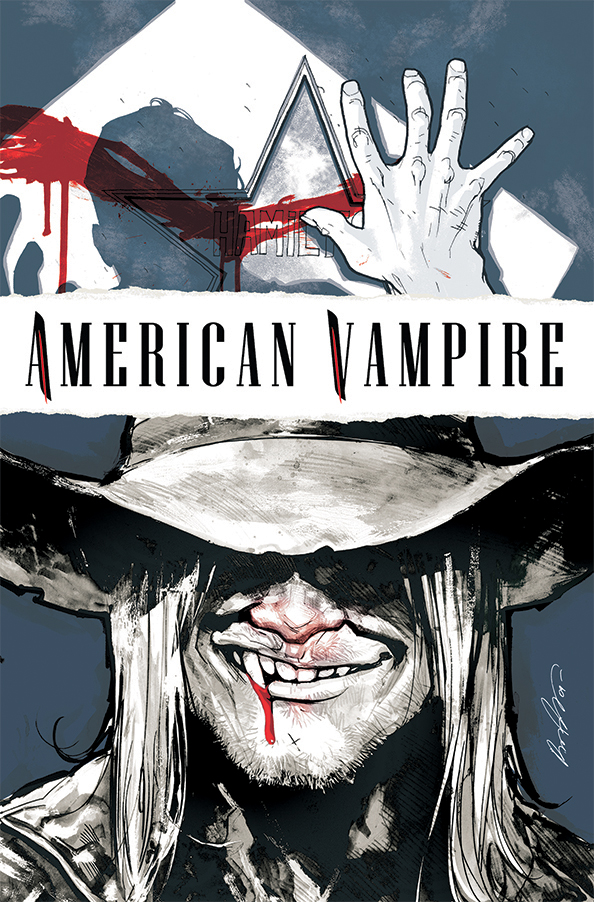
Ladies and gentlemen, may I present Skinner Sweet!  Already in its first issue, Scott Snyder’s epic ambitions for his American-Dream horror saga are evident, but its ambition takes a minor toll on the structure and pacing of its opening episode.  American Vampire #1 introduces so many characters—aspiring starlet Pearl Jones, her roommate Hattie, her amatory admirer Henry, leading man Chase Hamilton, vampire movie producer B. D. Bloch, vampire scoundrel and American outlaw Skinner Sweet, writer Will Bunting, Pinkerton agent James Book, his fiancée Ella Langum, Ronnie Jeeks and the rest of Sweet’s posse, deputy Felix Camillo, Henry Finch, vampire banker and European capitalist Percy—that none receives much nuance…yet.  Though the immediate characterizations of Snyder’s cast are sporadic and patchy, they betray a larger sense of history and detail underlying the episode’s action and characters.  The issue’s clutter of characters, then, ultimately becomes a strength, a tantalizing suggestion of a deeper history and a cast with complex motivations.

Without a doubt, bank robber and outlaw cowboy Skinner Sweet is the most instantly charismatic of the lot.  Introduced first as a pair of cowboy boots dangling from a folding deck chair, he spends “Big Break” lounging outside Pearl and Hattie’s apartment in shorts, a snugly fitting tank top, and a fedora and exchanging barbs with strong-willed Pearl.  While he quite easily could have remained little more than a leering, predatory stalker—and certainly his smirk maintains that possibility—Sweet’s body language instead invites attention, positioning himself as the object of the ladies' sexualizing stares more than the aggressor.  Sweet, no doubt, is fully aware of his cruel nature, and when he half-jokingly admits to Pearl that he's something "much worse" than an elephant man, he's not lying.  But his follow-through--"...but I'm pretty on the inside"--strangely doesn't come off like a lie either.

As he so often does, Snyder opens his series with a childhood recollection, a moment of innocence and wonder superimposed on the issue’s creepiest and most horrific sequence, the dumping of Pearl’s barely living body with a host of young female corpses.  The events that led to her disposal fully flesh out the underlying metaphor of Snyder's European vampires:  they are social, sexual, and economic predators, here feeding at will on the aspirations and Hollywood dreams of young, defenseless women.

The second act of American Vampire #1 offers a portrait of an alternative—or perhaps complementary—metaphor of the American variety.  Sweet is a fiercely independent, seemingly sadistic outlaw with a disdain for authority, a casual disregard for human life, and a predilection for candy.  His unintended transformation at the teeth of Percy solidifies him as something apart from them.  While the supporting cast of his backstory barely amounts to more than western stereotypes here, King—as Snyder for Pearl—offers great promise for the further unveiling of Skinner Sweet's saga as told by the train wreck's bystander, reporter Will Bunting.

[May 2010]

As collected in American Vampire, Volume 1 (ISBN 978-1401228309)