Showing posts with label Rafael Albuquerque. Show all posts

Sunday, March 9, 2014

American Vampire #17

"Ghost War," Part Five
written by Scott Snyder
art by Rafael Albuquerque

Snyder and Albuquerque are crafting another fine installment in their consistently riveting American Vampire series, but most of this issue of "Ghost War" feels more forced than usual.  It feigns surprises but ultimately is far more predictable than it would like to admit.  The unmasking of Skinner Sweet in the last issue was a fine surprise, not because we readers didn't recognize Sweet but because Preston did with such apparent ease.  His self-inflated bombast in their escape is loud and imperious but lacks the relish it often drips...with one notable exception.
Preston:  "I've been bitten enough that I've built up some immunity."

Sweet:  "Now you're just out to make me jealous, asshole!"  (American Vampire, Volume 3: 120 [American Vampire #17: 2])
It's a bizarre exchange, one in which the reasons for Sweet's jealousy are tantalizingly—and perhaps unintentionally—unarticulated.  Of whom, exactly, is Sweet meant to be jealous?  Preston, for marrying Pearl, for being her lover?  Pearl, for feeding freely on Henry for so many years?  Both?  It's further evidence of Skinner Sweet's strange obsession with Henry Preston, still another intriguing moment in an increasingly strange semi-romantic triangle whose pieces are difficult, if not impossible, to define.

The POW escape is less rich.  Snyder confirms what we and the soldiers must already suspect:  the Japanese are constructing weapons of mass destruction on Taipan using the contaminated and highly infectious blood of the local vampire breed.  It's a kind of biological analogue to the Manhattan Project mixed with the nuclear paranoia of Dr. Strangelove's "doomsday device".  Vicar's meager back-story, how he lost his arm, is meant to be poignant but falls well flat, as does his self-sacrifice.  The final splash may make the reader eager for "Ghost War"'s final installment, a showdown between the only two American Vampires for the life of a mortal man, but American Vampire #17 offers little more than a way to get there.  It's a stylish, kinetic trip to be sure, but it's still the penultimate act.

[September 2011]

As collected in American Vampire, Volume 3 (ISBN: 978-1401233334) 

Tuesday, February 4, 2014

American Vampire #16

"Ghost War," Part Four
written by Scott Snyder
art by Rafael Albuquerque

War makes strange bedfellows.  The Japanese prison facility darkening Taipan turns out, quite unsurprisingly, to be less a detention center than an occult science base, weapons development in vampire infection.  Their latest casualty:  Sam Lants, a weapons specialist who finds himself in a pit with a vampire land mine, loaded with shrapnel and Taipan vampire blood.

How exactly, or if, the Japanese army controls this feral breed remains unexplained.  They keep them caged at the prison, but they seem to show no fear of them wandering around the island.  Half of Taipan is, after all, under Japanese military control, the other half American.  They have, in other words, weaponized vampires, and any good soldier needs to know how to use his weapon.

Henry Preston, as it turns out, has quite the instinct for vampire hunting, and, of course, impressive caution and discretion as well.  He might never have met Skinner Sweet before the boat from Hawai'i, but he caught his scent right away.  To Henry's enduring credit, he plays along with Sweet's fiction, treating him like any other American soldier lost and wounded on the island, not only because he isn't entirely certain Skinner is a vampire, but also because he's honorable enough to wait it out.  In a troop of vampire hunters, the only one to recognize the vampire is the man who sleeps next to a vampire every night.

And so, trapped in a Japanese research prison, reduced to half their original crew, on the eve of the first field test of the vampire bomb on U.S. troops stationed on Taipan, Henry Preston and Skinner Sweet—along with Vicar Row and Calvin Poole—strike an unconventional alliance.  Preston offers Sweet his blood, a chance to regain his strength after the devastating attack by the Taipan vampires, and together they'll make their escape.  When Sweet snarls in the issue's closing splash, "Semper Fi, Motherfuckers!" (American Vampire, Volume 3: 116 [American Vampire #16: 20]), it rings with Sweet's characteristic irony.  It is simultaneously a cynical and defiant parody of military loyalty and allegiance and strangely truthful.  Against almost all expectation, Sweet is oddly a man of his word.  Semper Fi, indeed.

[August 2011]

As collected in American Vampire, Volume 3 (ISBN: 978-1401233334) 

Monday, January 20, 2014

American Vampire #15

"Ghost War," Part Three
written by Scott Snyder
art by Rafael Albuquerque

From Skinner Sweet's re-birth as the first American vampire out of his unceremonious burial in the territorial West, American Vampire's central metaphors have rooted themselves in the idea of autochthonous origins.  Vampires have a strong geographic affinity, as though emanating from the very earth itself.  When Preston observes "that dank earthen smell, like they'd come scrambling strait out of the dirt" (American Vampire, Volume 3: 75 [American Vampire #15: 1]), it seems more than appropriate that their ambush would be perpetrated by unknown creatures born literally from the Taipan soil.  War and invasion have disrupted the long-standing balance these creatures held with the local population, and a mysterious Japanese military base on the island appears to have stirred them once again.

In the finest installment yet in the "Ghost War" arc, Snyder clarifies some of the series' ambiguities in vampire mythology and injects some thrilling character moments into the war drama.  It's been clear for a while that different vampire species exhibit different physical characteristics and are therefore vulnerable to different materials—the premise is reliant on it, actually—but the psychological aspect of vampire transformation has always been opaque.  But as Lants describes it, the effects of infection on the host's personality are a widely varying.  The Taipan vampires are entirely feral, none of their humanity remaining after rapid transformation.  Pearl, on the other hand, has kept herself.  Sweet was already predatory in life and seems no more so in un-death.

But Sweet is the wildcard in "Ghost War."  He's insinuated his way into the band of vampire hunters as soldier Bill Pike, killing a few American troops to do so, but in the melee following the ambush he takes on the horde of Taipan vampires alone.  They, it seems, are one of his weaknesses.  And despite his continued anonymity as a vampire, he seemed ready to tell Henry Preston all.  Wounded and not healing as he normally would, Sweet is carried off at the end of the issue by the same Japanese troops as his uniformed peers to their ominous compound.

[July 2011]

As collected in American Vampire, Volume 3 (ISBN: 978-1401233334)

Saturday, January 11, 2014

American Vampire #14

"Ghost War," Part Two
written by Scott Snyder
art by Rafael Albuquerque

Surviving war demands operating under the most suitable perspective.  Henry Preston's right:  "Maybe it was a good thing, though--good that all we could see was the mission that morning.  God forbid you take the time to step back and see things for what they are in a place like that" (American Vampire, Volume 3: 56 [American Vampire #14: 4]).  Soldiers require a little myopia to be able to keep going, to willingly fail to see their own circumstances with complete clarity.  It's also undoubtedly an indictment of war itself that it necessitates this kind of shortsightedness as it depends on a wider scope to make it justifiable in the least.

It's also a liability, however, the inability to see the vampires for the trees, I suppose.  The Pacific theater is often overlooked in history's imagination of World War II in favor of the battlefronts on the European continent.  For all the atrocities committed under Nazi rule, German warfare was for most American troops familiar if horrible.  Combat in the Pacific against Japanese imperial troops was less so.  The powerful ethos developing out of late-19th-century militarism dictated cultural behaviors that prevented surrender and glorified self-sacrifice, the unwavering dedication and subordination of the individual to the state, one that kept some soldiers in their foxholes defending islands years after armistice was struck.  Additionally, racial differences—perceived as strongly by Allied as Imperial troops, by the VMS's "dead" soldiers as any vampire—encouraged a dehumanizing attitude.  When Preston and his platoon arrive in Taipan looking for humanoid vampires only to find wild, inhuman ones crouching in trees awaiting a guerrilla-style attack on their would-be exterminators, the echoes are there.

"Ghost War" is about being a soldier at war, the sacrifices one makes for the ones back home and sacrificing the ones back home.  Skinner Sweet and Pearl Preston (née Jones) are, as always, the wild cards.  Sweet's as self-serving as any; Hobbes is right about that.  But just what his stakes are in Taipan are unclear, since he would, of course, be the type to avoid a war zone.  And Pearl would do anything, including striking a tenuous alliance with Hobbes and the VMS, to save Henry, but she's equally as capable of killing them all to accomplish the same.

[June 2011]

As collected in American Vampire, Volume 3 (ISBN: 978-1401233334)

Wednesday, October 23, 2013

American Vampire #13

"Ghost War," Part One
written by Scott Snyder
art by Rafael Albuquerque

American Vampire's opening issue in its World War II arc is an excellent tease that invites new readers with its easily accessible exposition, fine character moments, and mostly fresh start for vampire Pearl Jones and her human husband Henry Preston.

It's an inevitable—albeit entirely hypothetical—stress on a marriage when one party grows old and the other does not.  Henry's greying hair and aging face are constant reminders of his mortality, his human frailty, and his vulnerability next to his ageless vampire wife Pearl.  He's still beautiful, and his age troubles Henry far more than it does Pearl, who by all accounts loves him just the same.  But, when considered with the uselessness he feels after being politely rejected for WWII combat, it's enough to make him want more from himself and enter into some kind of deal—maybe with the vampire-hunting organization Vassals of the Morning Star, maybe with Skinner Sweet, maybe independently with both—which lands him on an island lousy with vampires, on the verge of death, and writing a dying letter to Pearl.

Recruited by Hobbes—the politically savvy, if morally questionable, member of the Vassals to whom Henry confided Skinner's (and Pearl's) weakness; a man of his word, it seems, but a dangerous ally—to help exterminate a vampire nest on Taipan just off the coast of Japan, Henry Preston joins with a small band of agents either masquerading or doubling as a military team:  Private John Tickman (known commonly as "Tick"), communications expert; Corporal Calvin Poole, linguist and taxonomist; Sargeant First Class Samuel A. Lants, weapons and explosives technician; and erascible Romanian, senior member from the Vassals, Platoon Leader Vicar Jan Miro.  They're an unlikable bunch, haughty and self-righteous.  So, when Skinner Sweet shows up on the same ship, in uniform no less, and seemingly friendly with Henry, it's both surprising and unsurprising that he and Henry seem to share another plan.

[May 2011]

As collected in American Vampire, Volume 3 (ISBN: 978-1401233334)

Monday, September 2, 2013

American Vampire #9

"Devil in the Sand," Conclusion
written by Scott Snyder
art by Rafael Albuquerque and Mateus Santolouco

On the same day he learns about the existence of vampires, Cashel McCogan also discovers that his adoptive father, the lawman who raised him from childhood and whose death he so recently mourned, is actually a vampire and alive, from an ancient race of Irish vampires invaded and genocidally slaughtered by other European species.  Strigus Gaelic-Prime, presumed extinct.  Having lived most of his 700-year life as a respectable man, a faithful lover, and a devoted father, sincerely belonging to a community and killing no one as a predator, Gus is a foil to Sweet, a vampire lawman and perhaps one whom Jim Book could have emulated should he have given himself a chance.  He blurs the lines between human and monster and confuses the mission of the fanatical Vassals of the Morning Star.  That is, until his recent murder spree.

As revenge for his clan's extermination and to prevent the European vampires from setting up permanently in Las Vegas, Gus McCogan murdered their human puppets to lure them, successfully, to the burgeoning desert city and into his cross-hairs.  None of his victims are particularly palatable or innocent, least of all the vampires themselves, but they are human, for the most part, despite being dishonest and ruthless businessmen.  And this discrepancy puts newly enlightened Cashel in a particularly troublesome position, though it becomes less so when the rest of the vampires show up. 

Vampire McCogan's alliance with Skinner Sweet against their common enemy, although at this point not entirely unexpected, is unsurprisingly ill-advised.  The motivations for Sweet's back-stabbing—if he has any beyond sheer contrariness, a deep-seated disrespect for institutions of authority, and, in his words, the fact that he's "always, always got to be the last man standing" (American Vampire, Volume 2: 88 [9: 14])—are entirely opaque.  Nevertheless, Sweet's perverse creativity for retribution leads him to Cashel's pregnant wife with a hypodermic full of blood, leaving McCogan a widower after a violent (but unseen) delivery and a vampire baby.

As for Felicia Book, recently informed of the weaknesses of American vampires, the young hunter takes the opportunity, it seems, to test their effectiveness.  She has some success.  Gold, apparently and figuratively, poisons them.  Sweet may be able to dig out the bullets before they do too much harm, but he's now vulnerable to those who would have him dead.

[January 2011]

As collected in American Vampire, Volume 2 (ISBN 978-1401230692)

Saturday, August 31, 2013

American Vampire #8

"Devil in the Sand," Part Three
written by Scott Snyder
art by Rafael Albuquerque

Whatever I may have anticipated from the closing moments of the previous issue, I certainly didn't suspect that gun-toting Brit Linden Hobbes and crossbow-wielding Abilena Book would have tracked Pearl down to Northern California so that they could ask a favor, and a very big favor at that.  As members of a shadowy organization known as the Vassals of the Morning Star, a name with strange implications, Hobbes and Book need Pearl to inform them of her own mortal weaknesses so that they may kill her creator Skinner Sweet.  It's a devil's bargain, but as these things go, sometimes it's difficult to tell which party is the devil.  Hobbes and Book are fanatics belonging to a fanatical organization with a mission rooted in a precept that unilaterally condemns an entire race for being what they are.  And they're willing to threaten non-vampires, including Pearl's human lover Henry Preston, and seemingly violate their own agreements, such as theirs with Sweet, to achieve their genocidal objectives.  But, with the possible exception of Pearl and self-loathing James Book, American Vampire's vampires have by and large proved to be easy killers, though many—like Sweet—could easily have been villains before their transformation.  It's little surprise, then, that Pearl's refusal to cooperate with the vampire killers is a welcome display of loyalty and future self-preservation.

Meanwhile, Abilena's daughter Felicia and her partner Jack Straw attempt to convince Las Vegas lawman McCogan that the recent bout of murders is the work of a vampire—to quite humorous effect.  Despite his irritation at even the idea of conceding that the FBI imposters may have a plausible explanation for recent events, however fantastical it may seem, McCogan finds himself teamed with them for the evening, chasing down a large, winged vampire killing executives in charge of Boulder Dam.  Snyder and Albuquerque's slow reveal of the responsible vampire is exceptional, pieces of his extremely inhuman form and unique abilities dropping in each issue.

It's a testament to Snyder's tight, labyrinthine storytelling that I honestly didn't see either twist in this issue coming, but in retrospect they make absolutely perfect sense.  Henry, never one fond of Sweet and sometimes frightened by Pearl even if he still loves her profoundly, would be far more likely to cooperate with Sweet's hunters.  Cashel McCogan's father, a ghostly presence whose death has been hanging over Cashel's early tenure as Las Vegas sheriff, was just too heavy a narrative weight not to return. 

[December 2010]

As collected in American Vampire, Volume 2 (ISBN 978-1401230692)

Wednesday, August 21, 2013

American Vampire #7

"Devil in the Sand," Part Two
written by Scott Snyder
art by Rafael Albuquerque and Mateus Santolouco

If, like McCogan, we suspected Skinner Sweet of being responsible for the recent spat of murders and de-sanguinations in Las Vegas, it seems we would be wrong.  Sweet's certainly taken up residence in the burgeoning "Sin City" as a pimp and businessman whose employee was one of the last to see Mr. Beaulieu alive, but there's another vampire on the loose, tracking down the bosses of the consortium tasked with the building of Hoover Dam.  And Felicia Book and her partner Jack Straw, under the pretense of being an FBI agent and his assistant, are in town to find the murderer.  They are, instead, representatives of an organization called the Vassals, whose mission seems primarily to track down and kill vampires, a turn which expands the universe of American Vampire considerably.

Likewise, although the evolution of Sweet into something new in contrast to the pack of European entrepreneurs in Hollywood necessarily entailed the possibility of variety in vampire species, the glimpse into the world of the Vassals also opens up that variety.  Felicia's forensic investigation into the death of Mr. Beaulieu allows her narrow the species of vampire which could have perpetrated the murder, all of which seem to be documented in her research materials.  This killer is a species we haven't seen before.

And what should we make of Sweet's arrangement with the Vassals?  Under what conditions could a vampire known to be a killer even in his human form be granted immunity from an organization whose purpose is to hunt down vampires?  It's a suggestive tease, one that Felicia is particularly troubled by, but one that grants even further grey over Sweet's ambiguous character.

The final scene throws a wrench in the proceedings of the second story arc, reintroducing us to Abilena and her so-far unnamed partner who have traveled to rural California to kill Pearl Jones, in her words "the deadliest vampire on Earth" (American Vampire, Vol. 2, p. 52).  This is, of course, another mystery, since Pearl may be deadly but her seemingly idyllic life with Henry seems far from requiring Abilena's attention, except that she is the only known offspring of Skinner Sweet, the American vampire.

[November 2010]

As collected in American Vampire, Volume 2 (ISBN 978-1401230692)

Tuesday, August 13, 2013

American Vampire #6

"Devil in the Sand," Part One
written by Scott Snyder
art by Rafael Albuquerque

Leave it to Skinner Sweet to monetize vice in the most notorious party city in the United States at the very inception of its reputation.  You could even say Sweet lent Las Vegas its character.  Just over ten years after turning Pearl and taking down several Hollywood moguls, Skinner Sweet has set up as a brothel owner in Las Vegas' red light district, a city once relatively small and obscure made bigger and famous by the construction of Hoover Dam (olim Boulder Dam) twenty-five miles to the southeast and the economy of gambling, drinking and whoring that blossomed to entertain its massive workforce.

Enter Cashel McCogan, newly minted chief of police following the untimely death of his father the former police chief, father-to-be, and increasingly frustrated citizen of the growing metropolis.  He already has a history of run-ins with Sweet, whom he knows as Mr. Smoke and whom he suspects of orchestrating his father's murder.  If opening sequence in Colorado is anything to go on, he will have at least one more bloody confrontation with the vampire, one that leaves his as-yet unborn child a vampire himself.  And re-enter Felicia Book, daughter of Jim Book and Abilena Camillo and now assistant to FBI agent Jack Straw, both of whom seem fully aware of the existence of vampires and are readily capable of identifying their handiwork.

Interestingly, McCogan and Sweet receive similar artistic treatment.  They've got similar coloring, handsome facial features (even if McCogan lacks the sinister snarl Sweet achieves), comparable builds, and the same hat casting the same shadows out of which their eyes seem to pierce through.  The similarities are so convincing that I wasn't certain at first that the figure with the baby wasn't in fact Sweet himself.

[October 2010]

As collected in American Vampire, Volume 2 (ISBN 978-1401230692)

Monday, August 12, 2013

American Vampire #5

Chapter Five:  "Curtain Call" and "If Thy Right Hand Offend Thee..."
written by Scott Snyder and Stephen King
art by Rafael Albuquerque


However pervasive, action sequences are difficult to do right in comics.  They always seem stiffer than on film and thinner than the quieter, more verbal moments.  Relatedly, it's very difficult to right action dialogue without sounding like a throw-back to bad puns, cheesy one-liners and empty bravado.  Pearl's revenge on her European vampire attackers and her back-stabbing best friend and roommate Hattie shows just how well they can be done.  Snyder's set-up—a meditation on the natural hierarchy of predators and the delusional overconfidence of the vampire movie moguls—is very fine, but his best move is stepping out of the way to let Rafael Albuquerque's artwork tell the tale.  The details of the scene—including the dismembered and perhaps still living body of a young woman, their cache of bladed weaponry, and their pleasure in boasting of their earlier tortures—showcase the vampires' hubristic sadism.  But it's her more personal revenge on Hattie, the vampires' new starlet and a popular embodiment of the American desire for instant celebrity and validation, that is truly satisfying.  Just as Hattie's meteoric rise is on its surface the realization of the American Dream, the reality of her "break" is a more faithful representation:  self-promotion at the expense of others, spurred by jealousy and competitive friendship, and the willingness to achieve success at any cost.

Pearl's final scenes on the boardwalk with Henry, whom it is exciting to see collaborating in Pearl's earlier revenge, is a fine and gentle moment for a character whose recent actions could threaten to change her nature as well as her form in ways more cruel than I would like.  It, in some ways, validates her earlier actions by reinforcing that she is, in fact, still Pearl.  It's also a fine moment for Skinner Sweet, who once again manages to make honesty both charming and menacing.

Jim Book is the other side of Pearl's coin, the only other person Sweet has been known to turn.  Unlike Pearl, who has reluctantly but successfully embraced Sweet's transformation, Book resists it for over three years, barely surviving on groundhogs and sheep, trying large-scale transfusions and blood treatments to cure his condition.  Finally, he enlists Abilena, his former partner's daughter, to help him kill himself.  She agrees on the condition that he impregnate her, continuing a cycle of inherited revenge, handed down from one generation to the next.  Sweet, it seems, may outlive his enemies, but not his injustices.

[September 2010]

As collected in American Vampire, Volume 1 (ISBN 978-1401228309)

Sunday, June 2, 2013

American Vampire #4

Chapter Four:  "Double Exposure" and "One Drop of Blood"
written by Scott Snyder and Stephen King
art by Rafael Albuquerque

Pearl and Skinner each survive their first moonless night.  Lured back to Block and his Hollywood vampires by her roommate and close friend Hattie Hargrove, Pearl discovers her friendship to have been little more than pretense and Hattie to be murderously jealous and self-promoting and entirely lacking in loyalty, i.e., the exact inversion of Pearl herself.  Her transformation—perhaps better described as the revelation of her character—happens entirely within "Double Exposure".  The opening flashback of her introduction to Pearl is charming and believable, two young women struggling to make it as actresses in Hollywood and struggling to find friends in a strange city.  That she would stab her newly transformed vampire friend in the back is surprising enough.  That she colluded with Bloch and his buddies to kill Pearl in the first place is fully black-hearted.

In contrast, Pearl's burgeoning love interest, Henry, continues to prove himself.  Despite her running off alone, Henry comes to her rescue under, quite literally, the shadows of the Hollywoodland Sign.  Knowing about her new condition, he still recognizes her as the same person she was before.  Though the correlation between vampiric feeding and sex is old-hat, Snyder pulls it off well.  Henry's offer is both generous and loving, and Pearl's response liberating and honest.

Sweet's showdown is considerably less interested in saving his friends than it getting revenge on the Pinkerton agent and his friends responsible for his capture.  Still figuring out the rules of his unprecedented bloodline—rules that continue to be a little too explained in every issue, for my taste—Sweet finds himself weaker and more vulnerable than he has yet experienced.  This doesn't prevent him from getting the better of Felix Camillo and Jim Book.  Yet Book's biggest ambush is the kiss from goddaughter Abilena, and his look is one of complete shock and not a little horror in itself.  Sweet's revenge is creatively cruel, befitting the outlaw himself, the infection of Book with his blood.


[August 2010]

As collected in American Vampire, Volume 1 (ISBN 978-1401228309)

Wednesday, May 15, 2013

American Vampire #3

Chapter Three:  "Rough Cut" and "Blood Vengeance"
written by Scott Snyder and Stephen King
art by Rafael Albuquerque

How can a vampire who retains its human memories and emotions also transform into a calculating, brutal killer?  It's a difficult line that Snyder walks to perfection in Pearl.  Skinner Sweet, however charismatic a character, was always an outlaw who unflinchingly murdered his enemy's lover, fed on an entire town of strangers, and shows no remorse for collateral carnage.  Pearl was not.  Her new strength and predatory acumen exists alongside her sisterly love for her roommate and her burgeoning romance with Henry.  Yet, she shows no hesitation in getting her revenge:  slaughtering the self-promoting movie star who lured her into the vampires' lounge, ripping the face off one of her attackers, and skewering another on cactus thorns.  That she is more discriminating than Sweet in selecting her targets doesn't make her any less intuitive about her kills, and it's precisely this that gives her transformation such credibility.

"Blood Vengeance" continues Sweet's story as told by Bunting, his personal feud with Jim Book in the years following his re-emergence.  However, it is his untold history with the European vampires, alluded to in "Rough Cut," that is intriguing in its suggestiveness.  Having once eluded assassination by the Europeans in America—indeed, having decapitated the lot—Sweet seemed to have come to some tentative agreement, the "Treaty," which seems to be on somewhat tenuous ground and on the verge of being broken at any moment.  The meeting of the vampires early in the issue also alludes to "the Vassals," presumably another rival vampire organization.

[July 2010]

As collected in American Vampire, Volume 1 (ISBN 978-1401228309)

Tuesday, April 16, 2013

American Vampire #2

Chapter Two:  "Morning Star" and "Deep Water"
written by Scott Snyder and Stephen King
art by Rafael Albuquerque

Once again, an otherwise excellent story is slowed by its double-billing, and in this case an extra helping of exposition.  Following fast on the heels of her attack and desert disposal by a swarm of European vampire movie-execs, Snyder's "Morning Star" finally transforms his heroine Pearl into a vampire herself.  And once again, Skinner Sweet steals the scene.  Dying in a hospital bed of blood loss and internal damage after having been found staggering and bleeding in the desert by Hattie and Henry, Pearl is rescued by Sweet, and her "infection" is strangely delicate, a delicacy that is all the more surprising after his uninvited and somewhat predatory entrance through the window of her hospital room.  Though it does mimic his own transformation, Sweet chooses to infect her by kissing her eye with his bloodied lip.  Though, presumably, any means of entering her bloodstream would have transformed her, Sweet's choice is both tender—he could have simply dripped into any of her multiple open wounds—and politely restrained—he could have kissed her lips.

Their conversation following Pearl's awakening in the morgue and return home is considerably less dramatic, even as it is considerably longer.  While it imparts some necessary information to the reader, though, to be fair, an attentive reader could probably have pieced together most of it on his own, and it provides Pearl with a slight vampire-orientation lesson, the elaboration of the differences between Skinner and Pearl—the American vampires—and Percy, Bloch, and the rest of the Europeans is somewhat dull and a bit pedantic.  It does, however, continue the ambiguous characterization of Skinner Sweet, whose motivations and personality remain as enigmatic as before.  Because he jests almost out of habit and oozes wryness out of his greasy pores, its nearly impossible to pin him down.  He makes no secret out of his desire to use Pearl and her revenge to poke back at his own enemies, to use Pearl against Bloch for his own purposes, but his response to Pearl's question about why he turned her seems equally honest and true, even as it is triple-sided:  "Oh, I don't know—maybe because I'm just sick of Bloch and his kind having their way with pretty little country girls.  Or maybe because I can't keep out of trouble.  Maybe just because I like you, Dolly."

If "Morning Star" is heavy on exposition, "Deep Water" is structured by it.  One week after Pearl's transformation, author of Sweet's non-fiction "fiction" story Bad Blood, Will Bunting, hosts a re-issue reading at which he recounts his story.  Thus, Sweet's story becomes a dramatic flashback rendering the events between his transformation and his exhumation by divers scavenging outlaw memorabilia over a decade later.  And Bunting's account reads like a summary, a whirlwind version of Bunting's time at the coat-tails of Jim Book and Felix Camillo during the hey-day of western expansion and settlement.  The telling of it may be a little dry, that is, relevant but flat and compressed, but Albuquerque's artwork is excellent, particularly of Sweet's captivity in his coffin—his first meal on a rat, his awakening under water, and his re-emergence from his grave.

[June 2010]

As collected in American Vampire, Volume 1 (ISBN 978-1401228309)

Saturday, March 30, 2013

American Vampire #1

Chapter One:  “Big Break” and “Bad Blood”
written by Scott Snyder and Stephen King
art by Rafael Albuquerque

Ladies and gentlemen, may I present Skinner Sweet!  Already in its first issue, Scott Snyder’s epic ambitions for his American-Dream horror saga are evident, but its ambition takes a minor toll on the structure and pacing of its opening episode.  American Vampire #1 introduces so many characters—aspiring starlet Pearl Jones, her roommate Hattie, her amatory admirer Henry, leading man Chase Hamilton, vampire movie producer B. D. Bloch, vampire scoundrel and American outlaw Skinner Sweet, writer Will Bunting, Pinkerton agent James Book, his fiancée Ella Langum, Ronnie Jeeks and the rest of Sweet’s posse, deputy Felix Camillo, Henry Finch, vampire banker and European capitalist Percy—that none receives much nuance…yet.  Though the immediate characterizations of Snyder’s cast are sporadic and patchy, they betray a larger sense of history and detail underlying the episode’s action and characters.  The issue’s clutter of characters, then, ultimately becomes a strength, a tantalizing suggestion of a deeper history and a cast with complex motivations.
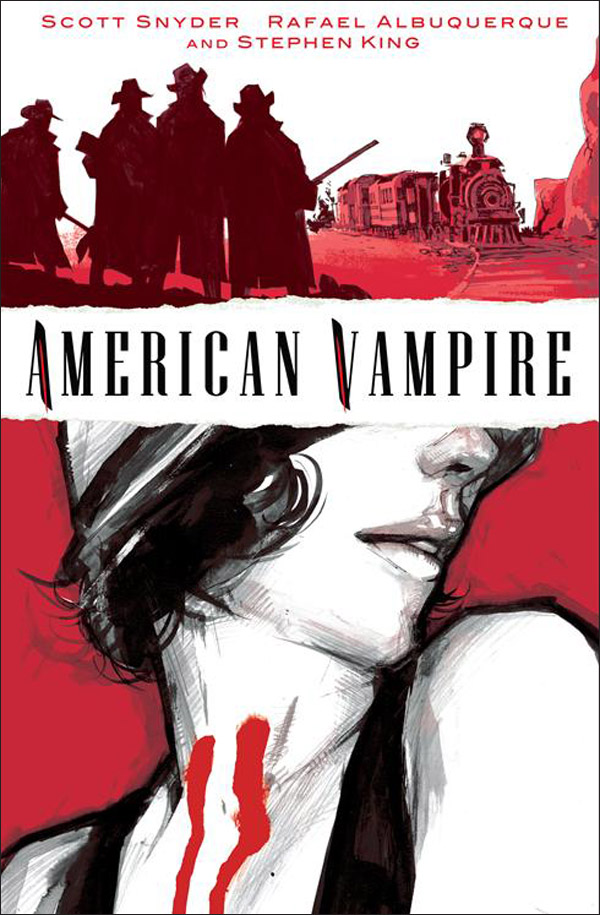
Without a doubt, bank robber and outlaw cowboy Skinner Sweet is the most instantly charismatic of the lot.  Introduced first as a pair of cowboy boots dangling from a folding deck chair, he spends “Big Break” lounging outside Pearl and Hattie’s apartment in shorts, a snugly fitting tank top, and a fedora and exchanging barbs with strong-willed Pearl.  While he quite easily could have remained little more than a leering, predatory stalker—and certainly his smirk maintains that possibility—Sweet’s body language instead invites attention, positioning himself as the object of the ladies' sexualizing stares more than the aggressor.  Sweet, no doubt, is fully aware of his cruel nature, and when he half-jokingly admits to Pearl that he's something "much worse" than an elephant man, he's not lying.  But his follow-through--"...but I'm pretty on the inside"--strangely doesn't come off like a lie either.

As he so often does, Snyder opens his series with a childhood recollection, a moment of innocence and wonder superimposed on the issue’s creepiest and most horrific sequence, the dumping of Pearl’s barely living body with a host of young female corpses.  The events that led to her disposal fully flesh out the underlying metaphor of Snyder's European vampires:  they are social, sexual, and economic predators, here feeding at will on the aspirations and Hollywood dreams of young, defenseless women.

The second act of American Vampire #1 offers a portrait of an alternative—or perhaps complementary—metaphor of the American variety.  Sweet is a fiercely independent, seemingly sadistic outlaw with a disdain for authority, a casual disregard for human life, and a predilection for candy.  His unintended transformation at the teeth of Percy solidifies him as something apart from them.  While the supporting cast of his backstory barely amounts to more than western stereotypes here, King—as Snyder for Pearl—offers great promise for the further unveiling of Skinner Sweet's saga as told by the train wreck's bystander, reporter Will Bunting.

[May 2010]

As collected in American Vampire, Volume 1 (ISBN 978-1401228309)