Sixteen: Let It Burn
written by Jonathan Hickman
art by Nick Dragotta
colors by Frank Martin
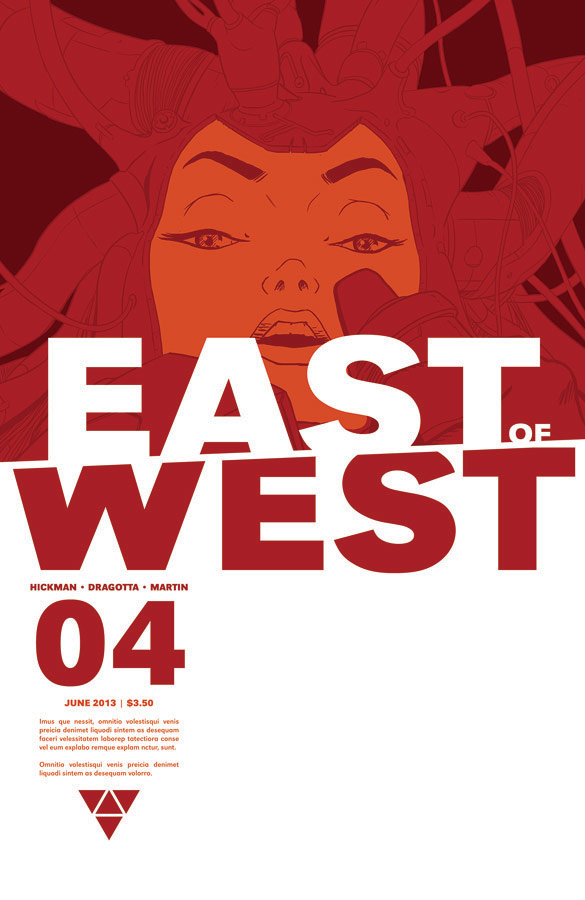
Texas falls. It falls quickly. Bel Solomon, still with the seditious spirit of the assassinated Cheveyo whispering in his ear, and his Rangers do their best to stave off the onslaught of the Endless Nation's machines of war, but they are overrun. And War, Famine, and vaunting Conquest come to glory in their victory and the devastation that the war leaves in its wake.
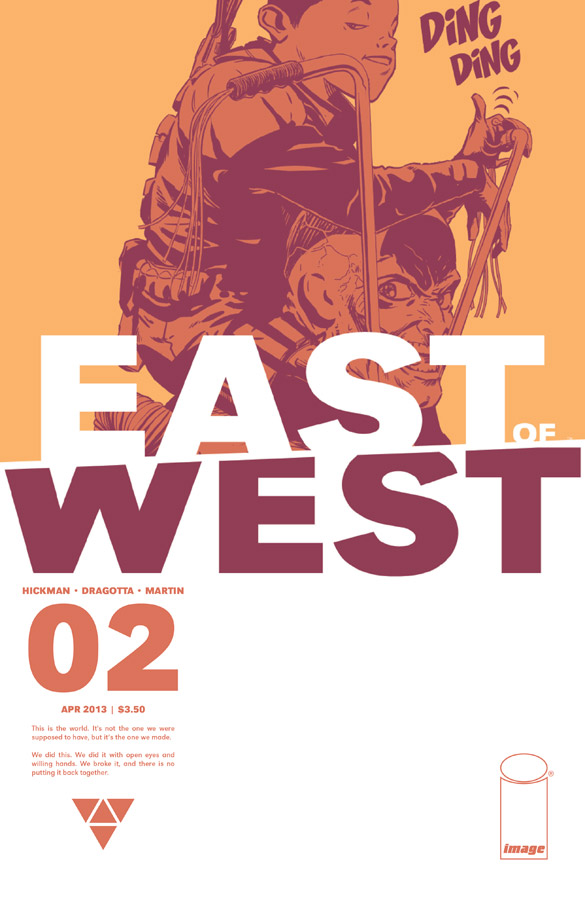
These three Horsemen are crude instruments. Like the self-aggrandizing humans they scorn—foolishly imagining themselves above the petty, animal motivations that instigate such savage conflict—they think themselves great, above the self-flattery and self-deceit that governs the "meat," the "apes," drinking blood from the sun-bleached skull, Conquest riding his bicycle-bars-bridled giant. If Conquest is triumphant, War is seductively blissful. Satisfied, and luxuriating in the blood of the battle-slain. So begins the second year of the Apocalypse.
The White Tower of the Union is besieged from within. Still fighting semi-organized insurgencies and widespread political unrest, still financially weak and beholden to the Kingdom of New Orleans for credit, and now unable to broker any peace with the Endless Nation, who beheaded their diplomatic emissary, President LeVay with her untrustworthy Chief of Staff Doma Lux finds herself vulnerable to the interference of foreign powers, who may very well be supplying insurgent efforts with weapons. But from her office in Washington, LeVay might very well exist in an entirely different world from the hangings in Texas. It's a testament to Hickman's storytelling that the commingling of such disparate genres blend with as great an ease as they do, that a political thriller could sit alongside public lynchings.
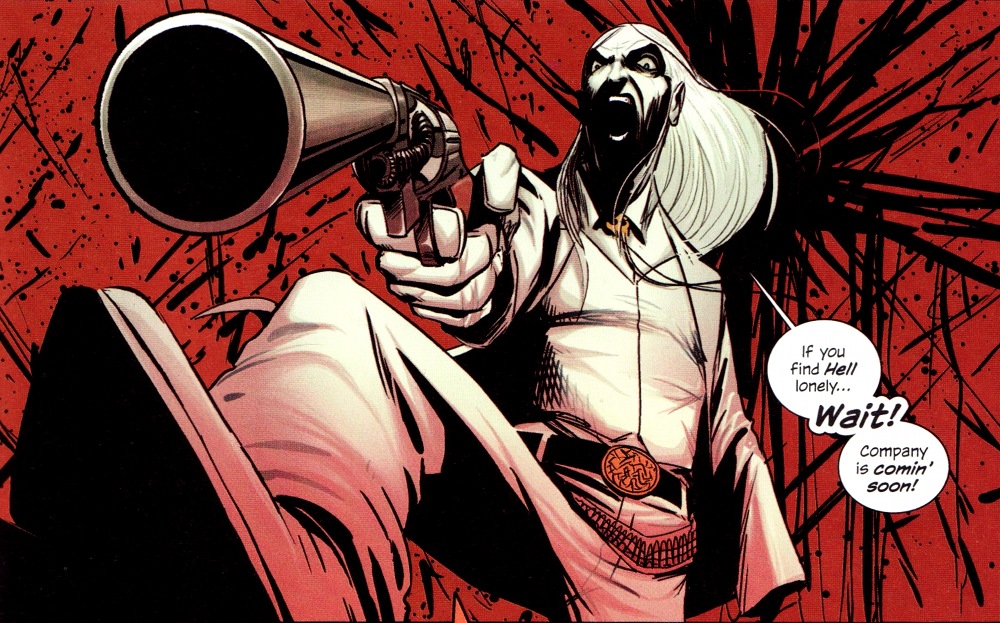
The last Ranger, formerly tasked by Solomon to kill the Chosen, returns to save Solomon from the gallows...for the time being. As ever, his robot dog is the charismatic lead in the rescue, slinking among the crowd in a cloak shitting decoy and distraction bombs, lassoing Solomon and dragging him away from danger. Hickman's mechanical Nation representative, spouting ironic doctrine and decrying the tyranny of the former governor, is a worthy villain for the moment. When the Ranger later chastises him—Where was I born, Bel? Did I not wear the star? It's not your nation... It never was. It was the people's" (East of West #16: 26)—his arrogance is laid bare. Whatever Solomon's crimes, the rest of Texas did not deserve its fate. But Dragotta's near-wordless account of the rescue is spectacular.
Meanwhile, the most welcome return, spotted on the horizon—a metaphor that Premier Xiolian is likely to entertain, like hope or an illusion—is her husband Death. "I think hope will be the death of us" (24), she thinks. But the Nation have come calling. Unsurprisingly, they too overestimated their power, and underestimated the need for soldiers as well as weapons in their war.
[December 2014]
In which a relatively recent comic book reader discovers and reviews comics new and old.
Showing posts with label Jonathan Hickman. Show all posts
Saturday, February 7, 2015
Tuesday, January 27, 2015
East of West: The World (one-shot)
The World
Sourcebook | Atlas | Encyclopedia | Timelines | Apocrypha
written by Jonathan Hickman
art by Nick Dragotta
colors by Frank Martin
There's the sly pretense of transparency in Hickman's East of West one-shot "companion," the generic facade of simple legibility—maps, charts, timelines, all in the easy service of unremarkable explication. And it is true that "The World" is a concise summary of the political intrigue and restructured geography of East of West, most of which previously available to shrewd, attentive readers in the scattered details and intimations of logic since its opening issue, but helpfully repackaged and condensed in a far more accessible format.
But "The World" presents a much more nuanced portrait of a divided continent on the brink of war than a simple, unmediated summary. Its maps are familiar, echoes of the world we know, and yet disorienting in that familiarity as new boundaries are etched across the landscape. They suggest a world entirely transformed—New York and Boston, for example, obscured by the inset of Washington, D.C., are unimportant, perhaps even absent, in this new world. Confederate shipping lanes out into the Atlantic from the Bahamas, an historically sensitive account of Southern economy without the devastation of Reconstruction, are the only suggestion of interests outside the seven nations, the sole outlet and known exception to their collective isolationism.
More telling, however, is the evidence it provides for internal disputes and political upheaval. The unrest in the Union was already well known, but the history of dynastic factioning in the People's Republic and the vestiges of that rivalry was unspecified, though now the Dragon and Widowmaker contentions make considerably more sense. The white-hot, righteous bloodbath from which the Rangers emerged was the stuff of legend, but their checkered and close history with the Endless Nation—now their conquerors—less absolute. It would seem a significant contingent of Texans were also Sioux, speakers of Lakota, those not members of the communal tribe or perhaps simply reluctant to join the Machine State. Cheveyo, the mystical outlaw of the Chosen and fellow bringer of the apocalypse, spoke Arapaho. Nihnootheiht, "he who was abandoned". The language of the Endless Nation is Lakota, unsurprising given the political and religious prominence of Red Cloud and his success in allying the Lakota Sioux, Cheyenne and Arapaho nations, but like the "disputed territories" that shade the landscape, it's a furtive reminder of the pervasive instability and long-simmering animosities at play in the coming war.
Dragotta's design work is impeccable and dramatically suggestive. The timeline, in particular, could have been little more than a string of informative but dry details. Instead it's a marvel, a bright, burning white nucleus that begins with the "fire in the sky" and the deaths of Red Cloud and Longstreet; radiates the yellow and bright oranges of the Union, the Confederacy, and the Republic of Texas; builds in cool complexity as the other nations coalesce; and ultimately, under the gravitational pressure of the Apocalypse, gathers into a planetary form with a fiery core. This is the World.
[December 2014]
Sourcebook | Atlas | Encyclopedia | Timelines | Apocrypha
written by Jonathan Hickman
art by Nick Dragotta
colors by Frank Martin
There's the sly pretense of transparency in Hickman's East of West one-shot "companion," the generic facade of simple legibility—maps, charts, timelines, all in the easy service of unremarkable explication. And it is true that "The World" is a concise summary of the political intrigue and restructured geography of East of West, most of which previously available to shrewd, attentive readers in the scattered details and intimations of logic since its opening issue, but helpfully repackaged and condensed in a far more accessible format.
But "The World" presents a much more nuanced portrait of a divided continent on the brink of war than a simple, unmediated summary. Its maps are familiar, echoes of the world we know, and yet disorienting in that familiarity as new boundaries are etched across the landscape. They suggest a world entirely transformed—New York and Boston, for example, obscured by the inset of Washington, D.C., are unimportant, perhaps even absent, in this new world. Confederate shipping lanes out into the Atlantic from the Bahamas, an historically sensitive account of Southern economy without the devastation of Reconstruction, are the only suggestion of interests outside the seven nations, the sole outlet and known exception to their collective isolationism.
More telling, however, is the evidence it provides for internal disputes and political upheaval. The unrest in the Union was already well known, but the history of dynastic factioning in the People's Republic and the vestiges of that rivalry was unspecified, though now the Dragon and Widowmaker contentions make considerably more sense. The white-hot, righteous bloodbath from which the Rangers emerged was the stuff of legend, but their checkered and close history with the Endless Nation—now their conquerors—less absolute. It would seem a significant contingent of Texans were also Sioux, speakers of Lakota, those not members of the communal tribe or perhaps simply reluctant to join the Machine State. Cheveyo, the mystical outlaw of the Chosen and fellow bringer of the apocalypse, spoke Arapaho. Nihnootheiht, "he who was abandoned". The language of the Endless Nation is Lakota, unsurprising given the political and religious prominence of Red Cloud and his success in allying the Lakota Sioux, Cheyenne and Arapaho nations, but like the "disputed territories" that shade the landscape, it's a furtive reminder of the pervasive instability and long-simmering animosities at play in the coming war.
Dragotta's design work is impeccable and dramatically suggestive. The timeline, in particular, could have been little more than a string of informative but dry details. Instead it's a marvel, a bright, burning white nucleus that begins with the "fire in the sky" and the deaths of Red Cloud and Longstreet; radiates the yellow and bright oranges of the Union, the Confederacy, and the Republic of Texas; builds in cool complexity as the other nations coalesce; and ultimately, under the gravitational pressure of the Apocalypse, gathers into a planetary form with a fiery core. This is the World.
[December 2014]
Tuesday, January 20, 2015
East of West #15
Issue 15: Awake Babylon
written by Jonathan Hickman
art by Nick Dragotta
colors by Frank Martin
It is a world thrust into war. The Nation have engaged the Republic of Texas, taken action against Armistice itself. The new Premier of the People's Republic, wife of Death and mother of the Beast, Xiaolian prepares her own agents for warfare in the wake of their mutual destruction. Chief of Staff—and perhaps soon-to-be President—of the Confederacy Chamberlain is itching for power and eager for conflict. Puppet of the Horsemen and President of the Union LeVay is powerless next to the machinations of her own Chief of Staff and the intervention of the Beast, who usurps her own missiles for his purposes. The world is about to burn, and many are standing in line to watch it happen.
How, then, does the Beast—newly named Babylon—elicit a strange optimism? He is a child of Death and a fearsome warrior. He was stolen away by a cabal of apocalyptic zealots, kept prisoner, trained and mentored by a computer interface with unknown but increasingly sinister motives, and embraced by the Horsemen Conquest, War, and Famine as their master. And the influences around him are considerable, the lies and deceptions deep. There is little cause for optimism in such a world, a world that promises to be built on destruction. But he calls his orb Balloon.
As he stands in a field of wildflowers glowing in the rays of the sun, but sees nothing but the graveyard wasteland that Balloon shows him, a warped distortion of the truth, he lacks only his own unmediated vision to see what is before him. The world has already burned, and it has already been built anew. In the devastation of the Deadlands, the most beautiful landscape in the world as it exists has emerged fresh and unblemished by the deadly politics of its neighboring nations.
[September 2014]
written by Jonathan Hickman
art by Nick Dragotta
colors by Frank Martin
It is a world thrust into war. The Nation have engaged the Republic of Texas, taken action against Armistice itself. The new Premier of the People's Republic, wife of Death and mother of the Beast, Xiaolian prepares her own agents for warfare in the wake of their mutual destruction. Chief of Staff—and perhaps soon-to-be President—of the Confederacy Chamberlain is itching for power and eager for conflict. Puppet of the Horsemen and President of the Union LeVay is powerless next to the machinations of her own Chief of Staff and the intervention of the Beast, who usurps her own missiles for his purposes. The world is about to burn, and many are standing in line to watch it happen.
How, then, does the Beast—newly named Babylon—elicit a strange optimism? He is a child of Death and a fearsome warrior. He was stolen away by a cabal of apocalyptic zealots, kept prisoner, trained and mentored by a computer interface with unknown but increasingly sinister motives, and embraced by the Horsemen Conquest, War, and Famine as their master. And the influences around him are considerable, the lies and deceptions deep. There is little cause for optimism in such a world, a world that promises to be built on destruction. But he calls his orb Balloon.
As he stands in a field of wildflowers glowing in the rays of the sun, but sees nothing but the graveyard wasteland that Balloon shows him, a warped distortion of the truth, he lacks only his own unmediated vision to see what is before him. The world has already burned, and it has already been built anew. In the devastation of the Deadlands, the most beautiful landscape in the world as it exists has emerged fresh and unblemished by the deadly politics of its neighboring nations.
[September 2014]
Friday, January 16, 2015
East of West #14
Fourteen: A World Full of Angry Children
written by Jonathan Hickman
art by Nick Dragotta
colors by Frank Martin
History is the stories we tell. And the stories we don't. Chamberlain assassinated President Burkhardt, a ring with a poisoned stinger during the melee following the explosion of Peter Graves of the Union. But at his funeral Chamberlain tells his grandchildren a different story, one of wartime bravery and loyalty and friendship, one which gives history the legend of a man. And it is truly telling that in Hickman's apocalyptic landscape, it's equally likely that Chamberlain's story is true or entirely fabricated. Truth is, more or less, what we believe, not what is.
[July 2014]
written by Jonathan Hickman
art by Nick Dragotta
colors by Frank Martin
History is the stories we tell. And the stories we don't. Chamberlain assassinated President Burkhardt, a ring with a poisoned stinger during the melee following the explosion of Peter Graves of the Union. But at his funeral Chamberlain tells his grandchildren a different story, one of wartime bravery and loyalty and friendship, one which gives history the legend of a man. And it is truly telling that in Hickman's apocalyptic landscape, it's equally likely that Chamberlain's story is true or entirely fabricated. Truth is, more or less, what we believe, not what is.
"Let me put it to you like this: Time is a series of overlapping rings that present each age with the same series of repeating generational opportunities. So...I'm gonna kill him. And if I'm wrong -- so be it...it'll all come back around." (East of West #14: 15)Faith too is what we make it to be. To each generation its own apocalypse. That anything, Death included, could lie outside the holy apocrypha, as Famine suggests, makes quite a mockery of the idea of fate and design. War's certainty that opportunity will re-present itself if once squandered seems far less inevitable as pieces of the Message's great prophetic puzzle fall to the wayside. Either it happens as it must, and only once, or it happens as we make it happen.
"All these people -- even ours -- believing all these long, dead lies... Legend says their three worlds sprang to life in the days following the fire in the sky. Here is your response, mystics and believers...here is a little fire of our own." (17)And so war happens. A war of faith and destiny against self-made action and responsibility, instruments against autonomous creatures of free will and decision.
[July 2014]
Friday, September 5, 2014
East of West #13
Thirteen: Dead Lands Comin'
written by Jonathan Hickman
art by Nick Dragotta
colors by Frank Martin
If the Ranger is a crack sniper, one of few more than a handful that could take off Cheveyo's head from 96 kilometers away—"And, bless their lethal souls...they've all long departed this mortal plane" (East of West #13: 7)—Death is a supernatural one, even with only the one eye and a revolver. Death's predictably angered by the Ranger's interference, another obstacle in his search for his son. Their brawl, a rather petulant display of mutually inflicted retribution, as though a little ass-kicking could satisfy or redress the inconvenience, is more braggadocio and hot air, but it's also a slick, humorous, Old West-styled introduction of two men who might just as easily be allies as adversaries.
The other unintended consequence of Cheveyo's assassination: He was killed in the dead lands, at the border between this world and the other, and whatever the intent of the bullet, it paid the blood price to open the door. It takes an uncharacteristic exposition dump to establish the rules and the stakes, and it feels a little out of place in Hickman's typically rich but spartan prose. But it's a fine, very fine and tender exchange between Wolf and Crow, one mourning the death of his father, the other regretfully begging for his help to ward off the coming beasts. When she gently lifts his face, she gasps at his newly tear-stained face now perfectly mirroring her own, the tattoo of a pain we don't yet know.
[July 2014]
written by Jonathan Hickman
art by Nick Dragotta
colors by Frank Martin
If the Ranger is a crack sniper, one of few more than a handful that could take off Cheveyo's head from 96 kilometers away—"And, bless their lethal souls...they've all long departed this mortal plane" (East of West #13: 7)—Death is a supernatural one, even with only the one eye and a revolver. Death's predictably angered by the Ranger's interference, another obstacle in his search for his son. Their brawl, a rather petulant display of mutually inflicted retribution, as though a little ass-kicking could satisfy or redress the inconvenience, is more braggadocio and hot air, but it's also a slick, humorous, Old West-styled introduction of two men who might just as easily be allies as adversaries.
The other unintended consequence of Cheveyo's assassination: He was killed in the dead lands, at the border between this world and the other, and whatever the intent of the bullet, it paid the blood price to open the door. It takes an uncharacteristic exposition dump to establish the rules and the stakes, and it feels a little out of place in Hickman's typically rich but spartan prose. But it's a fine, very fine and tender exchange between Wolf and Crow, one mourning the death of his father, the other regretfully begging for his help to ward off the coming beasts. When she gently lifts his face, she gasps at his newly tear-stained face now perfectly mirroring her own, the tattoo of a pain we don't yet know.
"Your father left something of his soul here in the waking world. It will grow and gather the balance from the ether. HUAARRK! In death... he's deceived us all... He's eluded our grasp and paying his due... And he's tricked you in offering up your soul." (23)As the dead soul takes the dead witch's body, stalking away with his new bone-skull body, Wolf surrenders something perhaps more than he realizes.
[July 2014]
Monday, June 16, 2014
East of West #12
Twelve: Worship God War
written by Jonathan Hickman
art by Nick Dragotta
colors by Frank Martin
No one leaves the summit of nations with a more self-satisfied expression than vengeful Xiaolian, except perhaps Doma Lux.
Though the petite Chief of Staff once seemed like an acolyte of the tall, severe President Antonia LeVay, in "Worship God War" it appears increasingly likely that she—like Archibald Chamberlain of the Confederacy—may, in fact, be the real force to be reckoned with from the Union. Mistakenly believing himself the recipient of some kind of sexual interaction, Peter Graves allows Doma Lux to shove a bomb down his throat. When it explodes during the summit, launching pieces of Graves across the table, LeVay appears as surprised and disgusted as any. Whether sincere or a designed deception, LeVay is no longer plainly calling the shots for the Union.
Likewise, the growing dissent between Chamberlain and President Burkhart perhaps instigates the Confederate leader's own assassination in the ensuing confusion. Though I believed his former assertions that he would rather not be the most visible political target, preferring instead the powerful shadows that allow him to maneuver in relative anonymity, Chamberlain may have seized his opportunity once Burkhart's politics began diverging meaningfully from his own.
As the Observer, a shaman of the Endless Nation, interprets, the two murders are independent treacheries. They are perhaps entwined with one another in the great conspiracy targeted by Xiaolian, but they are committed by two different hands with divergent motivations. But this observation—or perhaps only the sacrilege of his statistical technology—makes the Observer the third murder at the table, this time by Bel Solomon under the mystical puppetry of Cheveyo, yet another silent participant at the table.
The explosive apocalyptic fervor of East of West's first two arcs is supplanted in the last two issues by tense political machinations, though the stakes are equal. East of West neither forsakes its twisted humor—the young mouthy John Freeman cowering under the table beside his more awesome older brother; the carnage at the table as Xiaolian leaves with her military escort, a bloody echo of their meeting's beginning; the vacant, gore-spattered chair on the issue's cover—nor relents its fearsome rush toward the end of the world, but shifts into something more depressingly familiar, the futility of diplomacy among such self-serving and ineffective political leaders.
[May 2014]
written by Jonathan Hickman
art by Nick Dragotta
colors by Frank Martin
No one leaves the summit of nations with a more self-satisfied expression than vengeful Xiaolian, except perhaps Doma Lux.
Though the petite Chief of Staff once seemed like an acolyte of the tall, severe President Antonia LeVay, in "Worship God War" it appears increasingly likely that she—like Archibald Chamberlain of the Confederacy—may, in fact, be the real force to be reckoned with from the Union. Mistakenly believing himself the recipient of some kind of sexual interaction, Peter Graves allows Doma Lux to shove a bomb down his throat. When it explodes during the summit, launching pieces of Graves across the table, LeVay appears as surprised and disgusted as any. Whether sincere or a designed deception, LeVay is no longer plainly calling the shots for the Union.Likewise, the growing dissent between Chamberlain and President Burkhart perhaps instigates the Confederate leader's own assassination in the ensuing confusion. Though I believed his former assertions that he would rather not be the most visible political target, preferring instead the powerful shadows that allow him to maneuver in relative anonymity, Chamberlain may have seized his opportunity once Burkhart's politics began diverging meaningfully from his own.
As the Observer, a shaman of the Endless Nation, interprets, the two murders are independent treacheries. They are perhaps entwined with one another in the great conspiracy targeted by Xiaolian, but they are committed by two different hands with divergent motivations. But this observation—or perhaps only the sacrilege of his statistical technology—makes the Observer the third murder at the table, this time by Bel Solomon under the mystical puppetry of Cheveyo, yet another silent participant at the table.
The explosive apocalyptic fervor of East of West's first two arcs is supplanted in the last two issues by tense political machinations, though the stakes are equal. East of West neither forsakes its twisted humor—the young mouthy John Freeman cowering under the table beside his more awesome older brother; the carnage at the table as Xiaolian leaves with her military escort, a bloody echo of their meeting's beginning; the vacant, gore-spattered chair on the issue's cover—nor relents its fearsome rush toward the end of the world, but shifts into something more depressingly familiar, the futility of diplomacy among such self-serving and ineffective political leaders.
[May 2014]
Tuesday, April 15, 2014
East of West #11
Eleven: The Wall Beckons
written by Jonathan Hickman
art by Nick Dragotta
colors by Frank Martin
It's easy to forget that, though the Chosen hold powerful political positions (with one notable exception) in their respective nations, they are not, strictly speaking, official ambassadors. Their conspiracy of apocalyptic zealots, Machiavellian power-mongers, and slippery political officials was always a shadowy operation, conducted quietly and obscurely. If "Above All, Few Are Chosen" was the convocation of conspirators at the heart of the Armistice, "The Wall Beckons" is the diplomatic assembly of nations at the boundary of Armistice. The cast is admittedly much the same, but the discrepancies are very telling.
Following Death's invasion of her father's country, Xiaolian now rules the People's Republic of America as premier, and the summit is assembled at her invitation. President Burkhart of the Confederacy accompanies Chamberlain, and the others have similarly brought diplomatic seconds. Ezra, Keeper of the Message, does not attend. But it is the absence of Cheveyo, an exile from his nation, an outcast for his religious fervor, that strikes so pointedly.
The structure of East of West has pinged around Hickman's commuted North American geography, following Death's hunt and the conspirators themselves. Individual issues often feature portraits of each territory: "Above All, Few are Chosen" briefly in the Confederacy, "The House of Mao" and "Last Days of Dead Men" in the People's Republic, "To Do Justly, and To Love Mercy" in the Texas Republic, "The Pilgrimage" at Armistice, "The Street Is Burning" in the Union, and "A Kingdom of Riches" in New Orleans. East of West has been inconspicuously silent about the Endless Nation. "The Wall Beckons" announces them with style.
[April 2014]
written by Jonathan Hickman
art by Nick Dragotta
colors by Frank Martin
It's easy to forget that, though the Chosen hold powerful political positions (with one notable exception) in their respective nations, they are not, strictly speaking, official ambassadors. Their conspiracy of apocalyptic zealots, Machiavellian power-mongers, and slippery political officials was always a shadowy operation, conducted quietly and obscurely. If "Above All, Few Are Chosen" was the convocation of conspirators at the heart of the Armistice, "The Wall Beckons" is the diplomatic assembly of nations at the boundary of Armistice. The cast is admittedly much the same, but the discrepancies are very telling.
Following Death's invasion of her father's country, Xiaolian now rules the People's Republic of America as premier, and the summit is assembled at her invitation. President Burkhart of the Confederacy accompanies Chamberlain, and the others have similarly brought diplomatic seconds. Ezra, Keeper of the Message, does not attend. But it is the absence of Cheveyo, an exile from his nation, an outcast for his religious fervor, that strikes so pointedly.
The structure of East of West has pinged around Hickman's commuted North American geography, following Death's hunt and the conspirators themselves. Individual issues often feature portraits of each territory: "Above All, Few are Chosen" briefly in the Confederacy, "The House of Mao" and "Last Days of Dead Men" in the People's Republic, "To Do Justly, and To Love Mercy" in the Texas Republic, "The Pilgrimage" at Armistice, "The Street Is Burning" in the Union, and "A Kingdom of Riches" in New Orleans. East of West has been inconspicuously silent about the Endless Nation. "The Wall Beckons" announces them with style.
"What makes one sovereign state better than another? Is it having fractionally more money...or power...or influence? Yes. Of course it is. Is it having a greater power to destroy? Or to build? Yes. That also. Each head of state here represents some various measure of each of those things in some other varying degree...But one has more than all the others. You asked me earlier, who here should concern you...most? Well, there's your answer, Mister President. Take a good look...The Endless Nation has arrived." (East of West #11: 23-24)While East of West #11 neglects to propel the story too far, it's a fine reorientation to this world, one that accounts for a shift in perspective away from the Message and away from Death's vendetta. It gives familiar characters new, sometimes humorous, beats—John Freeman and Antonia LeVay, notably—and it introduces new ones with flourish. It also discloses, albeit obliquely, the location of the Oracle's second eye: a wooden box on Archibald Chamberlain's desk in the Black Towers.
[April 2014]
Monday, March 17, 2014
East of West #10
Ten: A Sea of Bones
written by Jonathan Hickman
art by Nick Dragotta
colors by Frank Martin
East of West would seem to be a fatalistic, even perhaps nihilistic, story. It is a bleak portrait of institutional corruption and terrorism in the face of imminent and inescapable apocalyptic annihilation. They are the agents of The Message, an prophetic vision of the end of the world—some pious apostles, others Machiavellian pragmatists, but each one Chosen, the apocalyptic elect. And it is perhaps true that eventually everything will end, destruction will win out.
If all light is terminal, brief and always dying, falling into the enduring darkness, and if only the blind are spared vision of the world's horrific ending, why would the Oracle desire Death's eye? She is, as much as anyone, an emblem of a fixed and predestined world, though even her glimpses seem incomplete. And why Death's? Her own—one of which is undoubtedly kept under the metal eye-patch of the Pathfinder, owner and barkeeper at the Atlas—have power themselves, it would seem. What can Death's see?
"A Sea of Bones" offers two small but provocative moments of unsuspected character development and one brutal, abrupt reminder of a man I'd almost forgotten hadn't been left behind. Groomed in a brightly lit room to see nothing but what his captors and his computer-tutor show him, another world projected in front of his eyes, Death's son is intelligent, cautious, and possesses a strangely human connection to his technological companion and co-conspirator, who speaks with "we" and "our". Wolf is not only human, the son of Cheveyo, but the childhood friend of John Freeman, Crown Prince of New Orleans. We knew him to have been educated in the Endless Nation, but their affection—two young boys holding hands—casts additional doubt on Freeman's conviction. But it is the anonymous Ranger, who makes a dramatic return, a sniper who explodes Cheveyo's head, drawn with kinetic relish by Dragotta. He's been silently looming in the dead country, his mechanical gun-dog chewing ominously on the bones there, on the cover of the previous two issues, a paradoxically prominent and stealthy foreshadowing.
† LINGUISTIC NOTE: nihnootheiht = "nih-" (prefix indicating tense) + -nooth- (verbal root, "abandon") + "-eih-t" (verbal suffixes conjugating person, number and voice) For further information, see UC Berkeley's English-Arapaho Dictionary and University of Colorado's Arapaho Project language website.
[March 2014]
written by Jonathan Hickman
art by Nick Dragotta
colors by Frank Martin
East of West would seem to be a fatalistic, even perhaps nihilistic, story. It is a bleak portrait of institutional corruption and terrorism in the face of imminent and inescapable apocalyptic annihilation. They are the agents of The Message, an prophetic vision of the end of the world—some pious apostles, others Machiavellian pragmatists, but each one Chosen, the apocalyptic elect. And it is perhaps true that eventually everything will end, destruction will win out.
It is a statement of the ultimate and inevitable triumph of nothingness, spoken to an audience of Horsemen, and a failed answer to the given question: "What is your favorite color?". Though "the Beast," Death's stolen half-human son, remains an unknown variable in this epic, that there might be a real answer to the question is a powerful hope in the face of fatalism, what is sensed and felt in defiance of that triumph."Black is not a color, it is the absence of light. All color is terminal -- spectral refugees from the ebony abyss. Black...endures." (East of West #10: 11)
If all light is terminal, brief and always dying, falling into the enduring darkness, and if only the blind are spared vision of the world's horrific ending, why would the Oracle desire Death's eye? She is, as much as anyone, an emblem of a fixed and predestined world, though even her glimpses seem incomplete. And why Death's? Her own—one of which is undoubtedly kept under the metal eye-patch of the Pathfinder, owner and barkeeper at the Atlas—have power themselves, it would seem. What can Death's see?
"A Sea of Bones" offers two small but provocative moments of unsuspected character development and one brutal, abrupt reminder of a man I'd almost forgotten hadn't been left behind. Groomed in a brightly lit room to see nothing but what his captors and his computer-tutor show him, another world projected in front of his eyes, Death's son is intelligent, cautious, and possesses a strangely human connection to his technological companion and co-conspirator, who speaks with "we" and "our". Wolf is not only human, the son of Cheveyo, but the childhood friend of John Freeman, Crown Prince of New Orleans. We knew him to have been educated in the Endless Nation, but their affection—two young boys holding hands—casts additional doubt on Freeman's conviction. But it is the anonymous Ranger, who makes a dramatic return, a sniper who explodes Cheveyo's head, drawn with kinetic relish by Dragotta. He's been silently looming in the dead country, his mechanical gun-dog chewing ominously on the bones there, on the cover of the previous two issues, a paradoxically prominent and stealthy foreshadowing.
"I've seen you before... Hunting under the full moon. All shadow and thunder in the flatlands. Nihnootheiht." (21)Cheveyo steps halfway into the other world and transforms himself. An enormous beast, a hybrid buffalo and human with an exposed skull, a shaggy red hide, and hooves at the ends of his fingertips. And Crow knows him. Nihnootheiht. Like Heetse'isi'—"the Grave"—it is Arapaho. "He (who) was abandoned."† It's a darkly suitable choice, a lethal embodiment of Cheveyo's sense of Wolf's betrayal, his son who defied his father and his father's teachings to follow Death in a crusade against The Message.
† LINGUISTIC NOTE: nihnootheiht = "nih-" (prefix indicating tense) + -nooth- (verbal root, "abandon") + "-eih-t" (verbal suffixes conjugating person, number and voice) For further information, see UC Berkeley's English-Arapaho Dictionary and University of Colorado's Arapaho Project language website.
[March 2014]
Thursday, January 30, 2014
East of West #9
Nine: A Kingdom of Riches
written by Jonathan Hickman
art by Nick Dragotta
colors by Frank Martin
In the virtual cacophony of political powerhouses and systems of government emerging from the fallout of the Civil War and the Armistice that followed the comet, who would have expected the Kingdom of New Orleans—geographically modest, populated by only 250,000 former slaves, and the last of the seven nations to be recognized—to rise as the richest of them all? By the accident of fortune, which bestowed a well of crude oil under the Gulf at their doorstep, and the shrewd savvy of its leaders, who fought and paid for the right to drill it up, the Kingdom of New Orleans is an oil nation, rich and powerful and courted by all others. And so rises Crown Prince John Freeman.
If, in the company of colorfully named and fancifully titled conspirators, John Freeman's seems dull and nearly anonymous, it is reaffirmed here. He is, as it turns out, only the first of fifteen John Freemans, the still surviving sons of a king who cannot be bothered to keep track of them. But the Crown Prince wears his near namelessness with defiance, a man who would embrace the obscurity of anonymity but is compelled by a name that marks him as interchangeable. He is fine to behold, a calculating and considered man as practiced at honesty as deception, and a little disquieting in his beauty. He may be young and as finely sculpted as a statue, but in the juxtaposition of their faces as they talk politics (East of West #9: 20), he is undeniably his father's son.
But the gem of "A Kingdom of Riches" is Death's bargain with the Oracle. Another casualty of the earlier wars, though the circumstances remain obscure, the Oracle takes great pleasure in angering Death. It's macabre exchange, illustrated by Dragotta in chilling chiaroscuro, a nest of tentacles in a rainstorm of needles. Death's apology to the Oracle is polite and even perhaps honest given the outcome of events, but his disdain for it, his spite, is evident in his toothy snarls, as though it left a noxious taste in his mouth. The deal, once struck, is painful to watch: the replacement of the eyes War took from her with Death's own. And now, he is blind. Blind Death seeking his son.
Hickman's strategy for storytelling in East of West is slow-burning, the gradual constricting of the story from the periphery, small matches casting light in small increments of an expansive and detailed world. It's a series that requires some patience and committed immersion, but its chapters are so rich and savory, each nugget of dialogue and panel worth relishing.
[January 2014]
written by Jonathan Hickman
art by Nick Dragotta
colors by Frank Martin
In the virtual cacophony of political powerhouses and systems of government emerging from the fallout of the Civil War and the Armistice that followed the comet, who would have expected the Kingdom of New Orleans—geographically modest, populated by only 250,000 former slaves, and the last of the seven nations to be recognized—to rise as the richest of them all? By the accident of fortune, which bestowed a well of crude oil under the Gulf at their doorstep, and the shrewd savvy of its leaders, who fought and paid for the right to drill it up, the Kingdom of New Orleans is an oil nation, rich and powerful and courted by all others. And so rises Crown Prince John Freeman.
If, in the company of colorfully named and fancifully titled conspirators, John Freeman's seems dull and nearly anonymous, it is reaffirmed here. He is, as it turns out, only the first of fifteen John Freemans, the still surviving sons of a king who cannot be bothered to keep track of them. But the Crown Prince wears his near namelessness with defiance, a man who would embrace the obscurity of anonymity but is compelled by a name that marks him as interchangeable. He is fine to behold, a calculating and considered man as practiced at honesty as deception, and a little disquieting in his beauty. He may be young and as finely sculpted as a statue, but in the juxtaposition of their faces as they talk politics (East of West #9: 20), he is undeniably his father's son.
But the gem of "A Kingdom of Riches" is Death's bargain with the Oracle. Another casualty of the earlier wars, though the circumstances remain obscure, the Oracle takes great pleasure in angering Death. It's macabre exchange, illustrated by Dragotta in chilling chiaroscuro, a nest of tentacles in a rainstorm of needles. Death's apology to the Oracle is polite and even perhaps honest given the outcome of events, but his disdain for it, his spite, is evident in his toothy snarls, as though it left a noxious taste in his mouth. The deal, once struck, is painful to watch: the replacement of the eyes War took from her with Death's own. And now, he is blind. Blind Death seeking his son.
Hickman's strategy for storytelling in East of West is slow-burning, the gradual constricting of the story from the periphery, small matches casting light in small increments of an expansive and detailed world. It's a series that requires some patience and committed immersion, but its chapters are so rich and savory, each nugget of dialogue and panel worth relishing.
[January 2014]
Friday, January 10, 2014
The Manhattan Projects, Volume 1
Science. Bad.
written by Jonathan Hickman
art by Nick Pitarra
Re-imagine some of the world's greatest scientists of the early-20th century as wizard scientists. Re-imagine the U.S.'s notorious Manhattan Project, responsible for the development of the atomic bomb and headed by physicist J. Robert Oppenheimer, as only one of many top-secret, pseudo-scientific research projects under the management of the American government: pan-dimensional space mining, A.I. super-computers, robotic limbs, molecular reconstitution, and inter-dimensional portals.
The success of The Manhattan Projects is largely attributable to its fancifully twisted historical revisionism, the persistent juxtaposition of popular real-world figures and their fictional occult counterparts, including Lieutenant General Leslie Groves, Jr., Spock-inspired Enrico Fermi, egotist Richard Feynman, Harry Daghlian, Jr., little more left than a skull in a space suit after his irradiation accident, and Presidents Roosevelt, now a dead supercomputer mainframe, and Truman, a Masonic priest. But foremost among these: Oppenheimer himself and Albert Einstein.
Artist Nick Pitarra and colorist Jordie Bellaire give Hickman's story a puzzling vibrancy. There's a suitable chaos in Pitarra's lines, a rich combination of Frank Quitely and Nickelodeon's Rugrats, that doesn't always make realistic sense but gives the series expressive depth and humor. Bellaire's coloring—vivid reds and blues for different worlds and comparably mute palates for Earth—helps significantly in differentiating the series' multiple timelines and worlds, if it presents semi-explained puzzles in some sequences. Simultaneously dark and whimsical, Pitarra and Bellaire capture just the right tone, a perfect match for the bizzare content.
Collects The Manhattan Projects #1-5: "Infinite Oppenheimers," "Rocket Man," "The Bomb," "The Rose Bridge," and "Horizon"
ISBN: 978-1607066088
written by Jonathan Hickman
art by Nick Pitarra
Re-imagine some of the world's greatest scientists of the early-20th century as wizard scientists. Re-imagine the U.S.'s notorious Manhattan Project, responsible for the development of the atomic bomb and headed by physicist J. Robert Oppenheimer, as only one of many top-secret, pseudo-scientific research projects under the management of the American government: pan-dimensional space mining, A.I. super-computers, robotic limbs, molecular reconstitution, and inter-dimensional portals.
The success of The Manhattan Projects is largely attributable to its fancifully twisted historical revisionism, the persistent juxtaposition of popular real-world figures and their fictional occult counterparts, including Lieutenant General Leslie Groves, Jr., Spock-inspired Enrico Fermi, egotist Richard Feynman, Harry Daghlian, Jr., little more left than a skull in a space suit after his irradiation accident, and Presidents Roosevelt, now a dead supercomputer mainframe, and Truman, a Masonic priest. But foremost among these: Oppenheimer himself and Albert Einstein.
"'In the beginning, when I first joined the Projects—before his internal civil war, before the Great Culling, before the Amalgamated Oppenheimer coalesced, thirty-two distinct versions of the doctor existed.In a stroke of morbid storytelling genius, Hickman transforms Oppenheimer into his own bomb, a slow-acting but catastrophic fission reaction initiated by the collision (via cannibalism) of both Oppenheimer twins, Robert and his genocidal brother Joseph. His personality fractures, resulting in a chain reaction of competing (and nearly infinite) Oppenheimers. Einstein is a punchline, literally: "A Jew, a scientist and a drunk walk into a lab" (101). Einstein. But, like Oppenheimer replaced by his evil red twin, the terrible progeny of his scientific imagination, Einstein too is replaced by another stepping through a dimensional portal of his own construction and stranded in the foreign world.
From there, the rate of fracture increased exponentially, and by 1968 that number was virtually endless.'
Clavis Aurea
The Recorded Feynman, Vol. 1" (The Manhattan Projects, Vol. 1: 31)
Feynman: "I can't believe we're doing this... Should we be doing this? Are we even allowed to do this?"Certainly, The Manhattan Projects is a creative romp, but it's always also a playful if deadly serious deconstruction of the correlation of warfare and political upheaval to scientific advancement. Science seems to owe an uneasy debt to turmoil. "The cause" as articulated by Wernher von Braun is an unsettling distillation of scientific prerogative, so unsettling precisely because it is so familiar. And yet, Hickman's sci-fi setting metaphorically expands the seemingly inescapable trajectory of human history. The galaxy, quite literally, is at war, a territorial fight for political supremacy and natural and scientific resources. The scientists of the Manhattan Projects, like their Manhattan Project counterparts, are uniquely equipped to combat the new threat, but the practical and moral consequences of their actions in that task are difficult to justify.
Groves: "Doctor Feynman, do you see anyone stoppin' us?" (78)
Artist Nick Pitarra and colorist Jordie Bellaire give Hickman's story a puzzling vibrancy. There's a suitable chaos in Pitarra's lines, a rich combination of Frank Quitely and Nickelodeon's Rugrats, that doesn't always make realistic sense but gives the series expressive depth and humor. Bellaire's coloring—vivid reds and blues for different worlds and comparably mute palates for Earth—helps significantly in differentiating the series' multiple timelines and worlds, if it presents semi-explained puzzles in some sequences. Simultaneously dark and whimsical, Pitarra and Bellaire capture just the right tone, a perfect match for the bizzare content.Collects The Manhattan Projects #1-5: "Infinite Oppenheimers," "Rocket Man," "The Bomb," "The Rose Bridge," and "Horizon"
ISBN: 978-1607066088
Wednesday, December 18, 2013
East of West #8
Eight: The Street Is Burning
written by Jonathan Hickman
art by Nick Dragotta
colors by Frank Martin
Since her selection by War, Famine and Conquest and her inauguration as the new President of the Union in East of West #2, Antonia LeVay has always seemed a patsy, both a zealot of the Message, slavish to its cryptic prophesies, and a tool of the Horsemen. She is chosen for her fervor, and not once after does her loyalty visibly waver. In "The Street Is Burning" LeVay returns to the White Tower of the Union to a city on the brink of revolution. The political cataclysm of mass assassination—the first by Death, the rest by his siblings—is compounded by economic turmoil, and having been tasked with subduing the masses by the Horsemen, LeVay sets out to put down the protests and dissidence. It is not surprising that her hand would be heavy. But why she would be so is.
Her knowledge of the Message is as comprehensive as any of the conspirators, and she has proved herself as steely as well, but her philosophy, her faith, may be as much a product of the coercion of circumstance than piety. That her fatalism is compatible with the bleak determinism of the Message prevents her compliance from being hypocritical but makes it no less compelled. Her gratitude—which she so proudly announces to her waifish Chief of Staff—is perhaps less sincere that it might seem. As her memory of her election recalls, it was a bloody day: her superiors beheaded; stared down by inhuman heralds of the apocalypse, still yet children and all the creepier for it; the entire proceedings cast in an eerie, bloody palette. And, as War's final quip at her swearing in reminds us, LeVay's life is as much in the balance as any. She, far more than the young revolutionaries, made the choice: frying pan or fire. The real question is: does she really care?
Death, meanwhile, descends for days down a labyrinth of stone stairs and bridges to nowhere, a slow, nightmarish fall that even Death's companions Wolf and Crow find disconcerting. But it is of his own making, a prison of mind as well as body designed to incarcerate the Oracle, another of Hickman's strangely savory inhabitants of his alternate history. Contrary to his claims to Wolf in "The Pilgrimage," Death asks the Oracle about his son. The reasons for his deception remain unknown but intriguing.
[December 2013]
written by Jonathan Hickman
art by Nick Dragotta
colors by Frank Martin
Since her selection by War, Famine and Conquest and her inauguration as the new President of the Union in East of West #2, Antonia LeVay has always seemed a patsy, both a zealot of the Message, slavish to its cryptic prophesies, and a tool of the Horsemen. She is chosen for her fervor, and not once after does her loyalty visibly waver. In "The Street Is Burning" LeVay returns to the White Tower of the Union to a city on the brink of revolution. The political cataclysm of mass assassination—the first by Death, the rest by his siblings—is compounded by economic turmoil, and having been tasked with subduing the masses by the Horsemen, LeVay sets out to put down the protests and dissidence. It is not surprising that her hand would be heavy. But why she would be so is.
"Frying pan, fire...are these really choices? I'm not sure they are." (East of West #8: 22)
Her knowledge of the Message is as comprehensive as any of the conspirators, and she has proved herself as steely as well, but her philosophy, her faith, may be as much a product of the coercion of circumstance than piety. That her fatalism is compatible with the bleak determinism of the Message prevents her compliance from being hypocritical but makes it no less compelled. Her gratitude—which she so proudly announces to her waifish Chief of Staff—is perhaps less sincere that it might seem. As her memory of her election recalls, it was a bloody day: her superiors beheaded; stared down by inhuman heralds of the apocalypse, still yet children and all the creepier for it; the entire proceedings cast in an eerie, bloody palette. And, as War's final quip at her swearing in reminds us, LeVay's life is as much in the balance as any. She, far more than the young revolutionaries, made the choice: frying pan or fire. The real question is: does she really care?
Death, meanwhile, descends for days down a labyrinth of stone stairs and bridges to nowhere, a slow, nightmarish fall that even Death's companions Wolf and Crow find disconcerting. But it is of his own making, a prison of mind as well as body designed to incarcerate the Oracle, another of Hickman's strangely savory inhabitants of his alternate history. Contrary to his claims to Wolf in "The Pilgrimage," Death asks the Oracle about his son. The reasons for his deception remain unknown but intriguing.
[December 2013]
Wednesday, December 11, 2013
East of West #7
Seven: The Pilgrimage
written by Jonathan Hickman
art by Nick Dragotta
colors by Frank Martin
"The Pilgrimage" is perhaps less delicious than most of East of West's previous issues largely because its most charismatic characters—Death himself, his estranged human wife Xiaolian, gruff Texan Bel Solomon, and slick Southern aristocrat Archibald Chamberlain—have little if any presence here. Instead, the shriller, more caustic characters take center stage: the imperious and cold-blooded President, equally haughty but newly mangled Keeper of the Message, and Death's siblings full of their own self-righteous zeal.
But "The Pilgrimage" is nevertheless about cost, the sacrifices of faith and revenge. The pilgrims, the relentless, annual parade believers flocking to Armistice only to be disappeared overnight, tested themselves. Death, War, Conquest and Famine may have ended the pilgrimages with their slaughter, but those generations before met an unknowable fate, unknowable even to the Horsemen. But sacrifice comes from all sides, and Ezra Orion—Keeper of the Message, adopted son of Conquest, and now hand of the beast—must give himself (and Conquest, her son) to the Message. But it's Death's sacrifice, the unspecified cost of passage to meet the Lady, that makes the best mystery here. There are, it seems, worlds in the lakes of the Mirrors, and ladies. Death still searches for his son, and still looks for what was stolen. Though driven by love and revenge rather than dogma and religious fervor, the cost must yet still be paid.
East of West is a fable of myth, the most sincere form of myth: apocalypse. But it's as interested in the story-telling, the ways in which destiny and history are literally written, as it is in the thrilling adventure of the end of time.
[November 2013]
written by Jonathan Hickman
art by Nick Dragotta
colors by Frank Martin
"The Pilgrimage" is perhaps less delicious than most of East of West's previous issues largely because its most charismatic characters—Death himself, his estranged human wife Xiaolian, gruff Texan Bel Solomon, and slick Southern aristocrat Archibald Chamberlain—have little if any presence here. Instead, the shriller, more caustic characters take center stage: the imperious and cold-blooded President, equally haughty but newly mangled Keeper of the Message, and Death's siblings full of their own self-righteous zeal.
But "The Pilgrimage" is nevertheless about cost, the sacrifices of faith and revenge. The pilgrims, the relentless, annual parade believers flocking to Armistice only to be disappeared overnight, tested themselves. Death, War, Conquest and Famine may have ended the pilgrimages with their slaughter, but those generations before met an unknowable fate, unknowable even to the Horsemen. But sacrifice comes from all sides, and Ezra Orion—Keeper of the Message, adopted son of Conquest, and now hand of the beast—must give himself (and Conquest, her son) to the Message. But it's Death's sacrifice, the unspecified cost of passage to meet the Lady, that makes the best mystery here. There are, it seems, worlds in the lakes of the Mirrors, and ladies. Death still searches for his son, and still looks for what was stolen. Though driven by love and revenge rather than dogma and religious fervor, the cost must yet still be paid.East of West is a fable of myth, the most sincere form of myth: apocalypse. But it's as interested in the story-telling, the ways in which destiny and history are literally written, as it is in the thrilling adventure of the end of time.
"It was story just like most stories...Lies stacked on top of truths. The two becoming one, so much so that you didn't know where the first ended and the other began." (East of West #7: 13)There's a kind of reverence in Hickman's storytelling. There's piety even in the design, which gives clean, open space to East of West's prayerful questions and proclamations, echoes from the apocalyptic vision itself. "Have you become what the Message demands?" (8). Together they become a peculiar liturgy for the reader, a glimpse at what the Message might be should it ever have existed.
[November 2013]
Wednesday, October 2, 2013
East of West #6
Six: To Do Justly, and To Love Mercy
written by Jonathan Hickman
art by Nick Dragotta
colors by Frank Martin
"To Do Justly, and To Love Mercy" shifts East of West's focus from Death's bloody rescue of his wife Xiaolian and the destruction of her father's country the People's Republic to Bel Solomon, Governor of the Republic of Texas and doubting traitor to the apocalyptic cause and the zealous advocates of The Message. Ezra Orion, Keeper of The Message, has assembled his fellow conspirators after Xiaolian's gift of her dead sister's hands unwittingly illuminates one of The Message's prophecies. One among them is a traitor.
The problem is: none of them can be trusted. So far, only the Keeper himself Ezra Orion, the recently dead Mao Hu, and the new President of the Union Antonia LeVay, chosen for her religious fervor by Death's apocalyptic siblings, have shown themselves to be demonstrably devout. The others' loyalties, when known, are dominated either by political pragmatism, naiveté, apathy, or some combination thereof. Chamberlain of the Confederacy, foremost among them, shows little allegiance but acute political savvy and a deft talent for survival. Bel Solomon, to whom this issue belongs, is a wayward idealist, whose slow moral devolution comes by gradual compromise and minor concession. The final two—Cheveyo, who similarly recognizes his fellows' duplicity and faithlessness, and John Freeman—are difficult to read. They may remain devoted or they, like Solomon or Chamberlain, be quietly working for their own ends.
Despite being revealed as the traitor of The Message by Chamberlain, though why his fellows believe him is not entirely clear, Bel Solomon makes his escape in a gunfight from a monster summoned by Cheveyo. He seeks help from an old friend.
The rest, ostensibly a flashback to a time when Solomon was an honorable and honest prosecutor, is a revenge fable. Following the improper and unjust acquittal of a demonstrably guilty murderer by a corrupt judge, bought by the deep pockets of the murderer's rich family, the husband and father of the victims, having failed in his plea of mercy for their deaths, demands his own justice. Stealing arms off the guards, he then kills both the unjust judge and the newly and erroneously exonerated murderer. So begins an era of change, or as is claimed, "Then came a reckoning" (East of West #6: 22). The judges and politicians were executed, and they were replaced by the Rangers, the lawmen. There was, however, a refreshingly cynical realism in their idealistic mission.
[September 2013]
written by Jonathan Hickman
art by Nick Dragotta
colors by Frank Martin
"To Do Justly, and To Love Mercy" shifts East of West's focus from Death's bloody rescue of his wife Xiaolian and the destruction of her father's country the People's Republic to Bel Solomon, Governor of the Republic of Texas and doubting traitor to the apocalyptic cause and the zealous advocates of The Message. Ezra Orion, Keeper of The Message, has assembled his fellow conspirators after Xiaolian's gift of her dead sister's hands unwittingly illuminates one of The Message's prophecies. One among them is a traitor.
The problem is: none of them can be trusted. So far, only the Keeper himself Ezra Orion, the recently dead Mao Hu, and the new President of the Union Antonia LeVay, chosen for her religious fervor by Death's apocalyptic siblings, have shown themselves to be demonstrably devout. The others' loyalties, when known, are dominated either by political pragmatism, naiveté, apathy, or some combination thereof. Chamberlain of the Confederacy, foremost among them, shows little allegiance but acute political savvy and a deft talent for survival. Bel Solomon, to whom this issue belongs, is a wayward idealist, whose slow moral devolution comes by gradual compromise and minor concession. The final two—Cheveyo, who similarly recognizes his fellows' duplicity and faithlessness, and John Freeman—are difficult to read. They may remain devoted or they, like Solomon or Chamberlain, be quietly working for their own ends.Despite being revealed as the traitor of The Message by Chamberlain, though why his fellows believe him is not entirely clear, Bel Solomon makes his escape in a gunfight from a monster summoned by Cheveyo. He seeks help from an old friend.
The rest, ostensibly a flashback to a time when Solomon was an honorable and honest prosecutor, is a revenge fable. Following the improper and unjust acquittal of a demonstrably guilty murderer by a corrupt judge, bought by the deep pockets of the murderer's rich family, the husband and father of the victims, having failed in his plea of mercy for their deaths, demands his own justice. Stealing arms off the guards, he then kills both the unjust judge and the newly and erroneously exonerated murderer. So begins an era of change, or as is claimed, "Then came a reckoning" (East of West #6: 22). The judges and politicians were executed, and they were replaced by the Rangers, the lawmen. There was, however, a refreshingly cynical realism in their idealistic mission.
"We quit because we realized if we went any further we stood a good chance of becoming what we hated. There is a time for righteous action. The season is short because given too much time, those who stand in judgement realize all men are flawed. Spend enough time with a star on you chest and you lose the ability to see people—you stop seeing them and only see their actions and the motivations behind them." (25)And so, and unnamed Texas Ranger assumes the task of killing the conspirators. By his promise for a debt owed, Bel Solomon will be last.
[September 2013]
Saturday, August 17, 2013
East of West #5
Five: The Message
written by Jonathan Hickman
art by Nick Dragotta
colors by Frank Martin
How do you write an abstraction as a character and still keep it an abstraction? I have no idea, but Hickman seems to have cracked that nut. For the first four issues of East of West, Death was largely himself, for lack of a better word. Sure, he exhibited several behaviors that would seem to violate his essential nature, but little was known about his motivations and even less was seen. His companions—Wolf and Crow, witches it would seem—the same, and his siblings even more so, if possible.
In "The Message" Death is, if anything, human. He appears sitting alone, under guard, and more than anything, defeated. Strange, considering his overwhelming victory against Mao and the forces of New Shanghai in the previous issue. His quest is, it seems, his penance as well as his revenge, his relentless attempt to make things right. He is also a lover and a husband, and a convincing one.
Xiaolian's seduction of the horseman is equally mythic and human. Xiaolian—beautiful, but steely and Spartan in earlier issues—is here both fierce and hurt, unyielding in her censure of Death and vulnerable as a lover and a mother. And she is captivating. At war during the first raising of the Four Horsemen and confronted by Death on the battlefield, she spares an enemy combatant not to grant mercy but to defy Death, an action both in keeping with abstract death and one worthy of romantic notice and flirtation.
East of West has excelled early, but "The Message" coalesces the very best that it has going. This is not to say that the explanations are comprehensive, because they're not at all, though East of West #5 has several notable revelations, but it shows exactly why these explanations are worth waiting and working for. Five issues into the series and Hickman's vision for his story seems complete. Details are many and meaningful. Bel Solomon, for instance, Governor of the Republic of Texas and last seen in #2 by my recollection, arrives in this issue fully formed, a man of independent thought and motivation, considered and regretful. We may have met him before, but we did not know him. And, it turns out, I very much like him. It seems we have just barely seen the tip of Hickman's iceberg, and by all accounts, this one's going to be worth the ride.
East of West is also, bar none, the single most beautiful series on the shelves right now. Dragotta's realization of Hickman's vision is so compelling and evocative that it would likely be worth the cover price just for his contributions. I continue to be impressed especially by his depiction of Death and Xiaolian's physical affection before he was first supposed to die, before he turned white. The four-panel series on p. 13 could tell their story without the series' strange and, I believe, unknown narrator. His full-page images of their son, the Chalice, on p.18 and the final of Death riding off into a particularly violent sunset demonstrate just how adept Dragotta is with both the series' futuristic and old-style western aesthetics, and their marriage in East of West is immaculate.
[August 2013]
written by Jonathan Hickman
art by Nick Dragotta
colors by Frank Martin
How do you write an abstraction as a character and still keep it an abstraction? I have no idea, but Hickman seems to have cracked that nut. For the first four issues of East of West, Death was largely himself, for lack of a better word. Sure, he exhibited several behaviors that would seem to violate his essential nature, but little was known about his motivations and even less was seen. His companions—Wolf and Crow, witches it would seem—the same, and his siblings even more so, if possible.In "The Message" Death is, if anything, human. He appears sitting alone, under guard, and more than anything, defeated. Strange, considering his overwhelming victory against Mao and the forces of New Shanghai in the previous issue. His quest is, it seems, his penance as well as his revenge, his relentless attempt to make things right. He is also a lover and a husband, and a convincing one.
Xiaolian's seduction of the horseman is equally mythic and human. Xiaolian—beautiful, but steely and Spartan in earlier issues—is here both fierce and hurt, unyielding in her censure of Death and vulnerable as a lover and a mother. And she is captivating. At war during the first raising of the Four Horsemen and confronted by Death on the battlefield, she spares an enemy combatant not to grant mercy but to defy Death, an action both in keeping with abstract death and one worthy of romantic notice and flirtation.
East of West has excelled early, but "The Message" coalesces the very best that it has going. This is not to say that the explanations are comprehensive, because they're not at all, though East of West #5 has several notable revelations, but it shows exactly why these explanations are worth waiting and working for. Five issues into the series and Hickman's vision for his story seems complete. Details are many and meaningful. Bel Solomon, for instance, Governor of the Republic of Texas and last seen in #2 by my recollection, arrives in this issue fully formed, a man of independent thought and motivation, considered and regretful. We may have met him before, but we did not know him. And, it turns out, I very much like him. It seems we have just barely seen the tip of Hickman's iceberg, and by all accounts, this one's going to be worth the ride.
East of West is also, bar none, the single most beautiful series on the shelves right now. Dragotta's realization of Hickman's vision is so compelling and evocative that it would likely be worth the cover price just for his contributions. I continue to be impressed especially by his depiction of Death and Xiaolian's physical affection before he was first supposed to die, before he turned white. The four-panel series on p. 13 could tell their story without the series' strange and, I believe, unknown narrator. His full-page images of their son, the Chalice, on p.18 and the final of Death riding off into a particularly violent sunset demonstrate just how adept Dragotta is with both the series' futuristic and old-style western aesthetics, and their marriage in East of West is immaculate.
[August 2013]
Wednesday, July 31, 2013
East of West #4
Four: Last Days of Dead Men
written by Jonathan Hickman
art by Nick Dragotta
colors by Frank Martin
Romance, yes. Love, often enough. But sexual heat is difficult for comics to do well. Xiaolian and Death's single-panel kiss, though, is surprisingly carnal, particularly given the clean, sleek style Dragotta has cultivated for the series. If their passion were too abstracted before, too soullessly epic, Dragotta changes that in a moment.
East of West #4 may be the story of the liberation of Xiaolian and the conquest of New Shanghai—to be sure, it is a spectacular battle—but "Last Days of Dead Men" is more a portrait of Xiaolian herself than the rescue of a damsel. She is fierce and unforgiving to her blood-thirsty sister and her tyrannical father, those responsible for her near death and capture as well as for their own part in the apocalypse, but despite her love for Death, she would save her people and mourn the execution of her betrayers even at her own hands. The main figures in Hickman's apocalyptic tale are compelling to a man but not particularly human in any relatable way, in part no doubt because several of them aren't actually human. But Xiaolian is the first to break this pattern, though she remains dangerous and mysterious.
Meanwhile, Hickman and Dragotta deliver one of the finest battle sequences I've yet seen in comics. Armed only with his robotic horse's firepower, and accompanied only by his fellows Wolf and Crow, Death assaults New Shanghai with a single-minded resolve. Why Premier Mao and his daughter Hu believed they might withstand an attack by Death himself is still unclear, but as Xiaolian points out to him, his humiliation is deserved for much that reason. As hinted in previous issues, Wolf and Crow both live up to their names, transforming into armies of the respective animals, tearing the heavily armored but human troops apart. Both Dragotta's stellar artwork and the panel organization and layout create a forcefully kinetic story, one with cinematic flourishes, pauses and crescendo worthy of Hickman's epic tone and style.
[July 2013]
written by Jonathan Hickman
art by Nick Dragotta
colors by Frank Martin
Romance, yes. Love, often enough. But sexual heat is difficult for comics to do well. Xiaolian and Death's single-panel kiss, though, is surprisingly carnal, particularly given the clean, sleek style Dragotta has cultivated for the series. If their passion were too abstracted before, too soullessly epic, Dragotta changes that in a moment.
East of West #4 may be the story of the liberation of Xiaolian and the conquest of New Shanghai—to be sure, it is a spectacular battle—but "Last Days of Dead Men" is more a portrait of Xiaolian herself than the rescue of a damsel. She is fierce and unforgiving to her blood-thirsty sister and her tyrannical father, those responsible for her near death and capture as well as for their own part in the apocalypse, but despite her love for Death, she would save her people and mourn the execution of her betrayers even at her own hands. The main figures in Hickman's apocalyptic tale are compelling to a man but not particularly human in any relatable way, in part no doubt because several of them aren't actually human. But Xiaolian is the first to break this pattern, though she remains dangerous and mysterious.
Meanwhile, Hickman and Dragotta deliver one of the finest battle sequences I've yet seen in comics. Armed only with his robotic horse's firepower, and accompanied only by his fellows Wolf and Crow, Death assaults New Shanghai with a single-minded resolve. Why Premier Mao and his daughter Hu believed they might withstand an attack by Death himself is still unclear, but as Xiaolian points out to him, his humiliation is deserved for much that reason. As hinted in previous issues, Wolf and Crow both live up to their names, transforming into armies of the respective animals, tearing the heavily armored but human troops apart. Both Dragotta's stellar artwork and the panel organization and layout create a forcefully kinetic story, one with cinematic flourishes, pauses and crescendo worthy of Hickman's epic tone and style.
[July 2013]
Thursday, June 6, 2013
East of West #3
Three: The House of Mao
written by Jonathan Hickman
art by Nick Dragotta
colors by Frank Martin
As promised by the final panel of East of West #2, "The House of Mao" begins with Death's wife, Xiaolian, captive in New Shanghai and, it is revealed, sister to Mao Hu of the Chosen, in attendance at Armistice for the meeting of the new President in the previous issue. Death, newly informed of her captivity, begins his unforgiving assault on the People's Republic. Seeking out their brother, the other three horsemen look to the hunter who aided them before, the Atlas bartender and, it turns out, the Pathfinder, and his treacherous eye.
All roads, it seems, point to events ten years prior, an ambush between Death and his grown apocalyptic siblings, orchestrated by at least some of the Chosen currently conspiring to end the world. The former President of the Union, Chamberlain of the Confederacy, Hu of the People's Republic, Cheveyo of the Endless Nation, the hunter-turned-Atlas-barkeep hired to track him, and at least one other cloaked and shadowy figure above them were there looking on. In East of West #3, we learn of another ambush preceding and perhaps precipitating the other: Hu, flushed with religious fervor, betrays her sister, wife of Death, to War, Famine and Conquest, who, it is widely believed, killed her. Instead, pieced together with prosthetics and medical regeneration, she is captured and held by mute guards in a garden for ten years. Hickman continues to pack East of West with story, moving through both the current apocalypse and its precursory events with deliberate and well-timed alacrity. He enhances his dense, rewarding storytelling with rich, savory dialogue and narration. It is, in fact, Hickman's finest style, far exceeding his other current efforts in its lush restraint.
As always, Dragotta's artwork is impeccable. His lines are clear, fine, and precise. His compositions are cinematic in their variable use of close-up, distance, and dramatic angles. He and colorist Frank Martin, who gives Dragotta's sleek pen-work both depth and texture, make an exceptional team. Add to this Hickman's willingness to write important details into the illustrations, and East of West becomes a rewarding piece of narrative art, whose visual components are integral as much as complementary.
[June 2013]
written by Jonathan Hickman
art by Nick Dragotta
colors by Frank Martin
As promised by the final panel of East of West #2, "The House of Mao" begins with Death's wife, Xiaolian, captive in New Shanghai and, it is revealed, sister to Mao Hu of the Chosen, in attendance at Armistice for the meeting of the new President in the previous issue. Death, newly informed of her captivity, begins his unforgiving assault on the People's Republic. Seeking out their brother, the other three horsemen look to the hunter who aided them before, the Atlas bartender and, it turns out, the Pathfinder, and his treacherous eye.
All roads, it seems, point to events ten years prior, an ambush between Death and his grown apocalyptic siblings, orchestrated by at least some of the Chosen currently conspiring to end the world. The former President of the Union, Chamberlain of the Confederacy, Hu of the People's Republic, Cheveyo of the Endless Nation, the hunter-turned-Atlas-barkeep hired to track him, and at least one other cloaked and shadowy figure above them were there looking on. In East of West #3, we learn of another ambush preceding and perhaps precipitating the other: Hu, flushed with religious fervor, betrays her sister, wife of Death, to War, Famine and Conquest, who, it is widely believed, killed her. Instead, pieced together with prosthetics and medical regeneration, she is captured and held by mute guards in a garden for ten years. Hickman continues to pack East of West with story, moving through both the current apocalypse and its precursory events with deliberate and well-timed alacrity. He enhances his dense, rewarding storytelling with rich, savory dialogue and narration. It is, in fact, Hickman's finest style, far exceeding his other current efforts in its lush restraint.
As always, Dragotta's artwork is impeccable. His lines are clear, fine, and precise. His compositions are cinematic in their variable use of close-up, distance, and dramatic angles. He and colorist Frank Martin, who gives Dragotta's sleek pen-work both depth and texture, make an exceptional team. Add to this Hickman's willingness to write important details into the illustrations, and East of West becomes a rewarding piece of narrative art, whose visual components are integral as much as complementary.
[June 2013]
Sunday, May 5, 2013
New Avengers #1
"Memento Mori"
written by Jonathan Hickman
pencils by Steve Epting
inks by Rick Magyar with Steve Epting
colors by Frank D'Armata
The best that can be said for the first issue of Hickman's new New Avengers series is that Black Panther is a magnetic personality with a high ceiling as the leader of a new band of superheroes and that Black Swan is a complete badass. For the most part "Memento Mori" is very standard superhero fare, passable but unimpressive. The introduction of three young Wakandan novices just to have their maudlin deaths serve as emotional fodder—perhaps the titular "memento"—for Black Panther's rejuvenated willingness to team up with the Illuminati seems particularly contrived. As does the ever-ballooning stakes of superhero worlds. EVERY world in INFINITE UNIVERSES is at stake! The continually elaborate hyperbole does little to enhance the emotional stakes or invest any real meaning into the enterprise. Instead, it manufactures an empty obligation to care.
Epting's artwork follows in the same tone as Hickman's story. It is, even at a quick glance, a typical superhero style. It's lines are crisp, muscles and gear are prominent, and shadow is used liberally to heighten contrast. Standing, or otherwise still, figures are statuesque, but characters in motion are sometimes awkward and stiff, such as Black Panther's assault on Black Swan. The notable exception to this—and one of the best visual effects in the issue, though it's one common to Black Panther comics—is his swift, leaping attacks on multiple villains, which are quite kinetic.
[March 2013, digital]
written by Jonathan Hickman
pencils by Steve Epting
inks by Rick Magyar with Steve Epting
colors by Frank D'Armata
The best that can be said for the first issue of Hickman's new New Avengers series is that Black Panther is a magnetic personality with a high ceiling as the leader of a new band of superheroes and that Black Swan is a complete badass. For the most part "Memento Mori" is very standard superhero fare, passable but unimpressive. The introduction of three young Wakandan novices just to have their maudlin deaths serve as emotional fodder—perhaps the titular "memento"—for Black Panther's rejuvenated willingness to team up with the Illuminati seems particularly contrived. As does the ever-ballooning stakes of superhero worlds. EVERY world in INFINITE UNIVERSES is at stake! The continually elaborate hyperbole does little to enhance the emotional stakes or invest any real meaning into the enterprise. Instead, it manufactures an empty obligation to care.
Epting's artwork follows in the same tone as Hickman's story. It is, even at a quick glance, a typical superhero style. It's lines are crisp, muscles and gear are prominent, and shadow is used liberally to heighten contrast. Standing, or otherwise still, figures are statuesque, but characters in motion are sometimes awkward and stiff, such as Black Panther's assault on Black Swan. The notable exception to this—and one of the best visual effects in the issue, though it's one common to Black Panther comics—is his swift, leaping attacks on multiple villains, which are quite kinetic.
[March 2013, digital]
Saturday, April 27, 2013
East of West #2
Two: Above All, Few Are Chosen
written by Jonathan Hickman
art by Nick Dragotta
colors by Frank Martin
In the wake of Death's assassination of the President, a new one must be sworn in at the White Tower, capital center of the Union and Hickman's futuristic, alternate-world White House. Unfortunately for the politicians in the order of succession, the newly resurrected horsemen of the apocalypse—Famine, War, and Conquest—have come to personally select the most suitable replacement for the former President. Looking for a believer in The Message, someone with more faith than politics, they decide on Secretary of the Interior, Antonia LeVay, a statuesque if severe and skeletal woman with long, streaked hair. Her first task is to meet with her predecessor's fellow apocalyptic conspirators, presumably those on Death's hit list provided by the Hunter, at Armistice, the wasteland at the heart of the continent and neutral territory for the surrounding nations' representatives. Her meeting also provides the reader with a swift introduction to East of West's primary players in the apocalypse and political leaders of the Seven Nations of America: (1) Ezra Orion, Premiere of Armistice and Keeper of The Message; (2) Hu, House of Mao, Security Minister of the People's Republic, the large territory west of the Rockies and presumably descendant of the final prophet of The Message, Mao Zedong; (3) Cheveyo of the Endless Nation, the plains nation of Native American tribes originally coalesced under Red Cloud; (4) Andrew Archibald Chamberlain, Chief of Staff at the Black Towers of the Confederacy, most of the American South east of Mississippi, identically coiffed if not related to prophet Elijah Longstreet; (5) John Freeman, Crown Prince of the Kingdom of New Orleans; and (6) Bel Solomon, Governor of the Republic of Texas.
Unlike the opening chapter, whose storytelling sequence is exquisite if chronologically and geographically dizzying, the structure of East of West #2 is surprisingly linear. Hickman seems to have settled himself into a sustainable mode, one dense with characters but one that clarifies the main narrative thread. East of West is fundamentally a vendetta western with apocalyptic stakes. Despite its considerable ambition, the series already shows focus and nuance, qualities that promise to keep it from spiraling into an unsustainable narrative mess.
Though his siblings show little complexity—not unexpected for "characters" defined as personifications—Death is gratifyingly sophisticated. Crow may simplify him—"You cannot ask fire not to burn, brother...and Death is an Inferno" (East of West #2, p. 12)—but he shows wit, intelligence, foresight, and occasionally restraint. And, we discover in the final pages, the ability to love and to seek vengeance on account of it. His conversation with Chamberlain, second on his hit list, further hints at Death's mysterious past. If Death's appearance on earth before his siblings were already puzzling, his attachment to the world, which Chamberlain alludes to—"Just as you did" (East of West #2, p. 22)—certainly is. Their tenuous alliance, if Death chooses to accept it, would itself test Death's patience and facility to deal.
Once again, Dragotta and Martin provide exceptional artwork. Where East of West #1 executed eerie and beautiful spacescapes and carnage, #2 delivers sleek and elegant futuristic cityscapes. Full-page illustrations of the White Tower and the Black Towers, as well as the half-page depiction of the desolate monument in the Armistice, built in the comet's crater, are other-worldly and yet provide a credibility to Hickman's re-imagined America. Ironically, given the Golden Bridge's location in the so-called Burning Plain, it's the most naturally beautiful landscape offered in East of West. Bison still graze in the lush grassland, and the night sky is a vivid shade of azure blue. Compared to the dense, urban cities surrounding the Towers, it seems a no man's land, one suitable to Death and his companions and their western-styled vendetta.
[April 2013]
written by Jonathan Hickman
art by Nick Dragotta
colors by Frank Martin
In the wake of Death's assassination of the President, a new one must be sworn in at the White Tower, capital center of the Union and Hickman's futuristic, alternate-world White House. Unfortunately for the politicians in the order of succession, the newly resurrected horsemen of the apocalypse—Famine, War, and Conquest—have come to personally select the most suitable replacement for the former President. Looking for a believer in The Message, someone with more faith than politics, they decide on Secretary of the Interior, Antonia LeVay, a statuesque if severe and skeletal woman with long, streaked hair. Her first task is to meet with her predecessor's fellow apocalyptic conspirators, presumably those on Death's hit list provided by the Hunter, at Armistice, the wasteland at the heart of the continent and neutral territory for the surrounding nations' representatives. Her meeting also provides the reader with a swift introduction to East of West's primary players in the apocalypse and political leaders of the Seven Nations of America: (1) Ezra Orion, Premiere of Armistice and Keeper of The Message; (2) Hu, House of Mao, Security Minister of the People's Republic, the large territory west of the Rockies and presumably descendant of the final prophet of The Message, Mao Zedong; (3) Cheveyo of the Endless Nation, the plains nation of Native American tribes originally coalesced under Red Cloud; (4) Andrew Archibald Chamberlain, Chief of Staff at the Black Towers of the Confederacy, most of the American South east of Mississippi, identically coiffed if not related to prophet Elijah Longstreet; (5) John Freeman, Crown Prince of the Kingdom of New Orleans; and (6) Bel Solomon, Governor of the Republic of Texas.
Unlike the opening chapter, whose storytelling sequence is exquisite if chronologically and geographically dizzying, the structure of East of West #2 is surprisingly linear. Hickman seems to have settled himself into a sustainable mode, one dense with characters but one that clarifies the main narrative thread. East of West is fundamentally a vendetta western with apocalyptic stakes. Despite its considerable ambition, the series already shows focus and nuance, qualities that promise to keep it from spiraling into an unsustainable narrative mess.
Though his siblings show little complexity—not unexpected for "characters" defined as personifications—Death is gratifyingly sophisticated. Crow may simplify him—"You cannot ask fire not to burn, brother...and Death is an Inferno" (East of West #2, p. 12)—but he shows wit, intelligence, foresight, and occasionally restraint. And, we discover in the final pages, the ability to love and to seek vengeance on account of it. His conversation with Chamberlain, second on his hit list, further hints at Death's mysterious past. If Death's appearance on earth before his siblings were already puzzling, his attachment to the world, which Chamberlain alludes to—"Just as you did" (East of West #2, p. 22)—certainly is. Their tenuous alliance, if Death chooses to accept it, would itself test Death's patience and facility to deal.
Once again, Dragotta and Martin provide exceptional artwork. Where East of West #1 executed eerie and beautiful spacescapes and carnage, #2 delivers sleek and elegant futuristic cityscapes. Full-page illustrations of the White Tower and the Black Towers, as well as the half-page depiction of the desolate monument in the Armistice, built in the comet's crater, are other-worldly and yet provide a credibility to Hickman's re-imagined America. Ironically, given the Golden Bridge's location in the so-called Burning Plain, it's the most naturally beautiful landscape offered in East of West. Bison still graze in the lush grassland, and the night sky is a vivid shade of azure blue. Compared to the dense, urban cities surrounding the Towers, it seems a no man's land, one suitable to Death and his companions and their western-styled vendetta.
[April 2013]
Tuesday, April 2, 2013
East of West #1
One: Out of the Wasteland
written by Jonathan Hickman
art by Nick Dragotta
colors by Frank Martin
The less you know about Hickman’s new apocalyptic sci-fi
drama before reading, the better. He
packs the opening issue of his new series so full of surprises—both modest and
genuinely impressive—and mythological puzzles that knowing anything going in is sure to ruin some
of the fun. Because I strongly recommend
the issue, I suggest reading the review that follows only after having done so.
Structurally, there’s a lot of story-telling happening here. Even having re-read the issue a few times,
I’m still somewhat unclear about the relative time between segments; fortunately, this
disorientation only enhances the issue.
Disentangling the order of events, the sequence of causes and effects
that comprise the immediate story’s history is a significant part of the
pleasure the series promises, a slow, deliberate, piecemeal reveal of the apocalypse. Born in a
supernatural gateway standing in a desolate and haunting spacescape, three horsemen of
the apocalypse—War, Famine, and Conquest, without their brother Death—cast
lots to uncover the truth behind his disappearance. Displeased with but certain in their answer, the three vow destruction on both their absent sibling and the rest of the world in his wake.
Meanwhile, Death himself—though he remains unnamed, since his naming would necessitate an actual death—pursues his own agenda, seeking out his former hunters and, correspondingly, beginning to flesh out for the reader the necessary back-story for the current apocalyptic state of affairs. This personal mission culminates in a genuinely surprising and fulfilling final twist, which many series would postpone for several issues. However full and substantial East of West #1 is, it still feels like only the tip of a very large and rewarding iceberg, an iceberg suggested by, if nothing else, the description of the three-part composition of The Message by Elijah Longstreet, Standing Bear, and Mao Zedong. East of West has a long and layered history underpinning its events, a history which, no doubt, will not remain as distant as it currently seems.
Tonally, East of West has
already mastered the quietly creepy.
Perhaps nothing in the episode was more chilling than Death’s companion
Crow’s parting declaration to the Atlas’s
barkeep and Death’s former hunter: “I
would have taken your eyes.” Unsettling
enough on its own, but in its recollection of battlefield crows, it becomes
downright sinister. Its tone, however, is not fixed, and Hickman shifts stylistic modes often enough to suggest more than one narrative voice for his epic. The intimate, if uninitiated, proximity to Death and his personal mission contrast strongly with the melodious and mythic tones of the aforementioned composition of The Message.
Dragotta’s artwork is a wonder, complemented by
Martin’s subtle coloring, especially his dramatic contrast of orange and
blue, and an overall elegance of design. It's a beautiful book. Dragotta's use of negative space and dramatic perspective is some of the best I can recall,
and it's particularly true for his distant space illustrations, which
give a dark and foreboding gravity to their minimal narrative
contribution.
Likewise, Dragotta seamless merges the series’ competing generic
styles. The futuristic western may be
far from a new category, but visualizing its components often results in uneven
edges and patchwork. Here, there are
none. Although the issue’s carnage could
border on the shockingly gratuitous, Dragotta lends a disturbingly beautiful
aesthetic to the corpses. There’s a
delicacy and pleasure there, as though seeing through the eyes of their apocalyptic
killers.
[March 2013]
[March 2013]
Subscribe to:
Posts (Atom)