Showing posts with label Deadpool Killustrated. Show all posts

Friday, June 7, 2013

Deadpool Killustrated #4

The Adventures of Sherlock Holmes
"Chapter IV:  What John Watson Had to Tell"
written by Cullen Bunn
pencils by Matteo Lolli
inks by Sean Parsons
colors by Veronica Gandini

And the end...makes no real sense.  A summary:  Deadpool's mayhem in the Ideaverse is causing confusion about the literary classics, but after Deadpool and his Frankenstein-built partner's altercation with Sherlock Holmes's literary Dream Team—Beowulf, Natty Bumppo, Hua Mulan, and John Watson, ever the odd man out—alongside the Three (well, actually Four) Musketeers, Holmes and Deadpool face off in a Time Machine dead zone, in which Deadpool seemingly wins (and dies), but Holmes saves the day by remembering the stories and "keeping them alive".  What?!

I suppose, in the end, it's some kind of call for cultural memory, a challenge to Deadpool Killustrated's readers to pick up Moby Dick, The Iliad, and Great Expectations.  It's a tactic—if entirely too Reading Rainbow—that at least recalls its general patronizing attitude toward its readers' literary background.  Most of the short series has explained too many of its allusions far too much.  It has beaten any alluding detail like a proverbial dead horse, leaving very little incentive for the reader to pick apart its dialogue or illustrations for further jokes.  Some of this is Deadpool's fault, since he's never been a character particularly fond of subtlety himself, but mostly it reads as Bunn's insistence that his literary cleverness, which wanes significantly with each issue, be fully recognized.  The result is just the opposite.  Nor are his jokes all that clever anyway.  Beowulf ripping off Frankenstein-Deadpool's arm or Watson quipping to Holmes about why he would want to remember the details of The Metamorphosis are about as good as they get.  And none are particularly nuanced or meaningful.  Allusions remain superficial throughout, and it's genuinely disappointing.

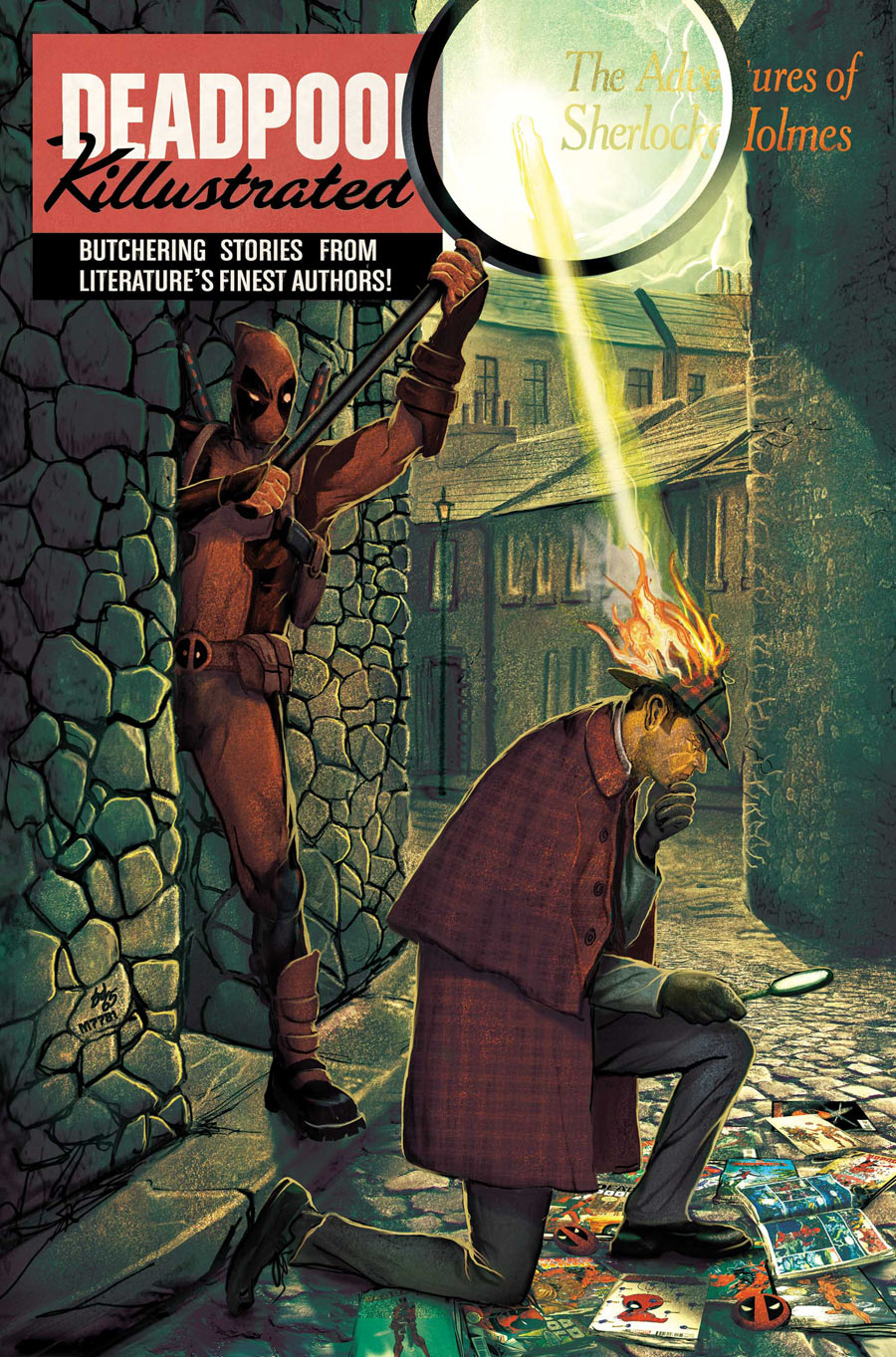
Even the quality and ingenuity of the artwork dwindles as the series progresses.  Scenes in early issues, particularly Moby Dick, were impressive and quite beautiful, but Scylla and Charybdis are downright boring and Deadpool's trip to seventeenth-century Paris entirely uninspired.  The exception remains Mike Del Mundo's covert art, which continues to be the most clever and dense joke in each issue.  Turning a magnifying glass on Holmes himself, scrutinizing a collection of Deadpool comics with his own, and burning him like a six-year-old would an ant colony is both funny and ironic, and ultimately far too good for the content that follows.

Saturday, June 1, 2013

Deadpool Killustrated #3

A Christmas Carol
"Stave 3:  The Second of the Three Spirits"
written by Cullen Bunn
pencils by Matteo Lolli
inks by Sean Parsons
colors by Veronica Gandini

Deadpool Killustrated recovers some of its quirky cleverness, which got lost a little in its second installment.  Its prologue in particular, a witty mimicry of Dickens' style in which Bunn acknowledges the "circumspect" nature of Deadpool's intent, hits on just the right tone while once again articulating the logical premise of the series.  There are, in fact, more jokes of higher quality in the first page than in the rest of the issue, though this is more a compliment for its opening than an outright dismissal of the rest.  Bunn sneaks in a few good zingers, mostly at the expense of Deadpool himself.

I find Deadpool Killustrated's insistence on maintaining chronological historical sequencing even within the Ideaverse somewhat unnecessary and perverse.  Especially as it is evoked in the series, literature exists simultaneously, no matter when it was written or the time it is meant to represent.  As a body of characters and stories from which new ones may be derived, there is no need to differentiate between Messina in 1178 B.C., India in 1900, or the entirely fictional Lilliput in 1699.  What does 1699 mean in Lilliput anyway?!  Why does Holmes need Wells' time machine to gather his band?  This temporal conundrum and its logical weirdness doesn't necessarily interrupt the overall logic of the concept, minimal as it is, but it is another of the intriguing consequences of his story that Bunn has left entirely on the table.  What kind of history would the Ideaverse have?  For that matter, what geography?

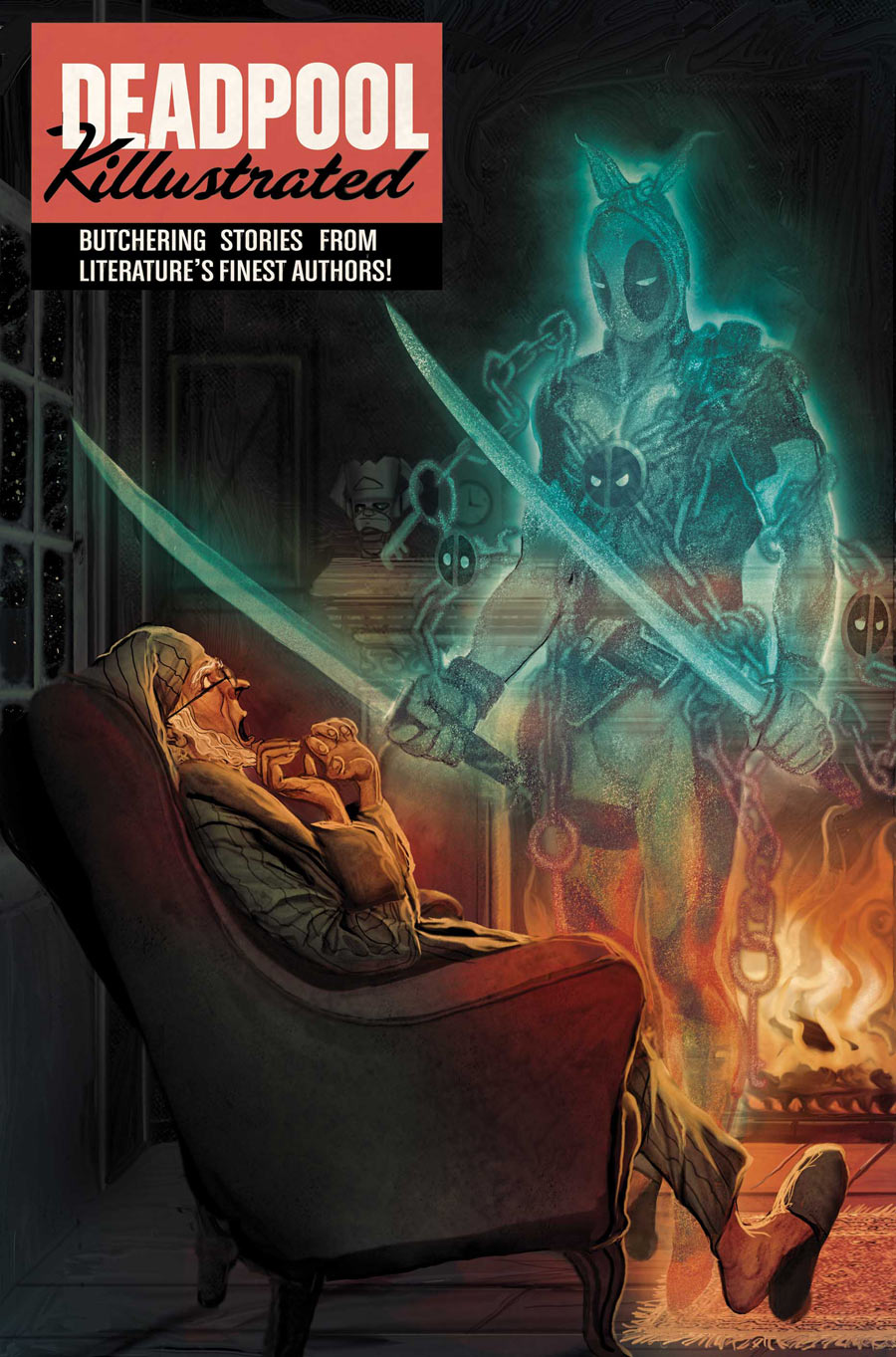
Given the medium of Mr. Bunn's satire, I suppose it's not surprising that Marvel comic book characters receive considerably less explanation than their literary comrades.  Visual equivalences, suggested by the alternating substitution of Marvel characters for their literary predecessors in sequential frames, are accomplished without comment, but it is apparently necessary to identify Captain Nemo, the cast of Kipling's The Jungle Book, and Scylla and Charybdis by name.  This is also in keeping with the heavily expositional quality of the series as a whole.  Though no character, perhaps in all of literary history, is better suited to exposition than Sherlock Holmes, his explanation for the displacement of part of Deadpool's personality into the body of Frankenstein's monster is entirely unnecessary.  His descriptions of how he and his team are always one step behind their quarry even more so.  On the whole, Deadpool Killustrated would benefit for a little more subtlety in its storytelling and few more literary allusions and jokes less obviously advertised by its own characters.

Thursday, May 30, 2013

Deadpool Killustrated #2

The Adventures of Tom Sawyer
"Chapter II:  Strong Temptations—Strategic Movements—the Innocents Beguiled"
written by Cullen Bunn
pencils by Matteo Lolli
inks by Sean Parsons
colors by Veronica Gandini

Where Deadpool Killustrated #1 was a witty cudgel, its follow-up is a thick, blunt club.  Once again, Mad Thinker's message, a de facto summary of the mini-series' conceptual premise, is the most thematically interesting bit of the issue.  Oddly enough, despite being articulated by another Marvel villain trying to sabotage Deadpool's mission, it attributes a kind of freedom-fighting meta-heroism to the kill-happy protagonist.  Imagining comic book characters as philosophically autonomous beings forced to endure the often ridiculous and needlessly cruel trials designated to them by their "progenitors"—the comic book creative teams dubbed by Mad Thinker as the "sadistic group thriving on the suffering of their creations" (Deadpool Killustrated #2, p. 2)—makes Deadpool's manic killing spree both ideologically sound, if lavishly bloody, and self-incriminating for the reader, who is necessarily inculpated in the newly imagined non-fictional bloodbath.

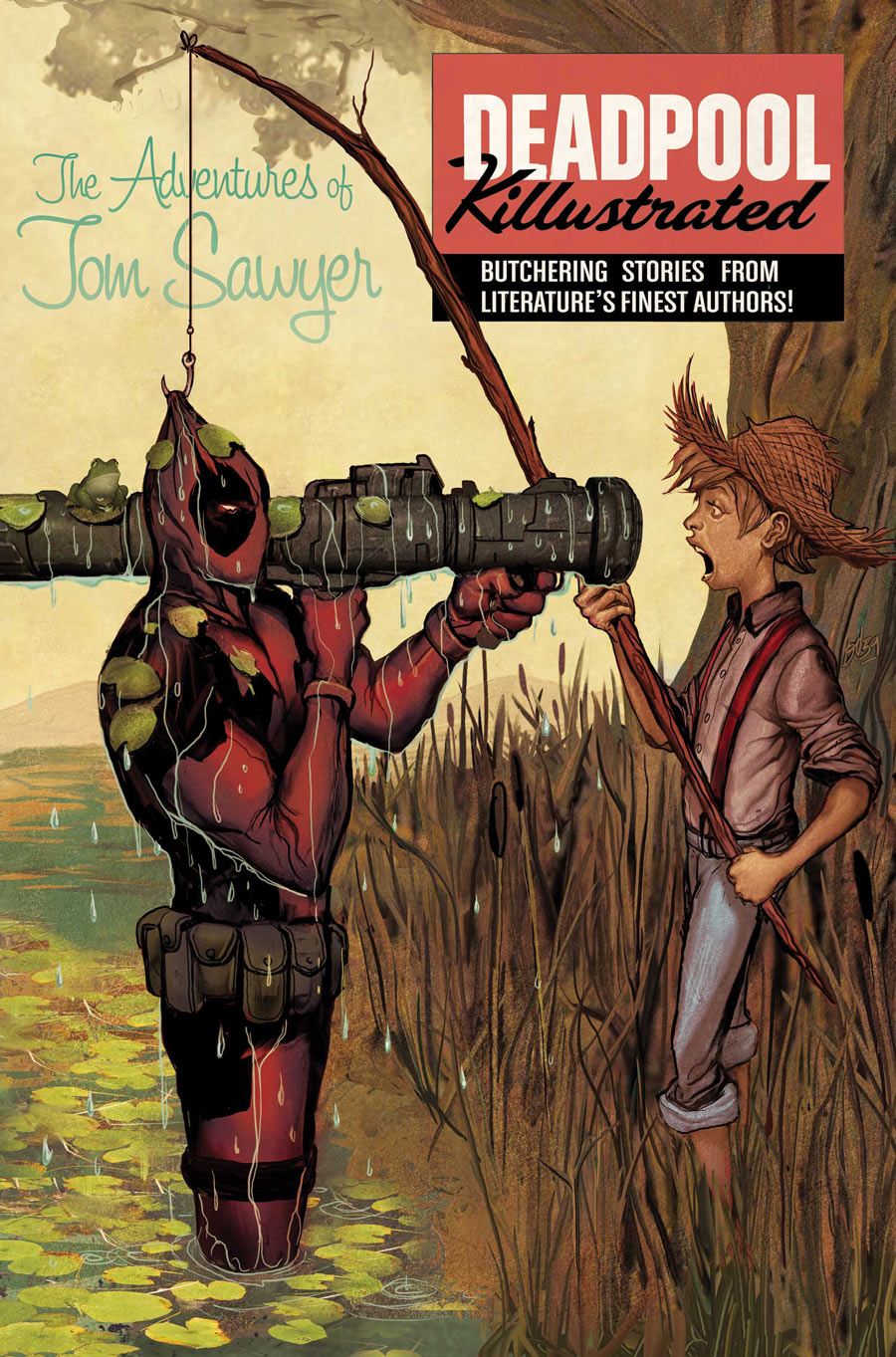
Deadpool's actual forays into the literary landscape—Mad Thinker's "ideaverse"—are, however, continually disappointing.  His battlefield swagger and casual bravado don't deliver the pointed barbs that they occasionally did in #1, and for the most part the kills themselves are humorous in their graphic farcicality but rather boring in their delivery.  The lone exception:  the single-page slaughter of Tom Sawyer, seen only as blood splatter and brain bits on a freshly white-washed fence.  The others—Captain Ahab, Dracula, the Headless Horseman, and the surprisingly resourceful fighters, the March sisters—are weak.

Bunn does finally start elaborating the thematic affinities between comic book characters and their literary predecessors, but these too seem mostly superficial.  Something meaningful might be made out of General Ross's transformation into Red Hulk as a thematic parallel to Ahab's obsessive quest for the symbolically chameleon White Whale, but the reduction of Elektra, She-Hulk, Black Widow, and Mockingbird to Little Women's March sisters simply because they are strong-willed and self-sufficient is almost insulting in its simplicity.  Others are more directly derivational, less interesting but more concrete in their cultural heritage.  To whatever other cultural figures he alludes, for example, Ghost Rider is certainly indebted to the Headless Horseman.

Sherlock Holmes's solution to Deadpool is, so far at least, also underwhelming.  Assembling a small team of characters picked out of literature to take the fight to Deadpool seems as equally blunt a plan as Deadpool's to simply annihilate the entire population of the ideaverse.  I expected better from literature's most famous deductive thinker.  The team, though is intriguingly hodgepodge:  Beowulf, Natty Bumppo, Hua Mulan, and, of course, Dr. Watson.

At its best, Deadpool Killustrated could be a clever and insightful deconstruction of literary inspiration and derivation, and the relative place of individual creativity in the larger cultural landscape.  In other words, just what exactly does Ghost Rider owe to Brom Bones?  Is every modern vampire causally dependent on Dracula?  Instead, Deadpool Killustrated has ignored some of the more interesting consequences of its own thinking in favor of brute force and a more or less ordinary superhero plot.

Wednesday, March 13, 2013

Deadpool Killustrated #1

Moby Dick
written by Cullen Bunn
pencils by Matteo Lolli
inks by Sean Parsons
colors by Veronica Gandini

Deadpool Killustrated's central concept is itself a mixed bag, simultaneously a brilliant stroke of literary metaphysics and a weak logical argument for the destruction of the worlds' superheroes by head-scratchingly oblique means.  And Bunn makes sure we get a full exposition sequence to explain, well, EVERYTHING.  It's full of gems, like "We are trapped in...the continuity.." and "metacidal," as well as clunkers, like "every idea spawning like salmon."  However, it's precisely what Bunn doesn't explain that delivers the issue's best narrative surprise, when in the final few pages, one of Mad Thinker's robots makes its way into the hands of Sherlock Holmes, who then stands poised to act as the series' hero and Deadpool's foil.

The issue might be logically porous but it's got several good jokes, which help buoy the story, most of them made by and at the expense of Deadpool himself.  The introduction of the New York Public Library as "the one place I fear" is a fine use of the page break, better if it required a page turn instead of just crossing the center gutter.  And for a man so adverse to reading, Deadpool can certainly bandy about some allusive barbs.  He quips as easily and knowingly over the dead bodies of Don Quixote and Sancho Panza—"Consider the windmill tilted."—as he alludes to Jaws—"We're going to need a bigger boat."  Or upon being extended Ahab's hospitality aboard the Pequod, he introduces himself, "Call me...Ishmael," despite, of course, there already being one on board.  Though, to be fair, he might have covered that one in his ad hoc litany of famous first lines at the library. 

As its premise would suggest, Deadpool Killustrated is simultaneously an homage to previous generations of literary classics remediated into comics and a haphazardly deconstructed send-up of the clash between those two (usually disparate) literary media.  Nowhere does this first issue distill this meta-humor more succinctly than in Michael Del Mundo's spoofing cover illustration.  Much of the comedy in the story derives from Deadpool's unexpected and homicidal interruption of famous literary scenes, and riding Moby Dick like an unruly rodeo bull while trying to chuck a bomb labeled with a fish-and-cross-bones down his blowhole does just that.

Unfortunately, the interior of the issue is significantly more uneven.  When its jokes work, Deadpool Killustrated is quite funny, and consequently the ceiling for its comedic potential is high, but most of its jokes seem rushed, forced, and superficial.  Its engagement with the literary classics, which Deadpool wants to disrupt, equally so.  Despite the explanation provided—that these literary figures serve as inspiration for the authors/"progenitors" of Marvel's superheroes and that the former's destruction would preempt the latter's formation—none of the literary characters featured in #1 bear any notable resemblance to Marvel superheroes.  Ironically—and it's an irony that's unrecognized by Deadpool himself, as when he remarks to Don Quixote as he shoots him, "When it comes to impractical pursuits, I got ya covered."—Deadpool has far more in common with his literary companions (Ahab, Quixote, and Pinocchio) than they do.  He insists that "the metaphor isn't lost on [him]," though I suspect that it is.

The artistic team of Lolli (pencils), Parsons (inks), and Gandini (colors) contribute some really quality work in the issue.  As is necessary for a character whose costume conceals facial expressions, Deadpool emotes really well with his body language, usually a potent combination of sardonic resignation and familiar weariness.  Like Del Mundo's cover, they also deliver on the punchlines.  In particular, the pile of dead Spider-mans...[Spider-men?]...as Deadpool muses, "I kill and I kill and I kill but it's never enough.  There's always another Spider-man...", is particularly well executed among the Marvel hero carnage.  But for sheer beauty of the artwork, Moby Dick must take the prize in this issue.  His enormity, unsettling color, and watery home are all impressive and provide a visually memorable opening sequence for the series.

[March 2013, digital]