Showing posts with label Ryan Browne. Show all posts

Wednesday, January 29, 2014

Bedlam #11

"Our Fires Burn Bright"
written by Nick Spencer
art by Ryan Browne

Anonymity, like the costumes they wear, is a shield, barriers that keep Madder Red and the First comfortably sequestered from their other lives.  "Our Fires Burn Bright" shatters that façade.

Following a particularly brutal beating by Matter Red twelves years ago, the First is dumped, still fully armored and masked, on the front doorstep of his family estate.  Madder Red knew Matt Severin.  But "Mister Pixel" would rather show Matt Severin a warped—though in his mind more true—version of himself, the one that would kill his own mother.  Severin proves capable.  Confronted with his own brutality—the broken, bloody and toothless skull of his mother mirrored in his own superhero mask—Matt Severin is able to see himself as he never has before, his name (from "the first of many") becomes a dark, ironic echo as his homicide precedes the twisted mayhem to follow.  This memory of his mother—far more compassionate if equally stalwart than her earlier characterization as a willful, domineering shrew—is a painful reminder of "Mister Pixel''s mind games, his ability to twist the truth, to twist an emotion into something gruesome and unrecognizable.

Like the First, Madder Red is unmasked.  Ten years, an aggressive course of therapy, and (morally questionable) brain surgery removed from his criminal career as Madder Red, Fillmore Press is met by his own undoer, a face he cannot see but who knows his darkest secret, the part of himself he has tried most rigorously to bury.  And Press is blindsided by that vulnerability.  "Mister Pixel" knows him: his villainous alter ego, his protracted and unorthodox recovery under "the doctor," and his current cooperation with the police as a consultant.  Press's transformation—his gradual concessions to reintegrate into society and become a better person—is emblematic of the very principles that the anarchist's campaign of terror was designed to undo.  His endgame:  revive Madder Red. 

In the end, both men fail.  Whether he can or not, Fillmore Press does not shoot; he stares down Madder Red, however close he may have come to resurfacing.  But Acevedo kills the wrong man, just another smoke screen in "Mister Pixel"'s web of misdirection, nothing but a weak-minded pawn though they do not yet know it.

"Our Fires Burn Bright" completes Bedlam's second arc without any comfortable resolution for its central plot.  The villain remains alive and anonymous; Severin is left to mourn his brutalized mother in a pathetic inversion of his own earlier encounter with Madder Red; Press denies his adversary the satisfaction of watching him commit murder and perhaps reawaken the sociopath; and Bedlam is left to burn.  It is in many ways a frustrating climax to a less impressive arc than Bedlam's first, but the final tease, the possibility that before shooting the killer and passing out Ramira Acevedo heard enough of his conversation with Fillmore to expose him as Madder Red, is stellar.  It's a bold move—and one that Spencer may not be fully committed to—but more than that, Press's reaction to the possibility invigorates and anchors the arc.  It is the story of Fillmore and Ramira's friendship, built on the tentative partnership forged in the first arc, and his sincere panic that she might know his past testifies to his earnest affection for her, as (perhaps) her willingness to kill an unarmed suspect to keep him from having to.  His concern as the paramedics wheel her away is surprisingly touching for a sociopath, even a reformed one:  "...Is she gonna be okay?  She my... She's my partner.  Kinda" (Bedlam #11: 20).

Monday, December 9, 2013

Bedlam #10

"I Can Fix This"
written by Nick Spencer
art by Ryan Browne

And so we discover, with little room for doubt, that Fillmore Press, former mass murderer and clinical psychopath, sincerely cares for Ramira Acevedo.  In the course of their collaboration on criminal investigations, their partnership had grown perceptively easy and natural.  Despite his past atrocities and current eccentricities, Press was figuring out how to be a partner, someone trustworthy and cognizant of his colleague's thinking.  But, confronted with a bullet-wounded Acevedo, Press offers his finest expression of concern and affection for his friend:  "Boss, I-- I can fix this--" (Bedlam #10: 18).  And at some point, though I can't recall just when, he started calling her Ramira.

This tenderness makes his confrontation with Bedlam's pixelated villain all the more disturbing.  It seems he knows Fillmore; they've met before.  In fact, Press very well may be one of those he's brainwashed, unable to see his face until Press has "purged himself of weakness".  By Press's own acknowledgement, he's highly susceptible to this kind of psychological influence, an influence which seems to know no bounds.  "I Can Fix This"'s final splash is a singularly powerful demonstration of this maniac's control over his army.  Triggering sleepers in the police department's S.W.A.T. team so that nearly the entire force takes themselves out is one thing.  Convincing a moral man almost unhealthily obsessed with justice to kill his (admittedly overbearing) mother is quite another, and it promises to test the depths of Press's new friendship with Acevedo, who the madman undoubtedly perceives as Press's weakness.

There's a symmetry that characterizes Spencer's mad vision, an almost fanatical devotion to counterpoints.  It's in the small details, like beginning an issue in a baseball stadium and ending it in a basketball gym, and in the series' major thematic structure, like the persistent invitations to see Press and Severin as dark mirrors of one another, more alike than different and yet nothing alike.  This structure provides a kind of narrative beauty to Bedlam, but the pulse remains with the central friendship.  After a few episodes dedicated more to Matt Severin, the man behind the mask of the First, it's refreshing to have them back at the heart of the story.

Friday, October 4, 2013

Bedlam #9

"Sticky Tricky"
written by Nick Spencer
art by Ryan Browne

Bedlam's opening arc was largely a character portrait of serial killer turned crime solver Fillmore Press; its second is quickly becoming a portrait of Press's former superhero nemesis, now fellow crime fighter, the First.  Revealed in "I'm a Victim Here" to be the alter ego of city councilman Matt Severin, the First is unexpectedly hounded by a barrage of personal and professional forces:  the city's swarm of journalists, fellow councilmen and government officials, several of whom currently oppose his bill for an 'extraordinary crimes' task force to combat the city's strange crime epidemics, and most of all his overbearing mother, who strongly protests his time spent as the First, thinking it more suitable to an idealistic boy's youthful exuberance than a grown man's chosen occupation.  Nevertheless, Severin proves as well-meaning and strategically intractable as his crime-fighting alter ego, if increasingly frustrated by the relentless creativity of the city's criminals and by efforts to thwart his effectiveness as both a politician and an adjunct lawman.

If the series' current interest in Severin develops him as a foil for Press—a foil who nevertheless shares some profound similarities, such as their mutual susceptibility to suggestion, a trait that may very well have saved Press's life in his rehabilitation under the strange doctor—it suffers some in the (hopefully temporary) demotion of Press and Acevedo.  Their quippy conversation upon arriving at the gory crime scene is a fine moment:  Press's near inhuman casualness at the sight of so many exploded bodies and her mildly amused acceptance of it.  After weeks, perhaps months, of working with one another, Fillmore begins to understand her sarcasm, but he humorously misunderstands the cause of her unease, concluding she must be fearful of being hit by more jumpers.  Unfortunately, the remainder of their conversation in "Sticky Tricky" is mostly business without the charm.

Ryan Browne's Madder Red sequences continue to impress, surpassing (if possible) the standard set by Rossmo.  Browne's Red is more cleanly expressive.  With colorist Jean-Paul Csuka, he utilizes a wider range of greys and pinks in the otherwise monochromatic deathscape.  He captures with greater fervor the twisted whimsy and homicidal play of Madder Red's games.  Nevertheless, Rossmo's shadow continues to hang over Bedlam's style.  Browne's command of Bedlam's art continues to improve considerably, but his rendering of character faces—particularly, Detective Acevedo and Fillmore Press—is still occasionally underwhelming.  His full-page splashes in "Sticky Tricky" are exceptional, however:  the street carnage of the multiple suicides (8), the First in full costume and heroic posture (13), and the issue's final dramatic reveal (22).

Friday, August 2, 2013

Bedlam #8

"I'm a Victim Here"
written by Nick Spencer
art by Ryan Browne

Though his methods are considerably more similar to 21st-century political terrorism, it turns out Spencer's new villain is as madly and philosophically motivated as his last...and perhaps more importantly, as Madder Red.  Speaking literally from the mouth of his victim/unwitting accomplice, he announces himself a savior, a man willing to induce the murderous birth pangs of a new freedom.  And Press continues to see through the ruse of the crimes.  Where Acevedo and her fellow police investigators follow only the most tangible clues, Press understands the rhetoric of violence.

Spencer too speaks this language.  While the opening act of his new villain—a series of public bombings in a cafe, city bus, university, and an office building—is eerily familiar, his second act—a dramatic epidemic of simultaneous suicides—is unearthly and fully in keeping with the tone Spencer has cultivated in Bedlam.

However, "I'm a Victim Here"'s finest and most surprising moment is its exceptionally quiet unveiling of the First, the rich only son of prominent business family and current city councilman advocating for an 'extraordinary crimes' task force, Matt Severin.  Part of what Bedlam has negotiated so well is its contrapuntal perspective on superheroics, and as such casting the First as a Bruce Wayne/Tony Stark/Oliver Queen golden child turned public service advocate fits the mold very well.  As Press's foil, Severin is more complete.

While new series artist Ryan Browne continues to underperform next to his predecessor Riley Rossmo, "I'm a Victim Here" shows considerable improvement over "Our Little Conversations".  Partly, no doubt, the longer turnover period allowed him more time to polish his style, but partly because it shows more of his own flavor than Rossmo's, Browne's artwork shines in this issue, particularly the opening flashback sequence between Madder Red and the First.  He still hasn't mastered the chaotic line movements of Rossmo and sometimes his faces get washed out or distorted by heavy shadows, but he seems to be finding his footing in the series.

Wednesday, June 5, 2013

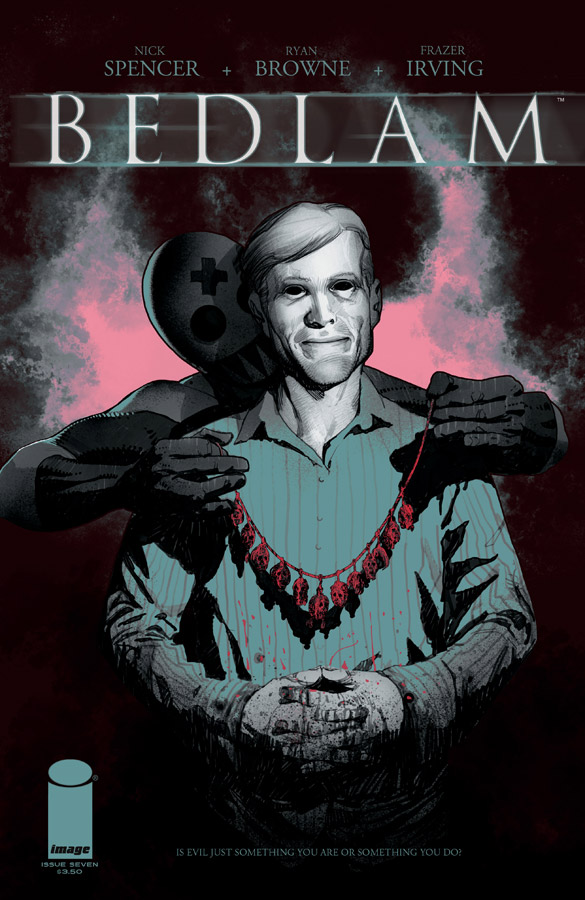
Bedlam #7

"Our Little Conferences"
written by Nick Spencer
art by Ryan Browne

Bedlam begins its second arc of Nick Spencer's serialized reformed mass-murderer + cop = buddy drama with "Our Little Conferences".  And I wasn't quite anticipating the time jump Spencer utilizes here.  Although Spencer is no more specific about it than a "few weeks," the character relationship between Det. Acevedo and Fillmore Press, formerly cautious appreciation and defensive banter, has fallen into a friendly partnership, one in which Acevedo regularly visits Press in his home, brings him contraband sweets, and consults freely about troublesome cases.  Despite jumping several steps, or perhaps because he jumps several steps, Spencer makes this work.  Acevedo's attempt to offer Press a consulting job—contingent, of course, on the approval of a bill granting her Department of Extraordinary Crimes permanent funding, which itself is in the midst of a City Council political battle—is perfect, especially as Press mistakes it for an accounting position.  But Press's past as Madder Red continues to infringe on his new life and new (albeit still unofficial) consulting job, and his continued proximity to murder and the reminders of his previous atrocities are constantly threatening to bring Madder Red back to the surface.

The new mystery remains fairly fledgeling, a series of simultaneously activated bombs by unrelated citizens motivated somehow by cell-phones orchestrated by a pixelated figure.  It's a promising beginning, and one that strikes a very different tone than the gothic, self-mutilated, religious zealots of the first six issues.  However, the continuity of the Acevedo-Press partnership helps transition this new tone, anchoring the series and providing it the kind of character consistency which can sustain Spencer's serial-form mystery.

While it's difficult to imagine what "creative differences" might have instigated former artist Riley Rossmo's departure from Bedlam, precisely because his interpretation of Spencer's story and characters were so flawlessly executed, his absence is already perceptible in the jarring drop in artistic quality in Bedlam #7.  Certainly, Rossmo's a very difficult act to follow.  Ryan Browne is a talented artist on his own, but the quality of his work here is very mixed, perhaps because it tries to ape Rossmo's earlier interpretations of the characters.  Some panels show his potential on the series, and I do anticipate improvement as he develops his own feel for Spencer's story, but some are downright sloppy and poorly defined (cf. top right panel of p. 15, as Fillmore tries to turn off his television).  I don't know what kind of deadlines Browne had for the turn-around, and I'm inclined to give him the benefit of the doubt on his first attempt, but I do hope his work picks up in the next few issues.