"Flesh Wounds"
written by Mike Carey
art by Jorge Coelho
And suddenly it makes sense why all Earth's super-powered folks in Mike Carey's Suicide Risk end up supervillains: they're criminals! They've had their powers confiscated and their memories wiped, and they've been relocated to Earth.
It's a remarkably innovative and humane prison solution until Jed and Hailey, a homeless couple in San Francisco, get their hands on a directory of inmates and a wand to restore their power and memories, when they stumble on a dead guardian agent hit by what looked like a speeding Volvo station wagon. For a few thousand dollars apiece they begin reviving superpowers and unleashing interplanetary criminals on Earth.
Carey's stand-alone episode certainly takes significant steps to clarify the mythology of Suicide Risk and, as suspected, exposes it explicitly as a sci-fi hybrid. While the larger universe in which these superpowered characters reside remains distant and unfocused, to them as much as to us, "Flesh Wounds" provides a sound and deceptively simple solution to their sudden appearance described by pre-Requiem Leo Winters in the first issue of Carey's series. One car accident and two destitute opportunists.
Jed and Hailey are easy to pity—especially Jed—and difficult to like. Screwed by circumstance and desperate to escape their squalorous lifestyle, including habitual heroin use, their scheme to monetize their apparent good fortune is entirely reasonable. But in the face of inhuman, technologically advanced enforcement agents and the accumulated evidence that their interference is causing worldwide crises, their willful ignorance about their own responsibility in it and their refusal to give up their racket is unforgivable. Hailey has replaced drug use with a sex addiction to those they turn, despite her longtime lover Jed's heartbreak and humiliation at her infidelity. And Jed, for his part, won't take a stand against his domineering partner. We may be happy they escape, for now, but we long for their comeuppance.
In which a relatively recent comic book reader discovers and reviews comics new and old.
Showing posts with label Jorge Coelho. Show all posts
Sunday, May 18, 2014
Saturday, August 3, 2013
Polarity #4
written by Max Bemis
art by Jorge Coelho
The superhero mythology of his bi-polar metaphoric fever dream continues to spin away from Bemis, but his handle on the heart of his semi-autobiographical mini-series is strongest here. His delivery, a more or less straightforward manifesto of hipster loathing and acceptance, is somewhat unoriginal and unsubtle, but after three issues of erratic (if entertainingly whimsical) angst and superhero antics, it was necessary for Bemis to clear the air, to clarify as much as possible his own relationship with his cultural movement. And, in conformity with the overall impression of previous issues, it's pleasantly generous if frustrated. As before, Polarity #4's finest moments are the small, personal ones. Tim's confession of love to Lily, in particular, is both genuinely sweet and funny.
The superhero conspiracy is, however, if you'll forgive the turn of phrase, somewhat half-baked. The transition of Dr. Mays from trusted confidant to deranged, power-hungry mad scientist is a considerable stretch, even if his weary frustration is comical as both. The shadowy forces behind his employment remain entirely in the shadows, and the reasons for wanting to develop an army of mental-patients-turned-superpowered-soldiers remains unexplained. The placement of sleeper agents, including the homeless man with multiple personalities, is clever but sloppily deployed. The conclusion of this criminal conspiracy conversely far too tidy.
[July 2013]
Thursday, June 6, 2013
Polarity #3
written by Max Bemis
art by Jorge Coelho
Polarity continues to be a slightly uneven but ceaselessly entertaining metaphorical romp through mental illness. Bemis struggles with the superhero/supervillain twists in his metaphor, which are often awkward and stilted, but he excels in his character development and ordinary dialogue.
Tim's short-lived career as a hipster-hero "reluctantly making it safe to be a douchey indie rocker in a gentrified former ghetto" is delightful, a combination of wish fulfillment, and self-aware sense of humor more superhero stories could employ. Tim is painfully aware that a large proportion of his fellow Brooklyn-ites and the rest of his generation are vapid and superficial, or at least so painfully insecure that they buy in to the vapid and superficial, but his superhero mission, whatever else it may be, is fundamentally optimistic and generous. This attitude, seemingly jaded but actually hopeful, makes Tim—and Bemis—infinitely more likeable.
His burgeoning relationship with Lily is sincere, one which Bemis readily acknowledges is based on his own with his now wife. Likewise, Tim's tumultuous friendship with his childhood bestie, Adam, who unfortunately has had to weather several of Tim's manic episodes, is perfectly rendered. These two relationships anchor the entire series, as well as Tim himself. The final few twists in Polarity #3 take the short series in an unexpected direction, one that jars the pace and potentially disrupts some of the very good things Bemis had developed. Though I'm not certain I like these twists, which I certainly don't think Bemis fully earned, I don't want to entirely dismiss them. After all, nearly every good superhero story—metaphor or not—needs a real villain, and, like them or not, I'm still eager to see how Bemis wraps up these rapid new developments.
[June 2013]
Monday, May 6, 2013
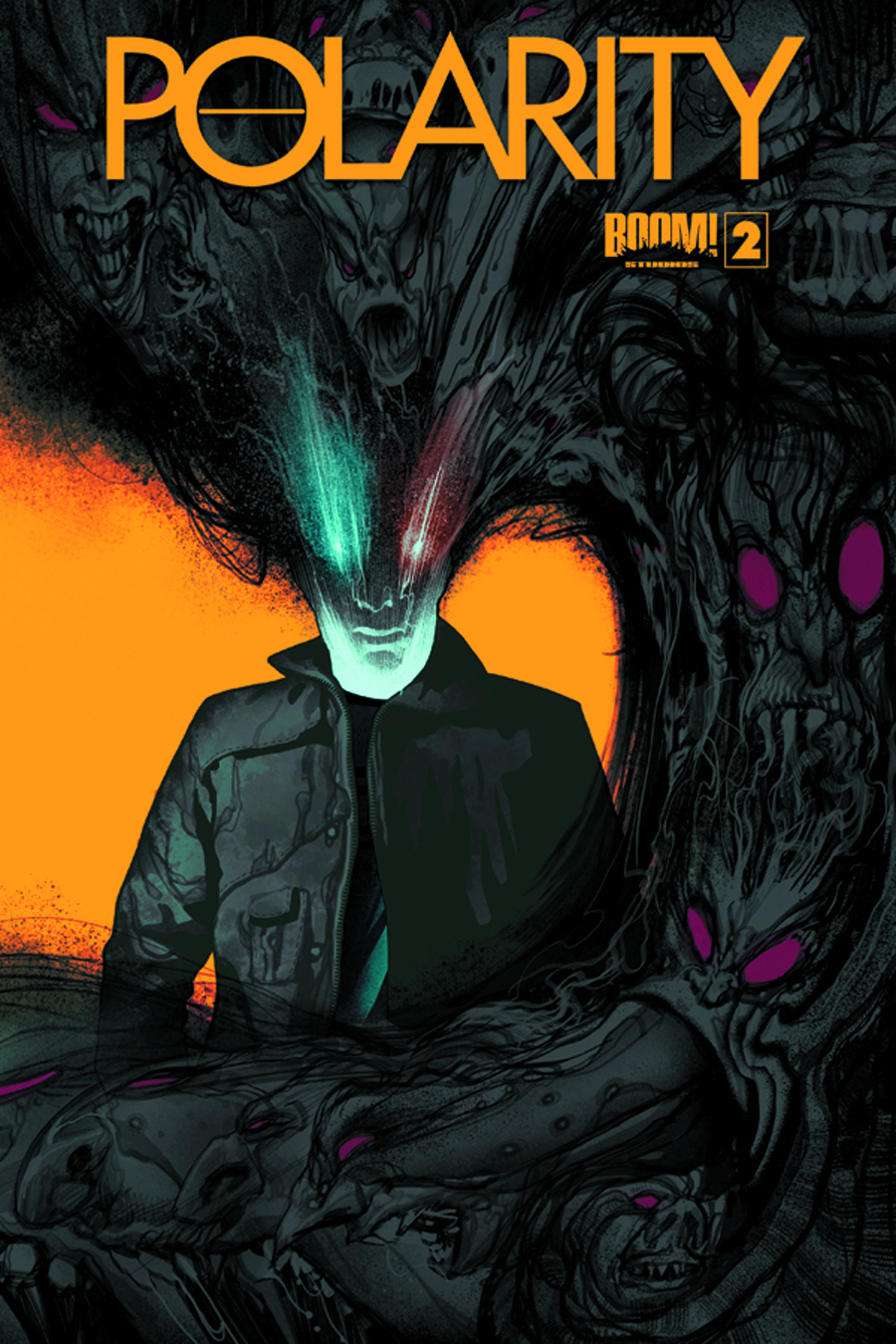
Polarity #2
written by Max Bemis
art by Jorge Coelho
"Suddenly, I realize I'm sitting pensively on the edge of a tall building, overlooking the city and pondering life. Only two types of people do this. Suicide cases...and superheroes." (Polarity #2, p.18)
As likable and wry as Bemis's Dr. Mays may be, his delivery of Polarity's central allegorical conceit—that bi-polar artist Tim Woods is actually if improbably accruing supernatural abilities as a result of the chemical imbalance of his manic episodes—is clunky, even for exposition. That said, once an enlightened and shirtless Tim returns home, loses his Jesus beard (no really, he thought he was Jesus), and goes back to living his life with only his normal discontent, Polarity regains its stride. Once Tim, perhaps ill-advisedly, decides to embrace his superhero potential at a particularly awkward and vapid dinner party with hipster girlfriend Alexis, Polarity zips at a pace that lends credence to Tim's cocaine-induced, super-powered mania.
Having embraced his disorder's potential, Tim's life suddenly takes a dramatic turn for the better. He dumps his pretentious, cheating girlfriend; his art—a clever homage to Irving's Polarity #1 cover—is well received by his admiring art agent, whom he puts into place with his mind-reading abilities; he returns to his former high school to rescue a young kid named Herschel from the latest crop of jock-bullies; and he musters enough ego and courage to ask out his crush Lily, who, it turns out, liked his not-manic personality.
If Polarity is Bemis's allegory for perceived invincibility caused by bi-polar episodes and its seductiveness, this issue tempts the reader as much as its protagonist with the promise of surging confidence and powerful singularity. The high of his successes and limitless potential of the future are tantalizing prospects, ones we know to be fragile and dangerous but ones which expose our willful optimism and secret egotism. We readers want to feel that too. And ultimately, the audience is as inculpated in the same enticing delusion as Tim himself.
[May 2013]
art by Jorge Coelho
"Suddenly, I realize I'm sitting pensively on the edge of a tall building, overlooking the city and pondering life. Only two types of people do this. Suicide cases...and superheroes." (Polarity #2, p.18)As likable and wry as Bemis's Dr. Mays may be, his delivery of Polarity's central allegorical conceit—that bi-polar artist Tim Woods is actually if improbably accruing supernatural abilities as a result of the chemical imbalance of his manic episodes—is clunky, even for exposition. That said, once an enlightened and shirtless Tim returns home, loses his Jesus beard (no really, he thought he was Jesus), and goes back to living his life with only his normal discontent, Polarity regains its stride. Once Tim, perhaps ill-advisedly, decides to embrace his superhero potential at a particularly awkward and vapid dinner party with hipster girlfriend Alexis, Polarity zips at a pace that lends credence to Tim's cocaine-induced, super-powered mania.
Having embraced his disorder's potential, Tim's life suddenly takes a dramatic turn for the better. He dumps his pretentious, cheating girlfriend; his art—a clever homage to Irving's Polarity #1 cover—is well received by his admiring art agent, whom he puts into place with his mind-reading abilities; he returns to his former high school to rescue a young kid named Herschel from the latest crop of jock-bullies; and he musters enough ego and courage to ask out his crush Lily, who, it turns out, liked his not-manic personality.
If Polarity is Bemis's allegory for perceived invincibility caused by bi-polar episodes and its seductiveness, this issue tempts the reader as much as its protagonist with the promise of surging confidence and powerful singularity. The high of his successes and limitless potential of the future are tantalizing prospects, ones we know to be fragile and dangerous but ones which expose our willful optimism and secret egotism. We readers want to feel that too. And ultimately, the audience is as inculpated in the same enticing delusion as Tim himself.
[May 2013]
Sunday, May 5, 2013
Polarity #1
written by Max Bemis
art by Jorge Coelho
Polarity is a half-fictional, half-autobiographical dramatization of the protagonist's uneasy struggles with bi-polar disorder. That Bemis speaks from his own experiences gives it a credibility and sincerity that's difficult to simulate. His dialogue is simultaneously rich, densely clever, and entirely believable. Timothy Woods'—Tim to everyone—relationships are well-defined: his easy but loveless fling with pretentious girlfriend Alexis; his longing flirtation with Lily; his truthful, close, and occasionally hurtful friendship with devoted childhood "bestie" Adam; and his caring fondness for his therapist Dr. Mays. If anything in Polarity rings false, it's Tim's place in the Brooklyn art scene. Whether Creed albums or Ace of Base dancing, Polarity is tethered soundly in pop music, but its representation of visual art is casual and distant. Bemis, former lyricist of Say Anything, is a musician, and whatever Bemis may insist on for his story, so is Tim.
It's also funny. Tim's manic spiral and self-deprecating narration offer plenty of laughs, most of which endear him to the reader—and, by extension, Bemis, whose confessional candor is refreshing. It's also a mildly scathing satire of hipster pretension told from the inside. It's not hateful as much as sad, a desperate bid for recognition and relevance, but one that maintains hope of discovering something real.
Polarity's unexpected turn in its final few pages spring the series in a different direction, or perhaps onto a different interpretive plane. For most of the issue, Tim's narration is distant from events, capable of recording his behavior and his feelings but from a more remote place, like—to whom, no doubt, the narrative voice is indebted—Bemis looking back on his younger self. His paranoia and delusions are recognized as such. Leaving home without his pants does not make him any more an invisible superhero than Apatow bromances confirm that he's reincarnated Jesus. However, his belief—formerly dismissed as delusion—that he can read the thoughts of his neighbors and that one of them, who has a particular fondness for soggy Reubens, is watching him is, in fact, true. It lends an unsuspected plausibility to Tim's delusions recasts Polarity, not as a distant description of living with bi-polar disorder, but rather as an allegory for it, a super-powered trip into the frightening and seductive promise of the incredible.
[April 2013]
Subscribe to:
Posts (Atom)