Wednesday, June 5, 2013

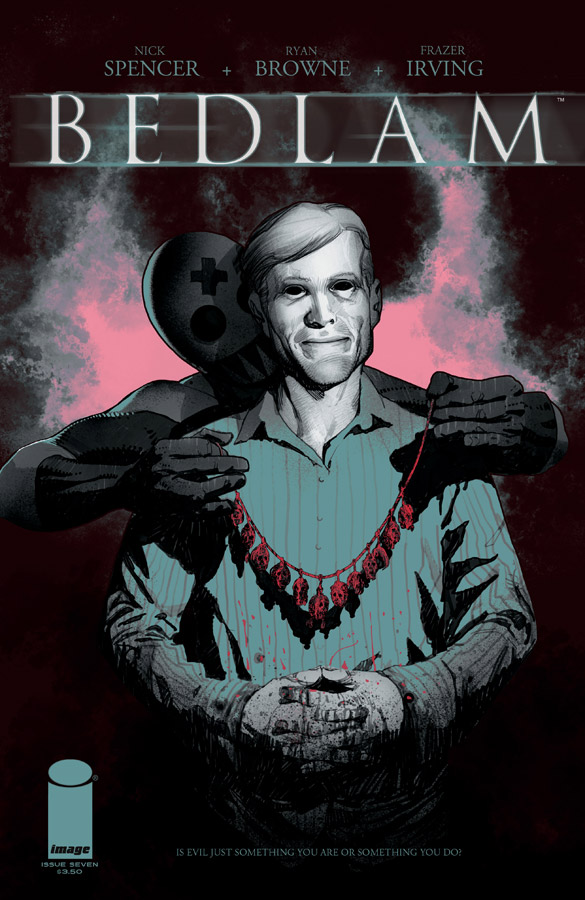
Bedlam #7

"Our Little Conferences"
written by Nick Spencer
art by Ryan Browne
Bedlam begins its second arc of Nick Spencer's serialized reformed mass-murderer + cop = buddy drama with "Our Little Conferences".  And I wasn't quite anticipating the time jump Spencer utilizes here.  Although Spencer is no more specific about it than a "few weeks," the character relationship between Det. Acevedo and Fillmore Press, formerly cautious appreciation and defensive banter, has fallen into a friendly partnership, one in which Acevedo regularly visits Press in his home, brings him contraband sweets, and consults freely about troublesome cases.  Despite jumping several steps, or perhaps because he jumps several steps, Spencer makes this work.  Acevedo's attempt to offer Press a consulting job—contingent, of course, on the approval of a bill granting her Department of Extraordinary Crimes permanent funding, which itself is in the midst of a City Council political battle—is perfect, especially as Press mistakes it for an accounting position.  But Press's past as Madder Red continues to infringe on his new life and new (albeit still unofficial) consulting job, and his continued proximity to murder and the reminders of his previous atrocities are constantly threatening to bring Madder Red back to the surface.

The new mystery remains fairly fledgeling, a series of simultaneously activated bombs by unrelated citizens motivated somehow by cell-phones orchestrated by a pixelated figure.  It's a promising beginning, and one that strikes a very different tone than the gothic, self-mutilated, religious zealots of the first six issues.  However, the continuity of the Acevedo-Press partnership helps transition this new tone, anchoring the series and providing it the kind of character consistency which can sustain Spencer's serial-form mystery.

While it's difficult to imagine what "creative differences" might have instigated former artist Riley Rossmo's departure from Bedlam, precisely because his interpretation of Spencer's story and characters were so flawlessly executed, his absence is already perceptible in the jarring drop in artistic quality in Bedlam #7.  Certainly, Rossmo's a very difficult act to follow.  Ryan Browne is a talented artist on his own, but the quality of his work here is very mixed, perhaps because it tries to ape Rossmo's earlier interpretations of the characters.  Some panels show his potential on the series, and I do anticipate improvement as he develops his own feel for Spencer's story, but some are downright sloppy and poorly defined (cf. top right panel of p. 15, as Fillmore tries to turn off his television).  I don't know what kind of deadlines Browne had for the turn-around, and I'm inclined to give him the benefit of the doubt on his first attempt, but I do hope his work picks up in the next few issues.

Tuesday, June 4, 2013

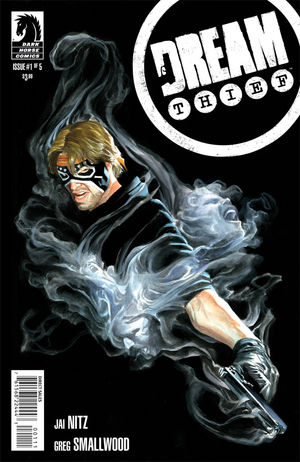
Dream Thief #1

written by Jai Nitz
art by Greg Smallwood

Wow!

"What would you do if you woke up in a strange room and didn't know where you were, or what you'd done the night before to get there?"

What begins as a familiar motto for any hangover-blurred, morning-after daze turns into something genuinely sinister and uncomfortably electrifying by the end of Dream Thief's first compact, thriller of an issue.

Despite disposing of it with the body of his dead girlfriend, the mask finds him again, like a supernatural bad penny, which transforms its wearer into a conduit of vengeance for dead men.  While the mask seems to play some role in John's weird and violent actions in his sleep, Dream Thief is innovative in its inclusion of several possible triggers for his change:  not only the mask, but a mysterious letter from his estranged father, now incarcerated in a state prison for unspecified crimes.  John himself blames the weed, the most unlikely to have been solely responsible, but a possible contributing factor alongside a supernatural mask, especially in obtaining it, or paranormal genetic trait.

Most impressively, Nitz pulls off some deft character reveals, more jarring—but still perfectly credible—than his plot twists.  John Lincoln is mostly a good guy, but opening a series as the protagonist wakes up after cheating on his girlfriend and then hops out to buy weed, doesn't exactly scream "hero".  But it turns out John's instincts about his girlfriend's weirdness and paranoia after their break-in are bang-on.  She's a mistaken and not a little bit racist murderer, who'd apparently been planning an escape to Belize to evade prosecution, but who ends up in the trunk of a car sinking into the Okefenoke Swamp thanks to John, his mask, and the spirit of the man she killed.

Note:  Never has punctuation been more seamlessly incorporated or concisely used in comic art.  Certainly the exclamation point/question mark hybrid used with the same face frame in each of John's wake-up scenes is appropriate, but it's the two-page spread on pages 12-13 whose use is particularly clever, as John moves from early-morning disorientation to full realization as he's confronted with the body of his dead girlfriend.

Sunday, June 2, 2013

American Vampire #4

Chapter Four:  "Double Exposure" and "One Drop of Blood"
written by Scott Snyder and Stephen King
art by Rafael Albuquerque

Pearl and Skinner each survive their first moonless night.  Lured back to Block and his Hollywood vampires by her roommate and close friend Hattie Hargrove, Pearl discovers her friendship to have been little more than pretense and Hattie to be murderously jealous and self-promoting and entirely lacking in loyalty, i.e., the exact inversion of Pearl herself.  Her transformation—perhaps better described as the revelation of her character—happens entirely within "Double Exposure".  The opening flashback of her introduction to Pearl is charming and believable, two young women struggling to make it as actresses in Hollywood and struggling to find friends in a strange city.  That she would stab her newly transformed vampire friend in the back is surprising enough.  That she colluded with Bloch and his buddies to kill Pearl in the first place is fully black-hearted.

In contrast, Pearl's burgeoning love interest, Henry, continues to prove himself.  Despite her running off alone, Henry comes to her rescue under, quite literally, the shadows of the Hollywoodland Sign.  Knowing about her new condition, he still recognizes her as the same person she was before.  Though the correlation between vampiric feeding and sex is old-hat, Snyder pulls it off well.  Henry's offer is both generous and loving, and Pearl's response liberating and honest.

Sweet's showdown is considerably less interested in saving his friends than it getting revenge on the Pinkerton agent and his friends responsible for his capture.  Still figuring out the rules of his unprecedented bloodline—rules that continue to be a little too explained in every issue, for my taste—Sweet finds himself weaker and more vulnerable than he has yet experienced.  This doesn't prevent him from getting the better of Felix Camillo and Jim Book.  Yet Book's biggest ambush is the kiss from goddaughter Abilena, and his look is one of complete shock and not a little horror in itself.  Sweet's revenge is creatively cruel, befitting the outlaw himself, the infection of Book with his blood.


[August 2010]

As collected in American Vampire, Volume 1 (ISBN 978-1401228309)

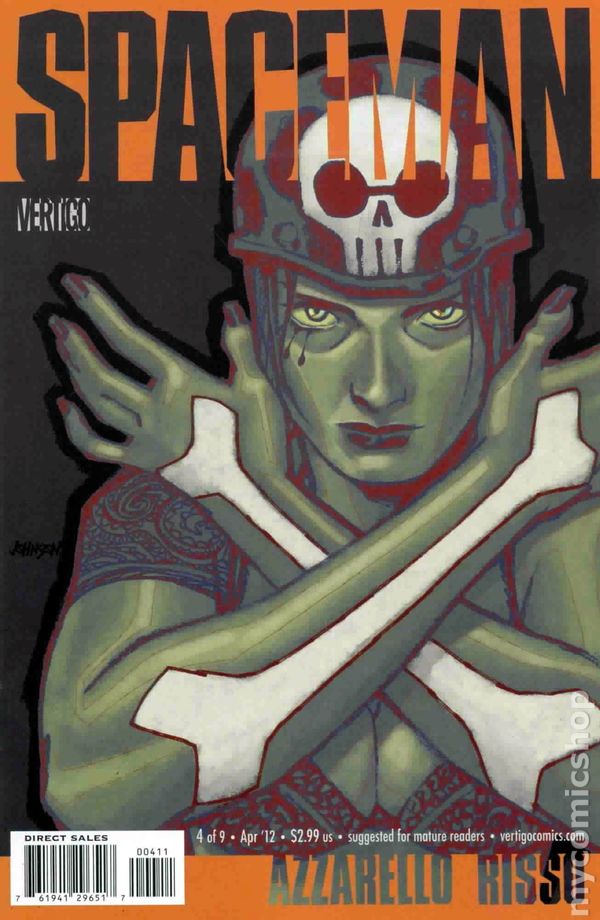
Spaceman #4

"Circus Dead" (4 of 9)
written by Brian Azzarello
art by Eduardo Risso

Although it's not exactly surprising, given his easy rapport with the friendly, drug-peddling children in his dockside slum, Orson's most reliable conspirators in keeping the kidnapped (then rescued by Orson) celebrity orphan Tara safe are those same kids.  They are seemingly the most reliable and honest people in Orson's life and, it turns out, Tara's as well.

The adults of Spaceman—the socially distant residents of Orson's neighborhood, the sheik and his goons who kidnapped Tara, the pirates who re-kidnapped her and manufacture new ways to exploit her prolonged disappearance with another kid after her rescue, her beautiful but difficult-to-read and sometimes short-tempered reality-show adoptive parents, their reality show directors and managers, the seemingly competent but brusque cops on her case, and Orson's internet sex appointment and her pimp—are, to a man, self-serving.  If their motivations are genuine, it's impossible to detect with any certainty.  It's no wonder that Tara takes so quickly to Orson, whose protective instincts must seem foreign.

Orson is stigmatized by his "Spaceman" origins, though as of yet, the precise details about why are unclear to the reader.  He is ostracized by human adults, and whether its because children are better judges of character or whether its because these kids are just too young to remember the Spaceman controversies, they're the only ones who will socialize with him outside the most minimal (if polite) of necessary interactions.  The sex professional hired by Orson didn't know he was a Spaceman, and when she finds out, she freaks out.  Orson must eat alone, at a table by himself.  Until now, the implied boundary between human and Spaceman was less well-defined, but "Circus Dead" makes it a major thematic point.  In his Mars episode, Orson and the other Spacemen must decide their priorities and confront their purpose.  Are they, as Spender insists, designed only to help mankind?  Can they pursue their own financial interests, as Carter and, it seems, Orson want?  Or are they, as Ottershaw concludes, part of mankind themselves?

[April 2012]

Saturday, June 1, 2013

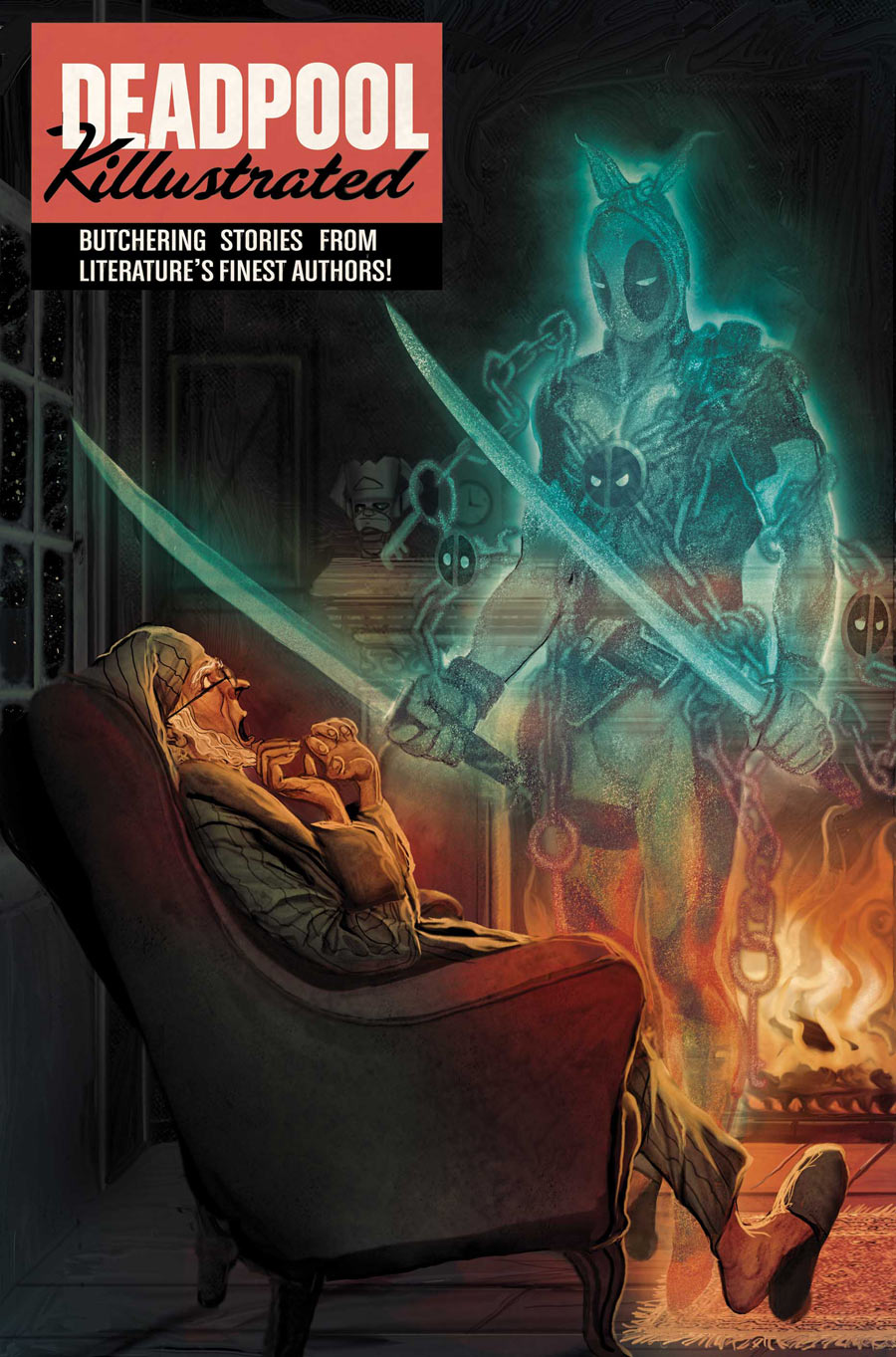
Deadpool Killustrated #3

A Christmas Carol
"Stave 3:  The Second of the Three Spirits"
written by Cullen Bunn
pencils by Matteo Lolli
inks by Sean Parsons
colors by Veronica Gandini

Deadpool Killustrated recovers some of its quirky cleverness, which got lost a little in its second installment.  Its prologue in particular, a witty mimicry of Dickens' style in which Bunn acknowledges the "circumspect" nature of Deadpool's intent, hits on just the right tone while once again articulating the logical premise of the series.  There are, in fact, more jokes of higher quality in the first page than in the rest of the issue, though this is more a compliment for its opening than an outright dismissal of the rest.  Bunn sneaks in a few good zingers, mostly at the expense of Deadpool himself.

I find Deadpool Killustrated's insistence on maintaining chronological historical sequencing even within the Ideaverse somewhat unnecessary and perverse.  Especially as it is evoked in the series, literature exists simultaneously, no matter when it was written or the time it is meant to represent.  As a body of characters and stories from which new ones may be derived, there is no need to differentiate between Messina in 1178 B.C., India in 1900, or the entirely fictional Lilliput in 1699.  What does 1699 mean in Lilliput anyway?!  Why does Holmes need Wells' time machine to gather his band?  This temporal conundrum and its logical weirdness doesn't necessarily interrupt the overall logic of the concept, minimal as it is, but it is another of the intriguing consequences of his story that Bunn has left entirely on the table.  What kind of history would the Ideaverse have?  For that matter, what geography?

Given the medium of Mr. Bunn's satire, I suppose it's not surprising that Marvel comic book characters receive considerably less explanation than their literary comrades.  Visual equivalences, suggested by the alternating substitution of Marvel characters for their literary predecessors in sequential frames, are accomplished without comment, but it is apparently necessary to identify Captain Nemo, the cast of Kipling's The Jungle Book, and Scylla and Charybdis by name.  This is also in keeping with the heavily expositional quality of the series as a whole.  Though no character, perhaps in all of literary history, is better suited to exposition than Sherlock Holmes, his explanation for the displacement of part of Deadpool's personality into the body of Frankenstein's monster is entirely unnecessary.  His descriptions of how he and his team are always one step behind their quarry even more so.  On the whole, Deadpool Killustrated would benefit for a little more subtlety in its storytelling and few more literary allusions and jokes less obviously advertised by its own characters.

Green Wake, Volume One

written by Kurtis Wiebe
art by Riley Rossmo

Frogs have never been quite so ominous.  After an accident for which he feels responsible kills his wife, Morley Mack finds himself disappeared into Green Wake by a swarm of smothering amphibians.  It's dreary, often raining, and always night.  It's residents rarely talk to one another, preferring to retreat into themselves, hide from each other, and guard their dark secrets, turning slowly into the frogs abundant in the place until they are cannibalized by Green Wake's other residents.

Mack and his friend Krieger have adopted the task of welcoming new arrivals and taking care of the population as best they can, a kind of impromptu police partnership in a city without institutional structures.  As such, they happen upon the first murders in living memory in Green Wake, each more gruesome than the last.  Seemingly perpetrated by fiery-headed Ariel but suggestively coinciding with the arrival of her former lover Carl, their investigation leads Mack and Krieger on a journey into their own pasts, particularly Mack, who's always been more curious than the other residents about Green Wake's purpose and meaning.

Ultimately, the city of Green Wake is both a manifest metaphor for the grief of guilt and loss as well as an actual place, a supernatural place/creature that feeds on the trauma of its residents.  Morley is both in a place of his own creation, perpetually supplied with his favorite brand of cigarettes by his own will, and in a place co-habitated by others, including his friend and fellow self-appointed investigator Krieger.  The details of how Green Wake works are only partially answered in its opening arc, and it's just possible that Wiebe himself isn't entirely clear on the subject, but Green Wake's atmosphere is perfectly so and far more thematically significant than the rules of the world-building.

Artist and colorist Riley Rossmo's contribution to Green Wake's success cannot be overstated.  Quite simply, it's beautiful.  Dark, dreary, splotched with ink and scratched up, and beautiful.  Rossmo's liberal use of impressionistic chiaroscuro, partially defined lines, and minimal incorporation of strong color perfectly captures the psychedelic-noir tone of the series.

Collects Green Wake #1-5
ISBN:  978-1607064329

Revival #10

written by Tim Seeley
art by Mike Norton

After a few dizzyingly over-packed issues with correspondingly little substantive plot advancement, Revival #10 recovers its footing.  Here, Seeley exhibits the kind of storytelling that his series needs to sustain itself in a monthly format.  The wide, variable array of characters and multiple (sometimes interconnecting) plot lines have tended to spiral the series into stagnation, when Seeley attempts to address every one in the same issue, a strategy which effectively embodies the media, criminal, and religious onslaught that the "revival" event has imposed on the town, but one that feels like buckshot storytelling with a hitched pace and little focus.  Revival #10 easily identifies its main story interest and seamlessly incorporates several of the other plots and characters into its thread, and as such provides a promising model for future issues in the series.

Having stumbled into the Check brothers' black-market "reviver" organ harvesting in the final moments of Revival #9, Dana's son Cooper and her ex's new girlfriend Nikki are held hostage by the murderous and entrepreneurial Checks.  As the tension rises and more and more potential victims inadvertently discover their secret business, the brothers' willingness to dispatch intruders, however innocent, becomes increasingly apparent.  Though Dana and the rest of the Cypress family forms the structural core of the series, the Check brothers are undoubtedly the issue's main figures, and their calculated, inhuman response to the medical anomaly its thematic center.

One of Revival's interests has always been the definition and boundary of what is "human," and though this is most manifestly visible in the scientific/medical debate about the status of the Revivers and their relative resemblance to their pre-death selves, Seeley uses the Checks to elicit a profound sympathy for the sometimes unsettling Revivers from the reader.  However cold and disconnected Martha Cypress, however crazed-looking Jenny, however murderous or troubled, the plight of Tommy the Torso is truly pitiful and his treatment inhumanly cruel.  Harvested for his parts, but still alive and about to be buried until police scrutiny following the organ-truck crash dies down, Tommy, now nothing but a bloody torso with exposed ribs and a sewn mouth, embodies the imminent dangers and unacceptable consequences of treating the Revivers as anything but human.

[May 2013]