"Cherry"
written by Matt Fraction
art by David Aja
colors by Matt Hollingsworth
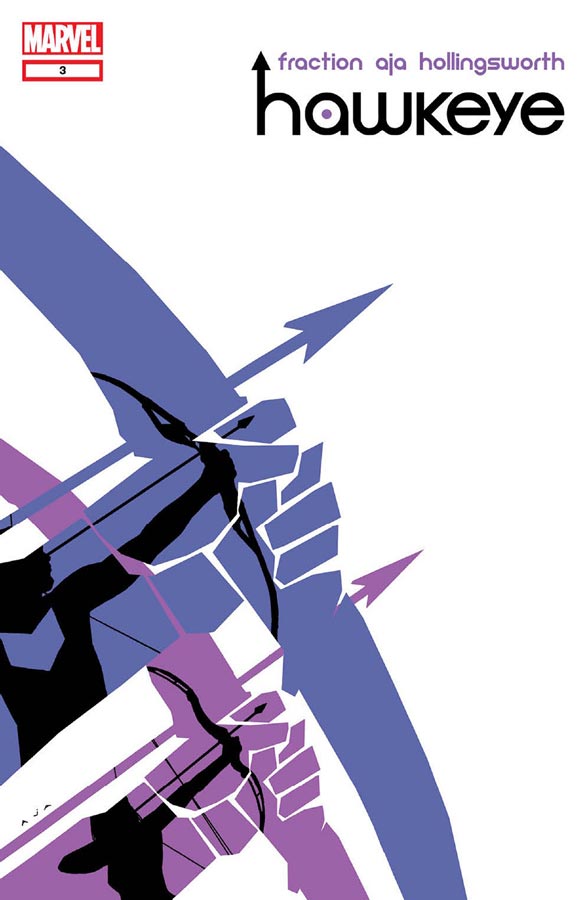
"Cherry" is Hawkeye's homage to classic chase movies—Vantage Point and The Italian Job, in particular—and earlier Hawkeye incarnations. That it doesn't miss a beat between issues is a testament to the flexibility of tone in the series and the unwavering cool of Fraction's Barton.
Like each of Hawkeye's issues so far, the chronology is fractured. The reader enters in media res, in the middle of a Bullitt-style car chase with a maybe-hostage, four Cooper Minis, and a Barton wielding a bow and hanging out the window of a 1970 Dodge Challenger. Structured as a "dumb idea" countdown—nine total—Barton recounts the somewhat unlikely events of the day. The issue's nostalgia is initiated by Barton's own dumb decision to organize and label his stash of trick arrows, gimmicks both clever and unwieldy from earlier Hawkeye stories, and Kate, Clint's younger protégé, is less than impressed by the collection. The collection: (1) net arrow, (2) bola arrow, (3) acid arrow, (4) tracer arrow, (5) putty arrow, (6) sonic arrow, (7) explosive-tip arrow, (8) cable arrow, (9) smoke bomb arrow, (10) rocket arrow, (11) suction-tip arrow, (12) electro-arrow, and (13) boomerang arrow, because Fraction really believes in Chekhov's guns.
To Clint Barton's credit and frequent confusion, he surrounds himself with women who are much cooler than he is. Kate Bishop is, as Barton himself expressed it, "perfect". She shares his talent and his wit, and is far less prone to common stupidity and bad luck. She is, though not the original, in many ways as much Hawkeye as Barton, and by the end of "Cherry" the hero of the issue, and Barton doesn't let her or himself forget it, a superhero equal and a good friend. She doesn't hide her attraction to Clint, but it doesn't—at least for now—interfere with their friendship or partnership. Though she's much more likely to articulate their partnership—such as shared coffee stashes—Clint seems continually flattered and happy that she would do so. Hawkeye #3's new girl is the titular Cherry, a mysterious redhead with a classic Detroit muscle car and an equally classic leather jacket, part fatale part action badass. Best of all, at the conclusion of the episode, she remains as mysterious as ever, and the reasons behind her pursuit by the "tracksuit Draculas" remains unexplained.
[December 2012]
As collected in Hawkeye: My Life as a Weapon (ISBN 978-0785165620)
In which a relatively recent comic book reader discovers and reviews comics new and old.
Tuesday, April 16, 2013
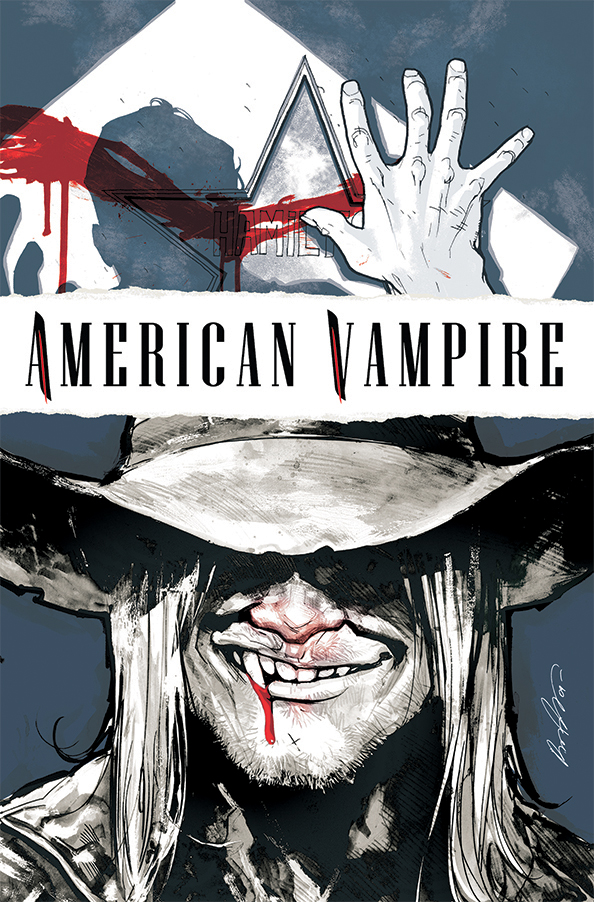
American Vampire #2
Chapter Two: "Morning Star" and "Deep Water"
written by Scott Snyder and Stephen King
art by Rafael Albuquerque
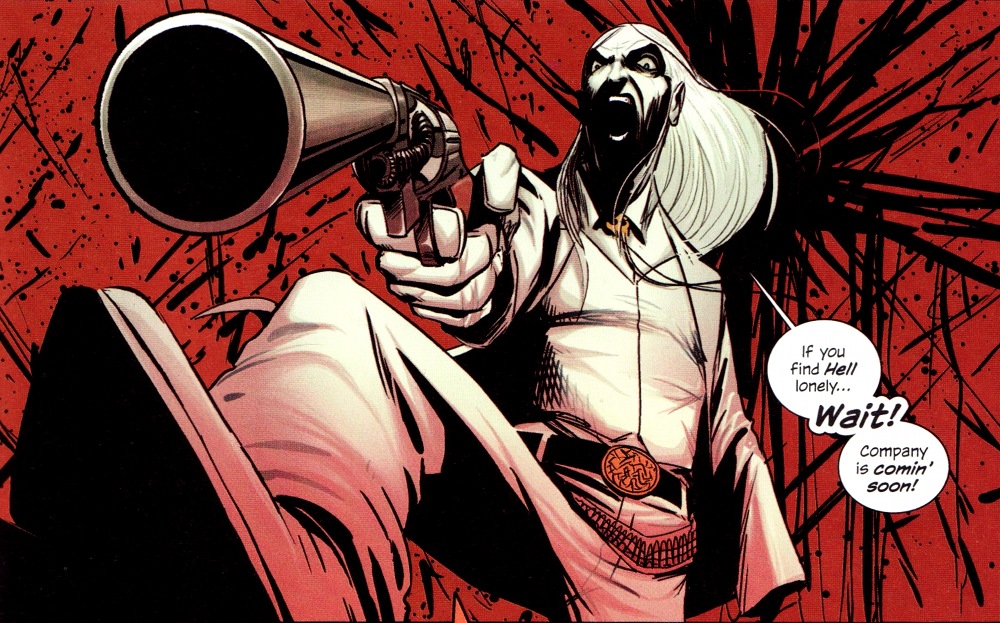
Once again, an otherwise excellent story is slowed by its double-billing, and in this case an extra helping of exposition. Following fast on the heels of her attack and desert disposal by a swarm of European vampire movie-execs, Snyder's "Morning Star" finally transforms his heroine Pearl into a vampire herself. And once again, Skinner Sweet steals the scene. Dying in a hospital bed of blood loss and internal damage after having been found staggering and bleeding in the desert by Hattie and Henry, Pearl is rescued by Sweet, and her "infection" is strangely delicate, a delicacy that is all the more surprising after his uninvited and somewhat predatory entrance through the window of her hospital room. Though it does mimic his own transformation, Sweet chooses to infect her by kissing her eye with his bloodied lip. Though, presumably, any means of entering her bloodstream would have transformed her, Sweet's choice is both tender—he could have simply dripped into any of her multiple open wounds—and politely restrained—he could have kissed her lips.
Their conversation following Pearl's awakening in the morgue and return home is considerably less dramatic, even as it is considerably longer. While it imparts some necessary information to the reader, though, to be fair, an attentive reader could probably have pieced together most of it on his own, and it provides Pearl with a slight vampire-orientation lesson, the elaboration of the differences between Skinner and Pearl—the American vampires—and Percy, Bloch, and the rest of the Europeans is somewhat dull and a bit pedantic. It does, however, continue the ambiguous characterization of Skinner Sweet, whose motivations and personality remain as enigmatic as before. Because he jests almost out of habit and oozes wryness out of his greasy pores, its nearly impossible to pin him down. He makes no secret out of his desire to use Pearl and her revenge to poke back at his own enemies, to use Pearl against Bloch for his own purposes, but his response to Pearl's question about why he turned her seems equally honest and true, even as it is triple-sided: "Oh, I don't know—maybe because I'm just sick of Bloch and his kind having their way with pretty little country girls. Or maybe because I can't keep out of trouble. Maybe just because I like you, Dolly."
If "Morning Star" is heavy on exposition, "Deep Water" is structured by it. One week after Pearl's transformation, author of Sweet's non-fiction "fiction" story Bad Blood, Will Bunting, hosts a re-issue reading at which he recounts his story. Thus, Sweet's story becomes a dramatic flashback rendering the events between his transformation and his exhumation by divers scavenging outlaw memorabilia over a decade later. And Bunting's account reads like a summary, a whirlwind version of Bunting's time at the coat-tails of Jim Book and Felix Camillo during the hey-day of western expansion and settlement. The telling of it may be a little dry, that is, relevant but flat and compressed, but Albuquerque's artwork is excellent, particularly of Sweet's captivity in his coffin—his first meal on a rat, his awakening under water, and his re-emergence from his grave.
[June 2010]
As collected in American Vampire, Volume 1 (ISBN 978-1401228309)
written by Scott Snyder and Stephen King
art by Rafael Albuquerque
Once again, an otherwise excellent story is slowed by its double-billing, and in this case an extra helping of exposition. Following fast on the heels of her attack and desert disposal by a swarm of European vampire movie-execs, Snyder's "Morning Star" finally transforms his heroine Pearl into a vampire herself. And once again, Skinner Sweet steals the scene. Dying in a hospital bed of blood loss and internal damage after having been found staggering and bleeding in the desert by Hattie and Henry, Pearl is rescued by Sweet, and her "infection" is strangely delicate, a delicacy that is all the more surprising after his uninvited and somewhat predatory entrance through the window of her hospital room. Though it does mimic his own transformation, Sweet chooses to infect her by kissing her eye with his bloodied lip. Though, presumably, any means of entering her bloodstream would have transformed her, Sweet's choice is both tender—he could have simply dripped into any of her multiple open wounds—and politely restrained—he could have kissed her lips.
Their conversation following Pearl's awakening in the morgue and return home is considerably less dramatic, even as it is considerably longer. While it imparts some necessary information to the reader, though, to be fair, an attentive reader could probably have pieced together most of it on his own, and it provides Pearl with a slight vampire-orientation lesson, the elaboration of the differences between Skinner and Pearl—the American vampires—and Percy, Bloch, and the rest of the Europeans is somewhat dull and a bit pedantic. It does, however, continue the ambiguous characterization of Skinner Sweet, whose motivations and personality remain as enigmatic as before. Because he jests almost out of habit and oozes wryness out of his greasy pores, its nearly impossible to pin him down. He makes no secret out of his desire to use Pearl and her revenge to poke back at his own enemies, to use Pearl against Bloch for his own purposes, but his response to Pearl's question about why he turned her seems equally honest and true, even as it is triple-sided: "Oh, I don't know—maybe because I'm just sick of Bloch and his kind having their way with pretty little country girls. Or maybe because I can't keep out of trouble. Maybe just because I like you, Dolly."
If "Morning Star" is heavy on exposition, "Deep Water" is structured by it. One week after Pearl's transformation, author of Sweet's non-fiction "fiction" story Bad Blood, Will Bunting, hosts a re-issue reading at which he recounts his story. Thus, Sweet's story becomes a dramatic flashback rendering the events between his transformation and his exhumation by divers scavenging outlaw memorabilia over a decade later. And Bunting's account reads like a summary, a whirlwind version of Bunting's time at the coat-tails of Jim Book and Felix Camillo during the hey-day of western expansion and settlement. The telling of it may be a little dry, that is, relevant but flat and compressed, but Albuquerque's artwork is excellent, particularly of Sweet's captivity in his coffin—his first meal on a rat, his awakening under water, and his re-emergence from his grave.
[June 2010]
As collected in American Vampire, Volume 1 (ISBN 978-1401228309)
Wednesday, April 10, 2013
The Astounding Wolf-Man #1
written by Robert Kirkman
art by Jason Howard
If The Astounding Wolf-Man has something new to offer the werewolf genre, it isn't in this issue. Kirkman's CEO-turned-werewolf is as conventional as they come. The incident triggering his supernatural shift is unseen and, at least here, mostly unknown—a "bear attack" on a family camping trip in Montana, you know, where the werewolves live. His transformations are also mostly unseen—muscle spasms and profuse sweating. His full-moon romps are as uneventful as they are conventional—rooftop frolicking and rabbit hunting. As a monster and would-be superhero—the direction suggested by the series title—I suppose it's important to keep the Gary-wolf from truly incriminating and compromising himself, but it makes for little suspense and low stakes.
As a human character Gary Hampton is a little more interesting. Although he mostly embodies the frazzled-financially-imperiled-businessman stereotype, with his conference calls to Asia and his corporate woes despite living comfortably in a large estate with a family maid, his relationship with his teenage daughter is earnest and believable. [Notably, the one surprising moment in The Astounding Wolf-Man's first issue comes on the tennis court with Chloe, when despite his newly acquired wolf blood, Gary fails miserably in keeping pace with his daughter in the match.] He may be a besieged businessman, whose company is flagging and whose month-long absence has cost his corporate prospects significantly, but he still prioritizes his time with her. Similarly, his banter with his wife seems sincere and affectionate.
Gary Hampton's affability is, in fact, the issue's most refreshing detail. Unlike his angst-ridden wolfish predecessors, Gary is humorously upbeat, a character trait that seems to carry over into his wolf personality, whose adventures seem driven more by a sense of fun and frivolity than by an aggressiveness. This twist, more than any other, sparks a little potential in the series, a window of opportunity to eschew the more conventional werewolf tales of inevitable tragedy for something else.
If Kirkman's wolf-man is a little underwhelming, Jason Howard's is not. There's no individual detail that's all that impressive, nor are the edges of Howard's monster all that complicated. However, the impression the Gary-wolf, a kind of wolf/gorilla hybrid, imposes is substantial.
[July 2007, digital]
art by Jason Howard
If The Astounding Wolf-Man has something new to offer the werewolf genre, it isn't in this issue. Kirkman's CEO-turned-werewolf is as conventional as they come. The incident triggering his supernatural shift is unseen and, at least here, mostly unknown—a "bear attack" on a family camping trip in Montana, you know, where the werewolves live. His transformations are also mostly unseen—muscle spasms and profuse sweating. His full-moon romps are as uneventful as they are conventional—rooftop frolicking and rabbit hunting. As a monster and would-be superhero—the direction suggested by the series title—I suppose it's important to keep the Gary-wolf from truly incriminating and compromising himself, but it makes for little suspense and low stakes.
As a human character Gary Hampton is a little more interesting. Although he mostly embodies the frazzled-financially-imperiled-businessman stereotype, with his conference calls to Asia and his corporate woes despite living comfortably in a large estate with a family maid, his relationship with his teenage daughter is earnest and believable. [Notably, the one surprising moment in The Astounding Wolf-Man's first issue comes on the tennis court with Chloe, when despite his newly acquired wolf blood, Gary fails miserably in keeping pace with his daughter in the match.] He may be a besieged businessman, whose company is flagging and whose month-long absence has cost his corporate prospects significantly, but he still prioritizes his time with her. Similarly, his banter with his wife seems sincere and affectionate.
Gary Hampton's affability is, in fact, the issue's most refreshing detail. Unlike his angst-ridden wolfish predecessors, Gary is humorously upbeat, a character trait that seems to carry over into his wolf personality, whose adventures seem driven more by a sense of fun and frivolity than by an aggressiveness. This twist, more than any other, sparks a little potential in the series, a window of opportunity to eschew the more conventional werewolf tales of inevitable tragedy for something else.
If Kirkman's wolf-man is a little underwhelming, Jason Howard's is not. There's no individual detail that's all that impressive, nor are the edges of Howard's monster all that complicated. However, the impression the Gary-wolf, a kind of wolf/gorilla hybrid, imposes is substantial.
[July 2007, digital]
Thursday, April 4, 2013
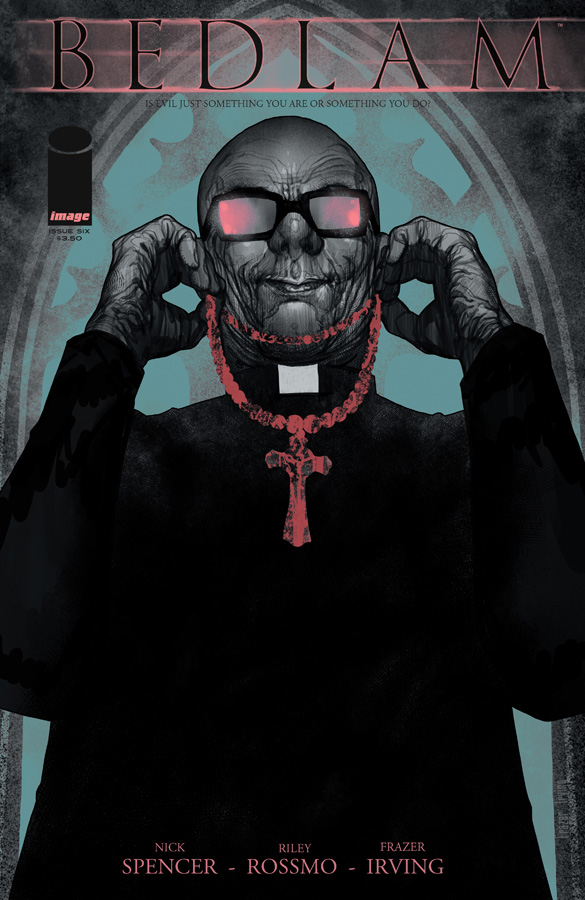
Bedlam #6
"Some of Us Got a Little More Lost Than Others"
written by Nick Spencer
art by Riley Rossmo
And just like that, it's over. While Spencer took Bedlam #6 in a significantly different direction than I had been anticipating, it was still less immediately satisfying than its predecessors, in large part because Fillmore Press and Detective Acevedo shared so few scenes. Still out from Press's drugged coffee, Ramira Acevedo spends most of the issue unconscious while Press interrogates jailed pedophile, former Archbishop Warton, and superhero the First battles Warton's zealous former victim and current Angel of Death, Eric, at the hospital.
It continues Bedlam's previous pattern of contrast: Fillmore Press vs. the First, Archbishop Warton vs. his protégé Eric. While the most obvious villain and hero battle on a far more public stage and with considerably more public results, the less obvious hero does his own negotiating with a far more sinister and ultimately more powerful villain. Warton's big watery eyes and diminutive stature contrast sharply with the powerful and intimidating physique of the younger Eric, much like Press's own wiry frame and pale skin differ so greatly from the First's muscled body and metal armor. And, like before, Press proves himself more valuable and effective than the First, who before Warton's call to the hospital was nearly defeated by the self-mutilated shooter.
While Warton's motivations are predictably radical and filled with brimstone and his actions amount to little more than a tantrum disguised as divine retribution, Press's solution is remarkably clever, one that will continue to put him in Warton's company regularly for the foreseeable future. And they are a strange pair; it remains unclear just how much of himself Press sees in Warton, as well as what—aside from the most immediate cessation of the slaughter at the hospital—Press hopes to achieve for himself or for Warton through this compromise.
However, Spencer does set up the future of the series in its final few pages. Realizing the corrupt politics behind the department's handling of her case, Detective Acevedo finds herself alienated—mostly by her own principled decision—from her boss. Still disinclined to publicly admit Press's value in the investigation and the crisis resolution, Acevedo is, at least by her own standards, generous in her thanks to Fillmore and not entirely adverse to his offer to return to the precinct to give a full statement, though she may still suspect he's not fully disclosing the content of his conversation with Warton. The conclusion of Bedlam's first arc may have seemed somewhat swift, but their growing partnership remains the nucleus of the series, and one to keep watching.
written by Nick Spencer
art by Riley Rossmo
And just like that, it's over. While Spencer took Bedlam #6 in a significantly different direction than I had been anticipating, it was still less immediately satisfying than its predecessors, in large part because Fillmore Press and Detective Acevedo shared so few scenes. Still out from Press's drugged coffee, Ramira Acevedo spends most of the issue unconscious while Press interrogates jailed pedophile, former Archbishop Warton, and superhero the First battles Warton's zealous former victim and current Angel of Death, Eric, at the hospital.
It continues Bedlam's previous pattern of contrast: Fillmore Press vs. the First, Archbishop Warton vs. his protégé Eric. While the most obvious villain and hero battle on a far more public stage and with considerably more public results, the less obvious hero does his own negotiating with a far more sinister and ultimately more powerful villain. Warton's big watery eyes and diminutive stature contrast sharply with the powerful and intimidating physique of the younger Eric, much like Press's own wiry frame and pale skin differ so greatly from the First's muscled body and metal armor. And, like before, Press proves himself more valuable and effective than the First, who before Warton's call to the hospital was nearly defeated by the self-mutilated shooter.
While Warton's motivations are predictably radical and filled with brimstone and his actions amount to little more than a tantrum disguised as divine retribution, Press's solution is remarkably clever, one that will continue to put him in Warton's company regularly for the foreseeable future. And they are a strange pair; it remains unclear just how much of himself Press sees in Warton, as well as what—aside from the most immediate cessation of the slaughter at the hospital—Press hopes to achieve for himself or for Warton through this compromise.
However, Spencer does set up the future of the series in its final few pages. Realizing the corrupt politics behind the department's handling of her case, Detective Acevedo finds herself alienated—mostly by her own principled decision—from her boss. Still disinclined to publicly admit Press's value in the investigation and the crisis resolution, Acevedo is, at least by her own standards, generous in her thanks to Fillmore and not entirely adverse to his offer to return to the precinct to give a full statement, though she may still suspect he's not fully disclosing the content of his conversation with Warton. The conclusion of Bedlam's first arc may have seemed somewhat swift, but their growing partnership remains the nucleus of the series, and one to keep watching.
Dial H #11
"W. T. Flash?"
written by China Miéville
pencils by Alberto Ponticelli
inks by Dan Green
Whoa, Mr. Miéville! What happened? Needless to say, Dial H's first attempt at a crossover, however slight and superficial, was not a great success. Like every issue of Dial H thus far, "W. T. Flash?" boasts some really excellent ideas, a few of which are reiterated from earlier issues, and some very well-written moments, but unlike previous issues, this one's a structural mess and exposition-heavy.
The Centipede continues his strange quest to make contact with the Fixer, the mysterious O's kind-of nemesis, a creature who, along with his army, is attempting to recover the Dials dispersed by the Operator—including Nelson and Roxie's—and patrol the Exchange. While the Centipede—former Canadian military agent Floyd Bergson—makes an excellent villain, I'm still very unclear about his motives and agenda, as well as just how a cleric of a Dial-based religion could pray-up the Fixer. While I suspect Miéville has a clear idea about how this operates, so to speak, I find it very difficult to tease out, though the confrontation implied by the final scene of Dial H #11 may begin to clarify these details.

The central thread in this issue is more promising if still uneven. In a pique of morning-after panic and feeling the powerful need to flee, Nelson dials up the Flash. Although the dialed heroes mostly don't correspond to any particular theme or need, like depressive, chain-smoking Nelson's Boy Chimney and Captain Lachrymose in Dial H #1, the Flash seems appropriate to his mood. And, more importantly, it's the first time either Nelson or Roxie dial up a recognizable hero, one that they know to exist and whom Nelson can't find once he assumes the identity. Naturally, this gets them wondering about the other dialed heroes, and the pair—Roxie far more reluctantly than Nelson—begin to realize what readers knew from Dial H #0, that the Dial allows its users to assume the bodies of independently existing heroes, however strange. While these are necessary revelations for the duo, it mostly feels reiterative here, not adding to the general body of Dial lore that Miéville's been building so meticulously.
The Dial H Flash issue was hotly buzzed (at least for Dial H), in no small part because of Brian Bolland's wonderful cover, but while Miéville's Nelson-Flash is often funny, his impromptu Flash adventure (completed, as noted, in Flash #18 and #19) is awkward, unnecessary, and jolts the already erratic pacing of the issue. Miéville's first attempt at integrating into the larger DC universe is weak, at best. Dial H #11 makes several things happen that needed to happen, but it is by far the thinnest and roughest of the issues to date.
Superheroes: The Flash
[June 2013]
written by China Miéville
pencils by Alberto Ponticelli
inks by Dan Green
Whoa, Mr. Miéville! What happened? Needless to say, Dial H's first attempt at a crossover, however slight and superficial, was not a great success. Like every issue of Dial H thus far, "W. T. Flash?" boasts some really excellent ideas, a few of which are reiterated from earlier issues, and some very well-written moments, but unlike previous issues, this one's a structural mess and exposition-heavy.
The Centipede continues his strange quest to make contact with the Fixer, the mysterious O's kind-of nemesis, a creature who, along with his army, is attempting to recover the Dials dispersed by the Operator—including Nelson and Roxie's—and patrol the Exchange. While the Centipede—former Canadian military agent Floyd Bergson—makes an excellent villain, I'm still very unclear about his motives and agenda, as well as just how a cleric of a Dial-based religion could pray-up the Fixer. While I suspect Miéville has a clear idea about how this operates, so to speak, I find it very difficult to tease out, though the confrontation implied by the final scene of Dial H #11 may begin to clarify these details.

The central thread in this issue is more promising if still uneven. In a pique of morning-after panic and feeling the powerful need to flee, Nelson dials up the Flash. Although the dialed heroes mostly don't correspond to any particular theme or need, like depressive, chain-smoking Nelson's Boy Chimney and Captain Lachrymose in Dial H #1, the Flash seems appropriate to his mood. And, more importantly, it's the first time either Nelson or Roxie dial up a recognizable hero, one that they know to exist and whom Nelson can't find once he assumes the identity. Naturally, this gets them wondering about the other dialed heroes, and the pair—Roxie far more reluctantly than Nelson—begin to realize what readers knew from Dial H #0, that the Dial allows its users to assume the bodies of independently existing heroes, however strange. While these are necessary revelations for the duo, it mostly feels reiterative here, not adding to the general body of Dial lore that Miéville's been building so meticulously.
The Dial H Flash issue was hotly buzzed (at least for Dial H), in no small part because of Brian Bolland's wonderful cover, but while Miéville's Nelson-Flash is often funny, his impromptu Flash adventure (completed, as noted, in Flash #18 and #19) is awkward, unnecessary, and jolts the already erratic pacing of the issue. Miéville's first attempt at integrating into the larger DC universe is weak, at best. Dial H #11 makes several things happen that needed to happen, but it is by far the thinnest and roughest of the issues to date.
Superheroes: The Flash
[June 2013]
Tuesday, April 2, 2013
Hawkeye #1
"Lucky"
written by Matt Fraction
art by David Aja
colors by Matt Hollingsworth
It's absolutely no coincidence that Fraction's inaugural issue of his new Hawkeye series is subtitled "a Clint Barton adventure". Hawkeye, as such, appears on only two pages to open the story, just enough time for him to commit an epic superhero fail, landing him in the hospital with multiple major injuries, a nearly full-body cast, and a six-week hospital stay while immobilized. As Clint Barton knows damn well, he's on a different superhero rung than most of his Avengers counterparts; he's just a guy—albeit with an unusual carnie background—that's just really, really good at the one thing he does: shoot a bow and arrow.
The central conceit of Matt Fraction's re-imagined Hawkeye is precisely that it looks at Barton's life, only tangentially the superhero antics of the Avenger's team member. The issue succeeds so well in no little part due to the fully realized and believably detailed world Fraction builds around his character. Barton's New York, fragrant with the "baked summer scent of hot garbage, wet pennies, and pee" (Hawkeye #1, p. 4), is far from the polished idealism of many superhero settings, which more often than not seem to suit the hero rather than being a real place for him/her to exist. Barton's fellow characters are similarly real, mixed bags of brutal, irritable, pathetic, and kind. Even Barton himself is prickly, if likable. He's grouchy and hostile with the well-meaning veterinarian, patient and understanding with an evicted fellow tenant and her baby, and unapologetically merciless with the boorish thugs who own the apartment building. Yet, ultimately, he makes his stand for the right people and the right reasons, choosing to go to bat for the financially bullied and evicted tenants, even the ones he doesn't particularly like.
Fraction and Aja have carved an entirely unique niche for their new series. Barton's narration, while entirely appropriate and often distinct, sometimes rings of Fraction himself, i.e., clever and funny but unnecessary musings that arise from Barton's inevitably unusual predicaments, such as his thoughts on Baccarat or his paleolithic weapon choice. Aja's inimitable style and design give Hawkeye a look as unusual as its voice. In full cooperation with Fraction's characterization of his protagonist, Aja renders him remarkably ordinary. Barton is beautiful, certainly, and finely built, but he lacks the imposing physique of so many superhero counterparts.
[October 2012, digital]
written by Matt Fraction
art by David Aja
colors by Matt Hollingsworth
The central conceit of Matt Fraction's re-imagined Hawkeye is precisely that it looks at Barton's life, only tangentially the superhero antics of the Avenger's team member. The issue succeeds so well in no little part due to the fully realized and believably detailed world Fraction builds around his character. Barton's New York, fragrant with the "baked summer scent of hot garbage, wet pennies, and pee" (Hawkeye #1, p. 4), is far from the polished idealism of many superhero settings, which more often than not seem to suit the hero rather than being a real place for him/her to exist. Barton's fellow characters are similarly real, mixed bags of brutal, irritable, pathetic, and kind. Even Barton himself is prickly, if likable. He's grouchy and hostile with the well-meaning veterinarian, patient and understanding with an evicted fellow tenant and her baby, and unapologetically merciless with the boorish thugs who own the apartment building. Yet, ultimately, he makes his stand for the right people and the right reasons, choosing to go to bat for the financially bullied and evicted tenants, even the ones he doesn't particularly like.
Fraction and Aja have carved an entirely unique niche for their new series. Barton's narration, while entirely appropriate and often distinct, sometimes rings of Fraction himself, i.e., clever and funny but unnecessary musings that arise from Barton's inevitably unusual predicaments, such as his thoughts on Baccarat or his paleolithic weapon choice. Aja's inimitable style and design give Hawkeye a look as unusual as its voice. In full cooperation with Fraction's characterization of his protagonist, Aja renders him remarkably ordinary. Barton is beautiful, certainly, and finely built, but he lacks the imposing physique of so many superhero counterparts.
[October 2012, digital]
East of West #1
One: Out of the Wasteland
written by Jonathan Hickman
art by Nick Dragotta
colors by Frank Martin
The less you know about Hickman’s new apocalyptic sci-fi
drama before reading, the better. He
packs the opening issue of his new series so full of surprises—both modest and
genuinely impressive—and mythological puzzles that knowing anything going in is sure to ruin some
of the fun. Because I strongly recommend
the issue, I suggest reading the review that follows only after having done so.
Structurally, there’s a lot of story-telling happening here. Even having re-read the issue a few times,
I’m still somewhat unclear about the relative time between segments; fortunately, this
disorientation only enhances the issue.
Disentangling the order of events, the sequence of causes and effects
that comprise the immediate story’s history is a significant part of the
pleasure the series promises, a slow, deliberate, piecemeal reveal of the apocalypse. Born in a
supernatural gateway standing in a desolate and haunting spacescape, three horsemen of
the apocalypse—War, Famine, and Conquest, without their brother Death—cast
lots to uncover the truth behind his disappearance. Displeased with but certain in their answer, the three vow destruction on both their absent sibling and the rest of the world in his wake.
Meanwhile, Death himself—though he remains unnamed, since his naming would necessitate an actual death—pursues his own agenda, seeking out his former hunters and, correspondingly, beginning to flesh out for the reader the necessary back-story for the current apocalyptic state of affairs. This personal mission culminates in a genuinely surprising and fulfilling final twist, which many series would postpone for several issues. However full and substantial East of West #1 is, it still feels like only the tip of a very large and rewarding iceberg, an iceberg suggested by, if nothing else, the description of the three-part composition of The Message by Elijah Longstreet, Standing Bear, and Mao Zedong. East of West has a long and layered history underpinning its events, a history which, no doubt, will not remain as distant as it currently seems.
Tonally, East of West has
already mastered the quietly creepy.
Perhaps nothing in the episode was more chilling than Death’s companion
Crow’s parting declaration to the Atlas’s
barkeep and Death’s former hunter: “I
would have taken your eyes.” Unsettling
enough on its own, but in its recollection of battlefield crows, it becomes
downright sinister. Its tone, however, is not fixed, and Hickman shifts stylistic modes often enough to suggest more than one narrative voice for his epic. The intimate, if uninitiated, proximity to Death and his personal mission contrast strongly with the melodious and mythic tones of the aforementioned composition of The Message.
Dragotta’s artwork is a wonder, complemented by
Martin’s subtle coloring, especially his dramatic contrast of orange and
blue, and an overall elegance of design. It's a beautiful book. Dragotta's use of negative space and dramatic perspective is some of the best I can recall,
and it's particularly true for his distant space illustrations, which
give a dark and foreboding gravity to their minimal narrative
contribution.
Likewise, Dragotta seamless merges the series’ competing generic
styles. The futuristic western may be
far from a new category, but visualizing its components often results in uneven
edges and patchwork. Here, there are
none. Although the issue’s carnage could
border on the shockingly gratuitous, Dragotta lends a disturbingly beautiful
aesthetic to the corpses. There’s a
delicacy and pleasure there, as though seeing through the eyes of their apocalyptic
killers.
[March 2013]
[March 2013]
Subscribe to:
Comments (Atom)